
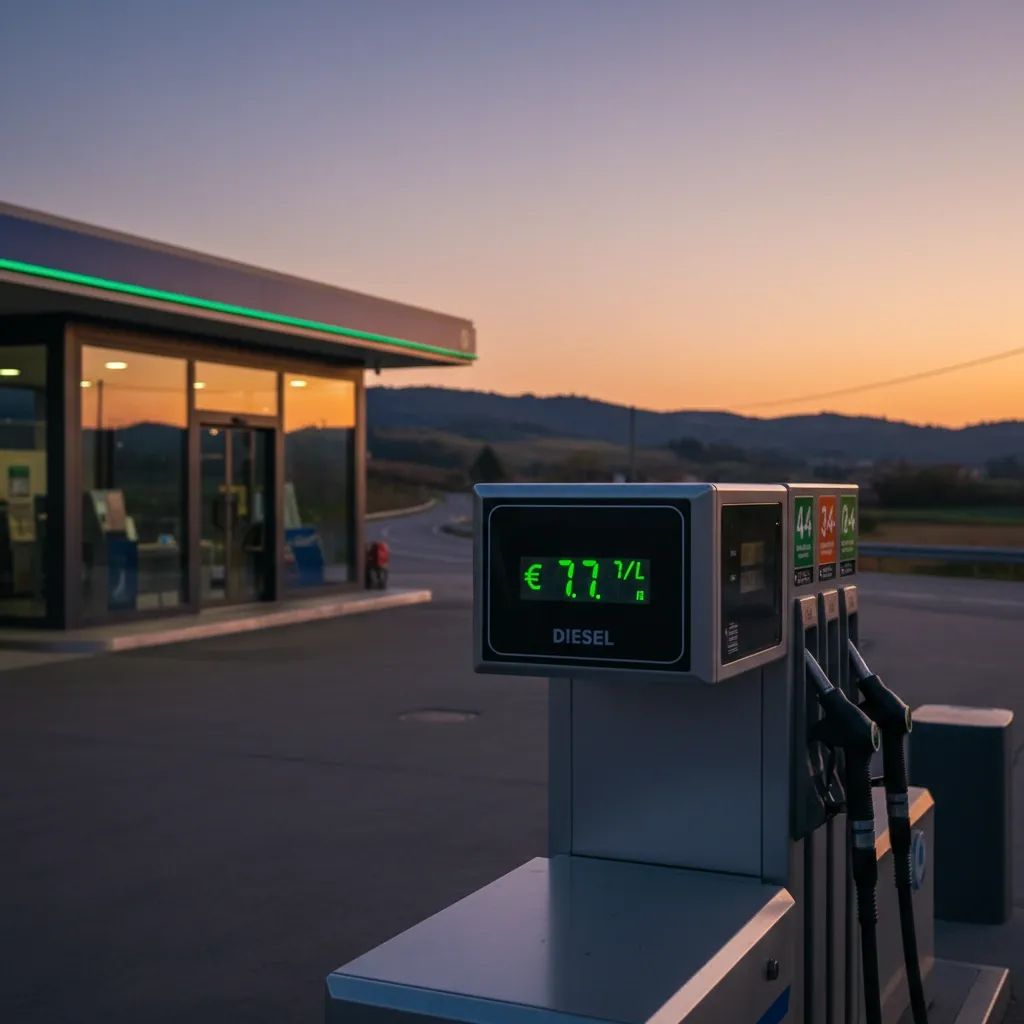
The Italy energy market is navigating choppy waters this week as natural gas prices on the Amsterdam TTF exchange whipsawed between €30.9 and €32.2 per megawatt-hour (MWh), driven by a cocktail of depleting U.S. storage inventories, geopolitical friction around the Strait of Hormuz, and a structural shift away from Russian pipeline supply. Meanwhile, diesel prices at Italian pumps have climbed to a nearly 12-month high of €1.714 per liter in self-service mode, a direct consequence of the €0.05 per liter excise hike that took effect on January 1 as part of the government's effort to eliminate what it called an "environmentally harmful subsidy" favoring diesel over gasoline.
Why This Matters
• Household budgets under strain: The cumulative effect of gas volatility and higher diesel costs is eroding purchasing power, especially for families reliant on road transport and natural gas heating.
• Inflation ripple effect: Consumer advocacy groups estimate the diesel excise adjustment will generate approximately €600M in additional tax revenue for the state in 2026, with consumer organizations projecting a broader €900M burden on consumers, with knock-on effects for food distribution costs.
• Energy security trade-offs: Italy's growing reliance on liquefied natural gas (LNG) imports—particularly from the United States—has reduced Russian gas dependency to 13% but exposed the country to greater volatility on global spot markets.
What Happened on European Gas Markets
The Title Transfer Facility (TTF) benchmark in Amsterdam—the reference point for European gas pricing—closed at €31.8/MWh on one trading session, down 0.6%, before reversing course the following day to settle at €32.2/MWh, a 3.7% daily gain. The turnaround came after the U.S. Energy Information Administration (EIA) published data showing a sharper-than-expected drawdown in American gas inventories, which spooked traders betting on a continued slide in prices.
Intraday swings have been pronounced throughout late February. Gas futures opened one session at €30.9/MWh, representing a 0.6% dip, before stabilizing around the €31 mark in subsequent trading. The month has seen prices oscillate between a low of €29.82/MWh on February 17 and a peak of €35.7/MWh on February 6, when colder weather forecasts and supply concerns related to the Strait of Hormuz—through which roughly 20% of global LNG transits—drove a temporary spike.
On a broader timeline, the TTF has declined 14.91% over the past month and is down 29.48% year-on-year, according to Trading Economics data. Yet the intra-week volatility underscores how sensitive the market remains to U.S. inventory reports, weather models, and Middle Eastern geopolitical signals.
The Diesel Shock: Why Pump Prices Are Climbing
Italian diesel prices hit €1.714/liter in self-service this week, the highest level in nearly 12 months, according to data compiled by Staffetta Quotidiana and the Italy Ministry of Enterprise and Made in Italy. The immediate catalyst was a round of recommended price increases by major fuel distributors, including a one-cent bump by Tamoil on both gasoline and diesel.
But the deeper driver is fiscal. On January 1, 2026, the Italy Revenue Agency implemented a €0.05 per liter excise increase on diesel, paired with a mirror reduction on gasoline, designed to eliminate the historical tax advantage diesel enjoyed over petrol. The government framed the move as removing an "environmentally harmful subsidy," but fiscal analysts note the operation is not revenue-neutral—it will generate approximately €600M in additional state income in 2026 alone.
Consumer advocacy groups have been quick to quantify the broader economic impact. According to estimates from consumer organizations, the diesel excise adjustment combined with broader energy cost pressures will result in an estimated €900M "price shock" hitting consumers this year, with diesel costs alone contributing a significant portion to household and business expenses. Federconsumatori described the increase as landing on households already battered by years of cumulative energy inflation.
Fuel Price Snapshot (February 25, 2026)
| Fuel Type | Self-Service (€/L) | Full-Service (€/L) | Highway Self (€/L) | Highway Full (€/L) ||-----------|---------------------|---------------------|---------------------|--------------------|| Gasoline | 1.665 | 1.805 | 1.769 | 2.029 || Diesel | 1.714 | 1.852 | 1.816 | 2.075 || LPG | 0.688 | — | 0.828 | — || CNG | 1.406/kg | — | 1.463/kg | — || LNG | 1.231/kg | — | 1.321/kg | — |
Source: Italy Ministry of Enterprise and Made in Italy / Staffetta Quotidiana
The ripple effects extend beyond the pump. Because a large share of Italy's food distribution network relies on diesel trucks, analysts warn that higher fuel costs will feed into grocery prices, amplifying inflationary pressure in an economy where household consumption remains fragile.
Impact on Residents and Businesses
For Italian households, the dual squeeze of volatile gas markets and structurally higher diesel costs translates into three immediate challenges:
Heating bills remain unpredictable. Though gas prices are down year-on-year, the intra-month swings of 10-15% mean fixed-rate contracts offer the only insulation from volatility. Floating-rate customers could see their February bills swing sharply depending on when their supplier locked in wholesale prices.
Commuting and logistics costs are climbing. Anyone driving a diesel vehicle—still the majority of Italy's passenger car fleet—faces increased fuel costs for an average 15,000 km driving year due to the excise hike. For commercial transport operators, margins are tightening, especially on fixed-price delivery contracts signed before the January adjustment.
Food and consumer goods inflation. The Confederation of Italian Consumers (Federconsumatori) warns that diesel-dependent supply chains will pass costs downstream, particularly for perishable goods requiring refrigerated transport. Early estimates suggest a 0.3-0.5 percentage point contribution to food inflation in Q1 2026.
For businesses, particularly in logistics, agriculture, and manufacturing, the outlook hinges on how long diesel remains elevated. The Italy Road Haulage Association has called for a temporary suspension of the excise increase, arguing it undermines competitiveness against EU neighbors with lower fuel taxes. So far, the Italy Cabinet has shown no indication of reversing course, treating the diesel equalization as a settled policy.
Why Gas Prices Are Still Volatile Despite Lower Russian Dependence
Italy's gas supply story in 2026 is one of substitution, not stability. The country has successfully reduced Russian pipeline gas from 45% of total imports in 2021 to just 13% in 2025, but the replacement fuel—liquefied natural gas, primarily from the United States—comes with its own risks.
The International Energy Agency (IEA) projects Europe will import a record 185 billion cubic meters of LNG in 2026, with U.S. shipments representing the lion's share. For Italy, this means greater exposure to:
• Global spot market pricing: Unlike long-term Russian pipeline contracts, LNG cargoes are often priced on short-term indices, making European buyers more vulnerable to demand shocks in Asia or supply disruptions in the Middle East.
• Geopolitical chokepoints: The Strait of Hormuz, through which 20% of global LNG passes, remains a flashpoint. Any escalation involving Iran or regional tensions could instantly tighten supply and spike prices.
• Weather-driven demand swings: Cold snaps in Asia can redirect LNG cargoes away from Europe, while mild European winters—like much of early 2026—can depress prices.
EU storage levels remain a concern. As of mid-February, stockpiles across the bloc stood at 31% of capacity, well below the 40.7% recorded a year earlier. Germany's reserves were at 20.7%, France at 21.1%. While these figures are not crisis-level, they offer less cushion than in previous winters, meaning any supply hiccup or demand surge could rapidly tighten the market.
Italy's Ministry of Energy Transition has emphasized the importance of the country's role as a Mediterranean LNG hub, with regasification terminals in Rovigo, Livorno, and Piombino playing a critical role in European supply security. A February 24 memorandum of understanding between Shell and Greece-based METLEN to supply 0.5-1.0 billion cubic meters annually starting in 2027 underscores the regional strategy of diversifying LNG sources and routing them through southern Europe.
How Italian Consumers Are Responding
The cumulative effect of energy price volatility is shaping consumer behavior in measurable ways. The 2026 Coop Report on Italian consumption describes households in a state of "disillusioned prudence," retreating to the home as a financial refuge and cutting discretionary spending. Key trends include:
• Active tariff shopping: Regulatory authority ARERA and consumer groups like Confconsumatori report a surge in households using online comparison tools to switch gas and electricity suppliers. The message is clear: fixed-rate contracts, even at a premium, are seen as insurance against further volatility.
• Energy-saving retrofits: Sales of programmable thermostats, LED bulbs, and boiler maintenance services have all ticked up. Confconsumatori recommends simple steps like lowering thermostat settings by 1°C (saving roughly 6-8% on heating bills) and eliminating standby power consumption.
• Fuel substitution at the pump: Anecdotal evidence from fuel retailers suggests a modest uptick in gasoline purchases relative to diesel, as the historical price advantage for diesel narrows or reverses. LPG and CNG conversions are also gaining interest, though upfront conversion costs remain a barrier.
For lower-income households, the pressure is acute. Italy's Energy Poverty Observatory estimates that roughly 2.2 million families struggle to afford adequate heating, and the combination of volatile gas prices and higher diesel costs is expanding that cohort.
Analyst Outlook: What Comes Next
Forecasts for European gas prices through mid-2026 remain mixed. Trading Economics consensus models point to prices drifting toward €30/MWh by late spring as heating demand ebbs and renewable generation (wind and solar) ramps up. However, several wildcards loom:
• Summer storage-building season: If prices remain elevated into March-April, the cost of refilling depleted storage for next winter could force industrial consumers to curtail demand, slowing economic activity.
• U.S. export capacity expansion: New LNG terminals coming online in Texas and Louisiana in late 2026 should ease global supply tightness, but any commissioning delays or domestic U.S. cold snaps could redirect cargoes away from Europe.
• Geopolitical risk premium: Tensions around the Strait of Hormuz, the Russia-Ukraine conflict, or U.S.-China trade friction all carry the potential to inject sudden volatility.
For diesel, the outlook is more straightforward: barring a reversal of the excise policy, prices are structurally higher. Brent crude traded at $70.93/barrel this week, up marginally but well below the peaks of 2022-2023. If crude remains range-bound, diesel prices should stabilize around current levels, but any supply shock—OPEC production cuts, refinery outages, or Middle East escalation—could push them higher.
What Residents Should Do Now
Given the dual energy pressures, here are practical steps for people living in Italy:
• Lock in fixed-rate energy contracts if possible. The premium over floating rates is currently 8-12%, but the downside protection is worth it for households on tight budgets.
• Monitor fuel prices regionally. Apps like Prezzi Benzina and the Italy Ministry of Enterprise's official price portal allow real-time comparison of pump prices within a 10 km radius.
• Consider energy audits. Many regional governments and utilities offer subsidized home energy assessments that identify low-cost efficiency improvements.
• Diversify transport where feasible. For urban residents, electric scooters, bike-sharing, and improved public transport can reduce diesel dependency.
• Watch for government relief measures. Past winters have seen ad-hoc subsidies or VAT reductions on energy bills when prices spike. The Italy Cabinet has shown willingness to intervene if political pressure mounts.
The bottom line: Italy's energy market is in a transition phase that trades one set of risks (Russian pipeline dependency) for another (global LNG volatility). For households and businesses, the cost of that transition is being paid daily at the pump and monthly on the utility bill.


