
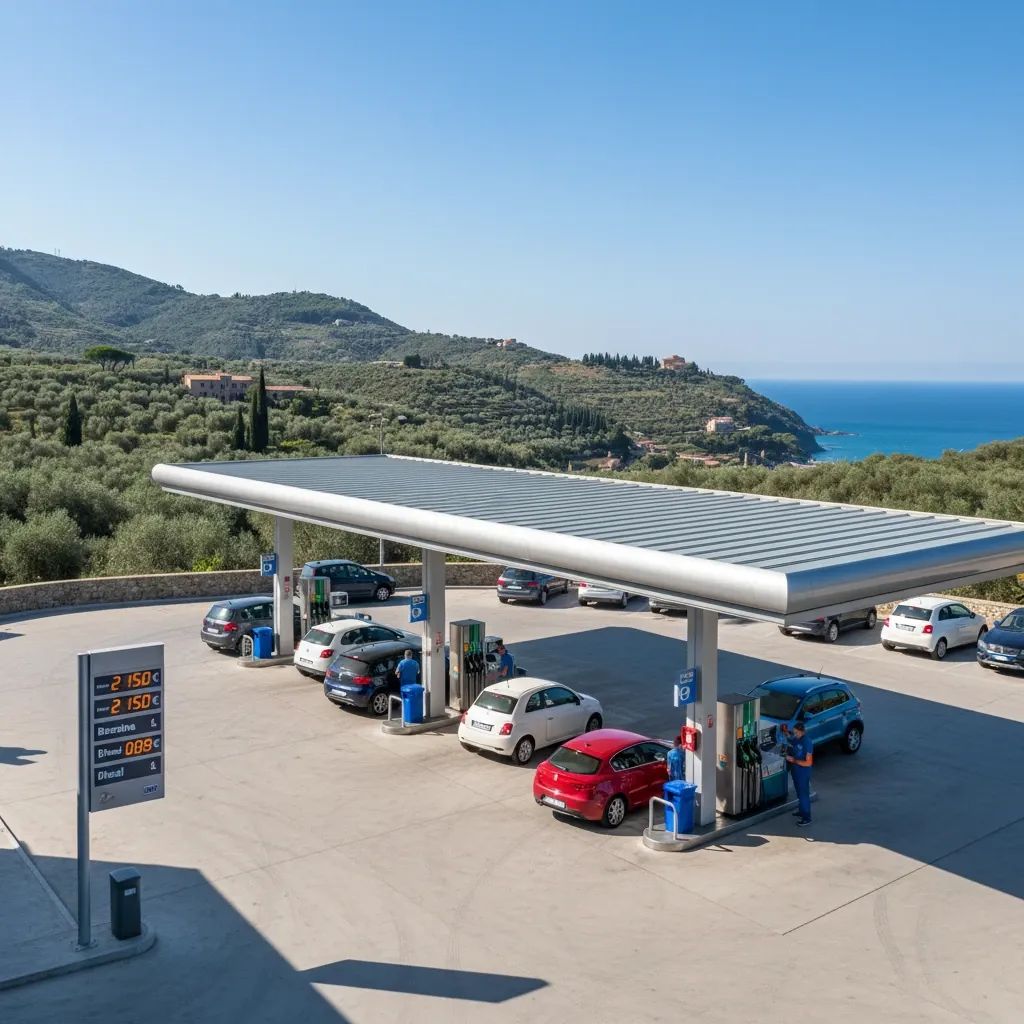
The Italy Ministry of Business and Made in Italy has confirmed that diesel fuel has reached its highest price point in 12 months, with self-service diesel hitting 1.73 euro per liter as of March 2—a direct consequence of geopolitical turmoil in the Middle East that has sent global crude oil markets into a tailspin. But according to Staffetta Quotidiana, an industry watchdog, this is "only the beginning." The full impact of the weekend's military escalation between the United States, Israel, and Iran has yet to filter through to Italian pumps, with more aggressive price hikes expected within days.
Why This Matters
• Fuel costs are climbing fast: Diesel has surpassed the 1.86 euro/liter mark for full-service stations, the steepest level since late February 2025.
• Electricity and gas bills at risk: Natural gas futures have spiked 25% to 39.85 euro per megawatt-hour, potentially triggering higher household energy tariffs.
• Supply chain disruption: The Strait of Hormuz, which funnels roughly 20% of the world's crude oil, has been effectively paralyzed by naval blockades and retaliatory strikes, halting tanker traffic and raising war-risk insurance premiums by 50%.
• Broader inflation threat: Consumer advocacy group Codacons warns that transport-dependent goods—from groceries to electronics—could see retail price increases as logistics costs surge globally.
The Hormuz Chokepoint and Global Oil Shock
The immediate trigger for Italy's fuel price surge lies 4,000 kilometers away in the Persian Gulf. On March 1, coordinated military operations by US and Israeli forces targeted Iranian infrastructure, prompting Tehran to retaliate with attacks on commercial shipping lanes through the Strait of Hormuz. This narrow passage, wedged between Iran and Oman, is the world's most critical energy transit route, channeling approximately 17 to 20 million barrels of oil daily alongside significant volumes of liquefied natural gas.
By March 2, the disruption had forced hundreds of tankers to anchor offshore, awaiting instructions or rerouting around the southern tip of Africa—a detour that adds 14 to 20 days to voyage times and dramatically inflates fuel consumption and crew costs. Major insurers have withdrawn war-risk coverage for vessels operating in the Gulf, while those still willing to underwrite policies have jacked up premiums, making transit economically unviable for many operators.
Brent crude, the international benchmark, opened Asian trading on March 2 at 82.37 dollars per barrel, a 13% intraday spike, before settling around 78.28 dollars. That represents a 9.7% jump from the February 27 level of 72 dollars. Analysts at Goldman Sachs estimate that a six-week total closure of the Strait would inject an 18-dollar risk premium per barrel into real-time pricing. If the blockade extends beyond that, some forecasters see Brent breaching the 100-dollar threshold—a level not sustained since early 2022.
What This Means for Italian Drivers and Households
Italy's vulnerability to external energy shocks is acute. The country imports the vast majority of its crude oil and natural gas, leaving consumers exposed to every tremor in global commodity markets. The current crisis is no exception.
As of March 2, self-service gasoline in Italy averaged 1.67 to 1.68 euro per liter, while self-service diesel ranged between 1.73 and 1.74 euro. Full-service diesel has climbed to 1.86 euro, overtaking gasoline for the first time in recent memory. This inversion is partly structural: since January 1, the Italy Government has recalibrated fuel excise duties, raising the diesel levy by 4.05 cents per liter while cutting the gasoline excise by the same amount. That policy shift alone adds roughly 2.50 euro to a 50-liter diesel fill-up, translating to an extra 60 euro per year for the average motorist.
But the geopolitical premium now layering atop those baseline costs could dwarf the excise adjustment. Industry sources tell Staffetta Quotidiana that the March 2 pump prices do not yet reflect the weekend's crude oil surge, meaning further increases are imminent. In a scenario where Brent stabilizes above 90 dollars—or worse, climbs toward 100—Italian motorists could see gasoline and diesel prices rise by 30 to 40 cents per liter over the coming weeks. For a household filling two vehicles monthly, that translates to an additional 30 to 50 euro per month in direct fuel costs.
Energy bills are also in the crosshairs. The Dutch TTF natural gas index, Europe's pricing benchmark, has surged 25% to 39.85 euro per megawatt-hour, touching its highest point since February 2025. Codacons, Italy's leading consumer rights organization, has warned that this rally could soon be "transferred onto household and business tariffs," raising both gas and electricity bills at a time when seasonal heating demand remains elevated. The cascading effect is straightforward: higher gas prices push up the cost of gas-fired electricity generation, which still accounts for a significant share of Italy's power mix.
The Logistics Crunch and Retail Price Ripple
Beyond the pump and the meter, the Hormuz crisis threatens to inject inflation across a wide swath of consumer goods. The strait's closure has created a double bottleneck for global supply chains, compounding disruptions already underway in the Red Sea due to Houthi militant attacks on vessels transiting toward the Suez Canal.
Shipping companies have been forced to reroute cargo around the Cape of Good Hope, extending transit times and driving up freight rates. Container lines report that war-risk insurance premiums have jumped by 50% or more, while fuel surcharges are climbing in tandem with crude prices. For Italy, a country heavily reliant on maritime imports for everything from electronics to clothing to industrial components, these costs will inevitably trickle down to store shelves.
Codacons has specifically flagged the risk to "prices of transported products," noting that the logistics crisis affects not just oil but also liquefied petroleum gas (LPG) and refined petroleum products, all of which move through Hormuz in vast quantities. Industries with high energy intensity—chemicals, glass, ceramics, paper, steel, automotive—face a double squeeze: higher input costs for energy and higher costs to move finished goods. Smaller manufacturers with thin margins may be forced to pass these costs directly to consumers, accelerating inflation in sectors that had only recently stabilized after the 2022 energy shock.
Policy and Market Responses
The Italy Revenue Department and other government agencies have yet to announce any emergency measures to cushion consumers from the price surge, though past crises have occasionally prompted temporary excise cuts or rebate schemes. For now, the official stance appears to be one of watchful waiting, with policymakers betting that diplomatic efforts or military de-escalation will cap the duration of the Hormuz disruption.
Market analysts, however, are less sanguine. Goldman Sachs has modeled that a 12-month supply disruption of 1 M barrels per day would add 8 dollars per barrel to the fair value of crude. A more severe scenario—a total six-week closure—could inject an 18-dollar risk premium. Some European trading desks are already pricing in a 80 to 90 dollar Brent range for the coming weeks, with outlier forecasts reaching 120 to 130 dollars if the conflict intensifies further.
Société Générale has offered a more cautious view, suggesting that the price spike could prove short-lived if markets regain confidence in continuity of supply. Yet that optimism hinges on a rapid resolution—something few geopolitical observers currently anticipate.
Alternative Routes and Strategic Reserves
Italy, like much of Europe, maintains strategic petroleum reserves designed to buffer against precisely this kind of supply shock. The International Energy Agency coordinates these releases among member states, and past crises have seen coordinated drawdowns to stabilize markets. However, those reserves are finite, and tapping them for an extended period would deplete cushions meant for even graver emergencies.
Alternative pipeline routes exist—Saudi Arabia and the United Arab Emirates operate overland pipelines that bypass Hormuz—but their combined capacity is limited to roughly 6 to 8 M barrels per day, far short of the 17 to 20 M barrels that normally flow through the strait. A sustained closure would therefore result in a net global shortfall of 8 to 10 M barrels daily, even with maximum use of bypass infrastructure. That gap would push oil prices into triple digits and trigger rationing or demand destruction in less wealthy economies.
For Italy, the calculus is stark: every sustained 10-dollar increase in Brent crude translates to roughly 10 to 15 cents per liter at the pump, absent currency fluctuations or refining margin changes. With Brent already up nearly 10 dollars in a matter of days, the March fuel bill for Italian households is set to climb sharply—and could climb much further if the Hormuz blockade persists into late March or April.
What Comes Next
The Italy Government is monitoring the situation closely, but immediate relief measures remain off the table. Consumers are advised to brace for sustained higher fuel costs through at least mid-March, with the possibility of even steeper increases if diplomatic efforts fail to reopen the Strait of Hormuz. Energy-intensive sectors should prepare contingency plans for higher input costs, and logistics-dependent businesses may need to revise pricing models to account for elevated freight and insurance expenses.
In the meantime, Italian motorists face a simple reality: the diesel they pump today is priced on last week's crude, and tomorrow's fill-up will reflect this weekend's chaos. The full cost of the Hormuz crisis is only beginning to land at the pump—and in household budgets across the peninsula.


