
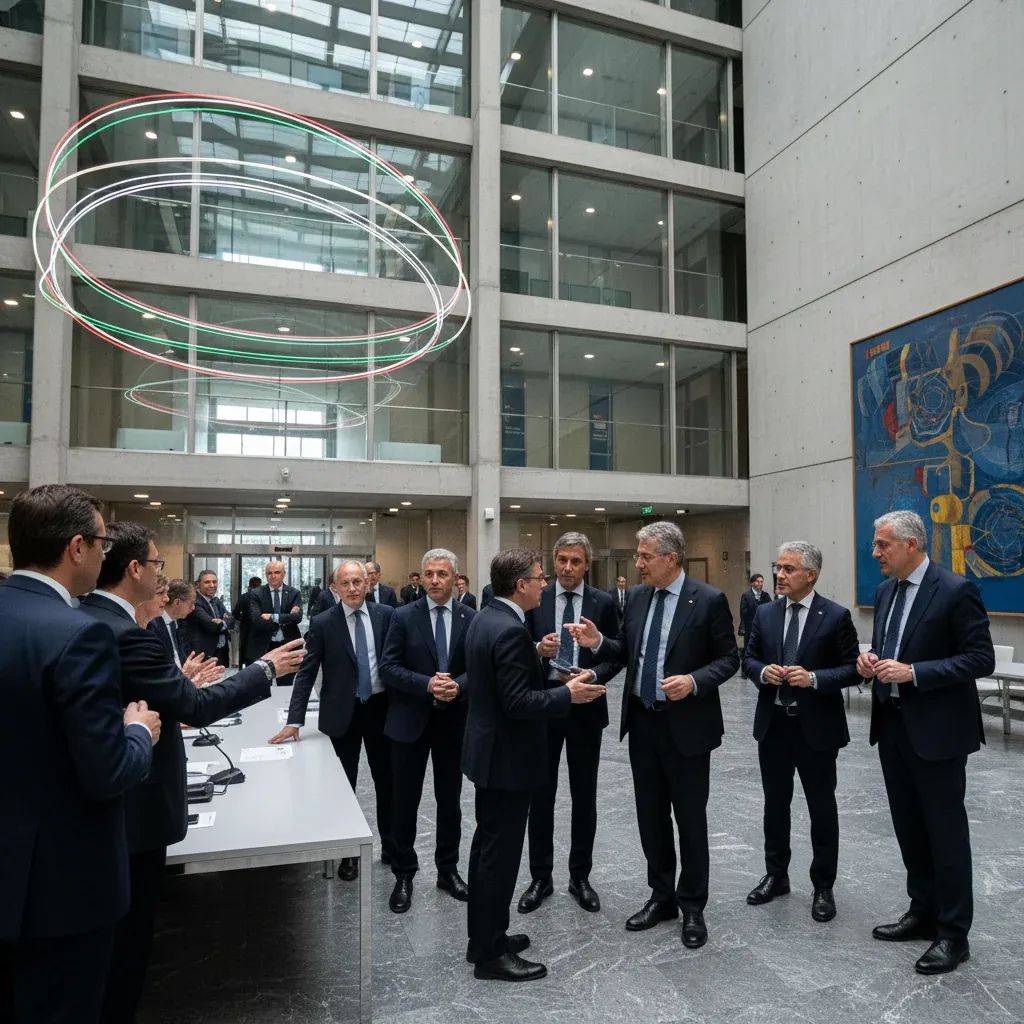
The Italian Football Federation (FIGC) presidency race has intensified, with Napoli owner Aurelio De Laurentiis publicly throwing his weight behind Giovanni Malagò while dismissing rival candidate Giancarlo Abete as unsuitable for the role—a declaration that sets the stage for a contentious electoral battle ahead of the June 22, 2026 election.
Why This Matters
• Leadership vacuum: The FIGC has been rudderless since Gabriele Gravina resigned April 2, 2026 following Italy's failure to qualify for the 2026 World Cup.
• Economic crisis: Italian clubs collectively face billions in losses, with player salaries consuming up to 80% of budgets—a model experts call unsustainable.
• Vote mechanics: While Serie A clubs (18 of 20) back Malagò, the amateur league holds 34% of voting power versus Serie A's 18%, making Abete a formidable opponent.
• Candidacy deadline: May 13, 2026 marks the cutoff for formal nominations, with both camps scrambling to secure support from players' and coaches' associations.
De Laurentiis Picks Sides—and Makes Enemies
Speaking outside the Serie A headquarters in Milan, De Laurentiis delivered a pointed endorsement that doubled as a character assessment of both contenders. "I called Malagò while boarding a flight to Los Angeles and told him, 'You must take charge of Italian football—there's no one better,'" the Napoli president recounted. "He's an entrepreneur, ran CONI, built Europe's most important sports club, sold Ferraris and Rolls-Royces worldwide. His only flaw? He loves Roma. We'll tolerate that."
The praise for Malagò came with a barb for Abete, the Lega Nazionale Dilettanti (LND) president and former FIGC chief from 2007 to 2014. "Abete is a dear friend—his brother is even a partner in one of my companies," De Laurentiis said. "But from my perspective, he's not the right person for this job. He might resent these words, but we're used to speaking our minds in a democracy."
The comments underscore mounting frustration among top-flight executives with what they perceive as institutional stagnation. "Since 2004, I've been telling everyone the system is obsolete, that kids won't watch football anymore, that we're getting everything wrong," De Laurentiis continued. "No one listens, because everyone's glued to their chair. The backside just won't unstick."
Malagò's Track Record—and the Roma Problem
Evelina Christillin, former UEFA executive and current FIFA Council member, offered a more measured take during a Radio Rai appearance. "As a close friend who's worked extensively with Giovanni, particularly on Olympic projects and the CONI executive board, I believe he's proven on the field what he can do," she said.
Malagò's résumé is difficult to dismiss. The Roman served three consecutive terms as CONI president from 2013 until his tenure ended in early 2025, a period during which Italy reached record athlete registration numbers and improved international sporting influence. He currently chairs the Milano-Cortina 2026 Organizing Committee for the Winter Olympics, handling a budget and logistical challenge that dwarfs the FIGC's operations. Before entering sports administration full-time, he ran a luxury automotive business and captained futsal teams to seven national titles.
The "Roma problem" De Laurentiis joked about is no trivial matter in Italian football's tribal culture. Malagò has openly identified as a Giallorossi supporter, which could complicate relationships with rival fanbases if he assumes control of national team matters. Still, his backers argue his business acumen and organizational success transcend club allegiances.
Abete's Counter-Offensive: The Dilettante's Power
Abete, 74, isn't conceding. The LND president commands the largest single voting bloc in the FIGC assembly—34% of the electorate—drawn from amateur and youth football organizations across Italy. That's nearly double Serie A's share, and it gives him a structural advantage despite lacking endorsements from professional clubs.
"We need to discuss programs and substance first," Abete told reporters when asked about his candidacy. His supporters point to his earlier FIGC tenure, during which Italy hosted major international tournaments and maintained relative stability, though critics note the Calciopoli scandal's lingering effects during his watch.
The electoral math is brutal for Malagò: even with Serie A's near-unanimous support and overtures to the players' association (AIC, 20% of votes) and coaches' union (AIAC, 10%), he needs to fracture Abete's grassroots coalition or risk falling short. The amateur leagues have historically resented Serie A's commercial dominance and could view Abete as a guardian of their interests.
What This Means for Residents
For Italians invested in the national team's fortunes—or simply tired of watching clubs collapse under debt—the leadership contest carries tangible consequences. The new president will inherit a system facing regulatory overhaul:
New financial rules taking effect this season require clubs to balance three-year budgets within a €60M deficit ceiling, with violations triggering immediate transfer bans unless owners inject fresh capital. Starting with 2025-26 contracts, relegated Serie A players automatically see salaries cut 25% until promotion. These reforms aim to prevent the wage spirals that have plagued Italian football, where personnel costs routinely exceed revenue.
Infrastructure remains a scandal. Italy ranks outside Europe's top ten for stadium construction or modernization between 2007 and 2024, costing clubs matchday revenue and forcing the national team to play in aging facilities. Proposals for a special commissioner with emergency powers to cut through bureaucratic red tape are on the table, particularly with Euro 2032 co-hosting duties looming.
Youth development has stalled. Serie A fields some of Europe's oldest squads, with minimal playing time for Italian prospects. Reforms under discussion include mandatory second teams for top clubs, stricter limits on foreign players, and tax incentives for deploying Under-23 Italian talent—measures inspired by Germany's post-2000s overhaul that produced a generation of World Cup contenders.
The Calendar Debate and National Team Fallout
De Laurentiis's reform wishlist centers on slimming Serie A from 20 to 16 clubs, a move he claims would ease fixture congestion and give the Azzurri at least two months of uninterrupted preparation. "We're exhausted being led by people who interpret institutional roles for personal prestige," he said. "The most important thing is to work, but to work you must know how. An entrepreneur who builds businesses, not just occupies seats, can fix what's broken."
The comment was widely interpreted as a jab at Abete's long tenure in various football bodies. Christillin echoed the scheduling concerns while stopping short of endorsing either candidate: "There are so many reforms needed—fewer Serie A teams, investment in youth, infrastructure, financial discipline. Germany's model, where no club has budget crises, should be our template. Here, the situation is dramatic."
She noted the paradox of Italy's thriving Under-age national teams versus the senior squad's failures. "It's not that we lack raw material—it gets squandered," Christillin said. "Where do these promising kids end up? Not on the field."
Mondiali Pipe Dream and Geopolitical Footnotes
On the margins of the leadership battle, Christillin addressed speculation about Italy replacing Iran at the 2026 World Cup should Tehran withdraw. "It's all in FIFA's hands," she said, referencing Regulation 6.7 that grants the FIFA Council discretion on replacement nations. "I see Iran's participation as quite difficult. Their football federation wants to play, but the government seems much more cautious."
Italy, as the 12th-ranked non-qualifier, would theoretically be first in line under sporting merit. Christillin proposed an alternative: "Last year, Palestine was eliminated by Oman on a dubious 97th-minute penalty in Asian qualifiers. It would be a beautiful gesture to bring them in." She dismissed the idea of a playoff involving Italy as "a bit humiliating for a nation that's won four World Cups."
The speculation remains just that—FIFA has given no indication Iran will withdraw, and with the tournament beginning in June 2026, decisions on replacement participants must be finalized soon. For most observers, the focus remains squarely on who will steer Italian football through its next chapter.
What Comes Next
Malagò is scheduled to meet the Serie A assembly today to present his platform in detail. Abete is expected to formalize his candidacy through the LND in the coming days. Behind the scenes, both camps are courting the AIC and AIAC, whose combined 30% could tip the balance.
The May 13, 2026 deadline will clarify whether any dark horse candidates emerge, though the race appears locked into a binary choice: the entrepreneurial outsider with Olympic credentials versus the veteran insider with grassroots clout. For a federation still reeling from its second consecutive World Cup absence, the stakes extend beyond personalities to the structural viability of Italian football itself.


