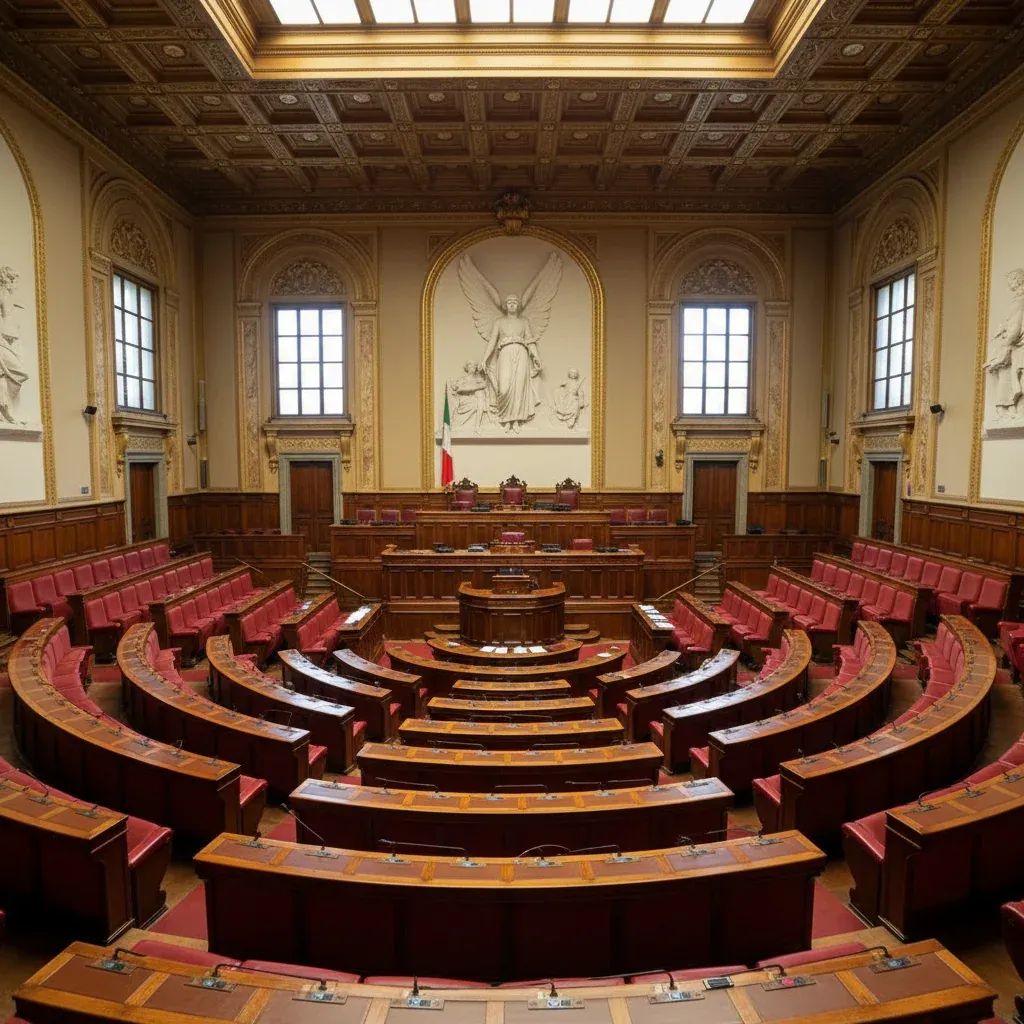
The Italy Senate has begun its review of the electoral law reform—colloquially dubbed "Stabilicum"—which passed the Chamber of Deputies on July 16, 2026, and now faces its second reading at Palazzo Madama. The measure proposes a proportional system corrected by a majoritarian bonus of 70 seats at the Chamber and 35 at the Senate for any coalition exceeding 42% of the national vote. The reform has generated significant debate regarding its constitutional implications, electoral fairness, and effects for voters and smaller parties.
Why This Matters:
• For voters: Parties that fail to clear the 3% threshold will not have their votes counted toward coalition totals under a recent amendment—meaning ballots cast for smaller parties may not contribute to determining bonus seats if those parties underperform.
• For governance: The reform aims to award a governing majority without a second-round runoff, but only if the winning coalition tops 42% in both chambers simultaneously. If that mark is not reached, Italy defaults to pure proportional representation with no majority bonus.
• For political stability: Proponents argue the law addresses chronic fragmentation that has hampered Italian governments. Critics contend it creates structural advantages for incumbent coalitions and reduces parliamentary independence.
The Senate Calendar: Autumn Review Expected
Senate President Ignazio La Russa indicated that the Constitutional Affairs Committee will formally take up the bill in the week of July 22, 2026, with substantial debate expected to continue into the fall. The brief window before the August recess leaves limited time for initial committee discussion, with primary legislative work scheduled for September and beyond.
The ruling coalition projects smooth passage, though La Russa signaled pragmatism on the contested issue of preference voting—a mechanism that was narrowly defeated in the Chamber by a single vote. "The center-right leadership will decide whether to resubmit the amendment for preferences," he stated. "If Parliament indicates it cannot support it, that perspective must be respected."
Minister Luca Ciriani (Fratelli d'Italia) acknowledged: "We sought preference voting. We would advocate for it again if circumstances allowed. Whether that opportunity exists in the Senate remains uncertain. I believe this law remains sound legislation, even without preferences."
The blocked-list format—where candidates are pre-ranked by party leadership—has drawn criticism from civil-society organizations and constitutional experts who argue it limits voter choice in candidate selection. The reform does include a "ripescaggio" clause (salvage provision): the highest-polling list within a coalition that falls below 3% can still win seats, offering limited accommodation to micro-parties.
The 3% Threshold: Implementation and Effects
A provision added during the Chamber's consideration has emerged as a central point of contention. Under this rule, votes for lists that fail to reach 3% will not be counted toward the coalition's aggregate total for purposes of the majority bonus calculation. Supporters of this provision argue it strengthens coalition incentives and clarifies voter intent. Opponents contend it disadvantages supporters of smaller parties.
Riccardo Magi, secretary of Più Europa—which received 2.9% in the 2022 general election—characterized the provision as problematic: "We're discussing votes that were validly cast but will not be assigned to the coalition for bonus calculations," he said. "These represent real constituencies and policy positions being excluded from bonus determination."
Angelo Bonelli of Alleanza Verdi Sinistra (Green-Left Alliance) expressed concern that the provision concentrates power with larger coalitions, while Five Star Movement leader Giuseppe Conte argued the reform contains provisions "designed to advantage the incumbent coalition by excluding certain votes from bonus calculations."
Center-left parties, aware that smaller allies like Azione (Carlo Calenda) or Italia Viva (Matteo Renzi) might approach or fall below the threshold, have similarly objected. Democratic Party secretary Elly Schlein stated: "The government is prioritizing electoral law changes—a concerning signal about their legislative priorities."
Government Position: Rationale for Electoral Structure
Government officials have emphasized that the reform addresses longstanding challenges in Italian governance. The 42% threshold and bonus system, they argue, will reduce the need for protracted coalition negotiations and produce more stable parliamentary majorities. By clarifying the Prime Minister candidate on the ballot, supporters contend voters gain transparency about executive leadership.
Fratelli d'Italia leadership has stressed that the blocked-list system—while limiting candidate choice—ensures coherent party platforms and reduces candidate-driven fragmentation that has historically complicated Italian governance. The 3% threshold, government figures note, reflects standard practice across Europe and prevents legislative fragmentation that can impede decision-making.
Constitutional Considerations: Legal Challenges Ahead
Constitutional scholars have raised concerns regarding potential Article 3 violations (equality before the law) and Article 67 implications (parliamentary independence). The Constitutional Court's 2014 "Porcellum" ruling invalidated comparable mechanics, finding they could produce outcomes diverging significantly from voter preferences.
The Senate's regional structure—defined in Article 57 of the Constitution—presents another legal question. By calculating bonus seats nationally and distributing them regionally, critics argue the reform may alter the Senate's territorial character in ways that previous constitutional jurisprudence has rejected.
International comparative analysis is mixed. Germany's Federal Constitutional Court has questioned whether even 3% thresholds fully satisfy electoral equality principles, though many European democracies employ such barriers. Poland uses an 8% coalition threshold, and Sweden employs a 4% threshold with regional exceptions—models that balance national cohesion with pluralism.
What This Means for Residents of Italy
Timeline and implementation: The reform is currently in the Senate committee stage. If approved in the Senate, it would require Presidential signature and potential publication before the next general election. The next regular general election is scheduled for spring 2027, though early dissolution remains possible.
Who can vote: Italian citizens aged 18 and above retain the right to vote. The reform does not alter voter eligibility. EU citizens residing in Italy may participate in European Parliament and municipal elections but not general elections for the national Parliament—this remains unchanged.
Your vote and coalition arithmetic: Your ballot will contribute to determining which coalition achieves bonus seats. If you support a party polling near or below 3%, your vote will count toward the party's total but may not be included in bonus calculations if the party falls below the threshold.
Candidate selection: Under the blocked-list format, you will not rank individual candidates. Party leadership determines candidate ordering on the list. If local representation or personal candidate choice is important in your voting decision, this represents a structural change from previous mixed systems.
Coalition Dynamics: Majority Support Tempered
Even within the ruling center-right coalition, enthusiasm shows mixed signals. Lega deputy Stefano Candiani expressed skepticism: "This reform does not energize us. We have consistently maintained that debating electoral law when Italians face urgent economic and security challenges represents a misallocation of parliamentary time." His statement reflects broader sentiment about electoral debate consuming legislative resources.
Nicola Fratoianni of AVS countered: "The majority coalition itself demonstrates internal strain and conflicting commitments. This electoral law reflects those tensions rather than a coherent governance vision."
Timeline and Next Steps
The Constitutional Affairs Committee, chaired by Andrea De Priamo (Fratelli d'Italia), will formally begin review in the week of July 22, 2026. Committee work is expected to extend into early September, with a full Senate vote unlikely before the fall session. Opposition parties plan to propose numerous amendments as part of the legislative process.
The center-right holds a Senate majority, though votes from centrist senators could prove consequential for key amendments or procedural matters.
International Electoral Systems: Comparative Context
Electoral design varies significantly across democracies. Poland sets an 8% coalition threshold (5% for individual parties). Lithuania employs a 7% coalition threshold. Sweden uses a 4% national threshold while allowing parties to enter Parliament through district-level representation—a model balancing national and regional representation.
Germany's approach provides relevant precedent: after constitutional challenges to European election thresholds, the Bundestag retained a 5% federal threshold but exempts parties winning three direct constituencies. Italy's reform provides no comparable alternative pathway, potentially concentrating coalition influence more substantially.
The Bigger Picture: Governance, Representation, and Democratic Design
The Stabilicum reflects a deliberate choice about governance priorities. Its proponents argue that electoral mechanics producing stable majorities serve citizen interests through effective government. Its critics contend that representation of diverse voter preferences and coalition pluralism deserve equal weight.
For residents of Italy, the practical question centers on whether you prioritize stable governance or proportional representation. The reform's success will depend partly on whether the ruling coalition can achieve the 42% threshold—a measure determined by voter choice in the next general election, currently scheduled for spring 2027.