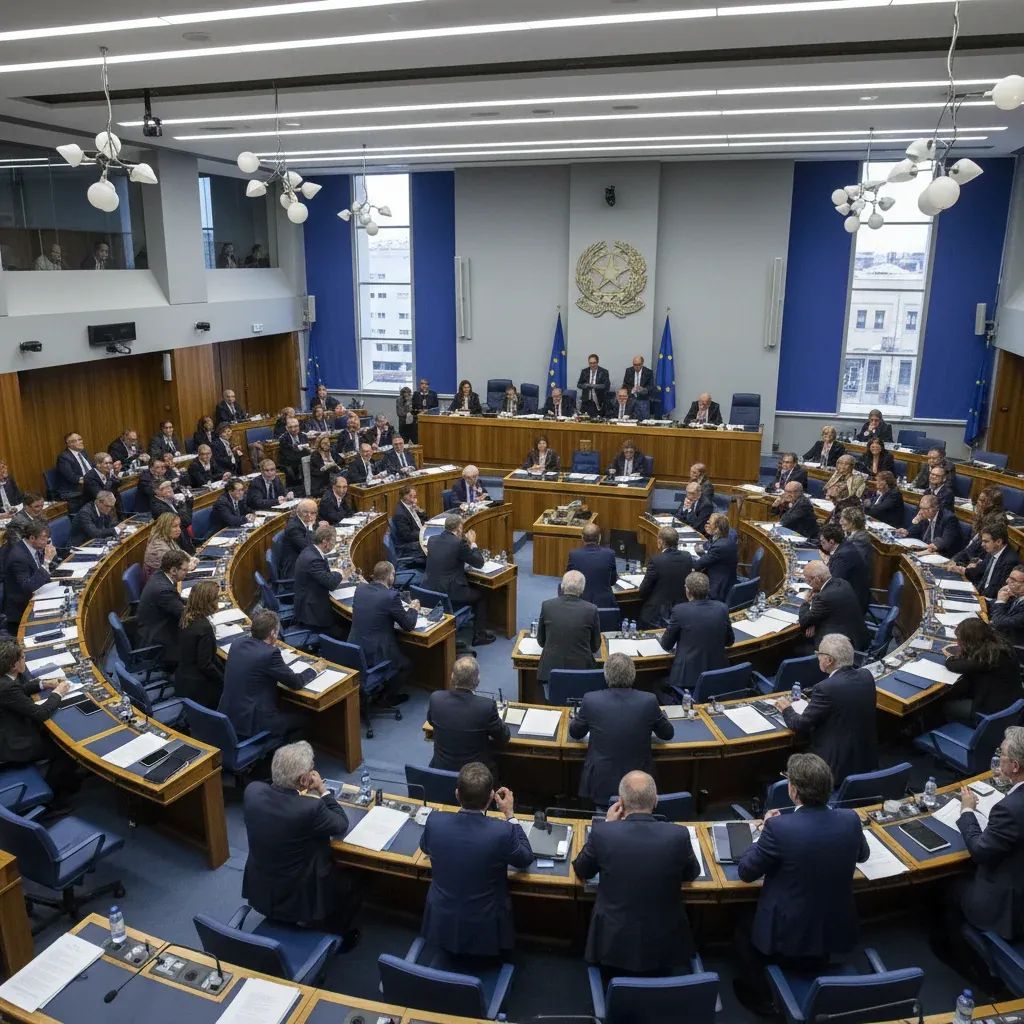
Italy's governing coalition has passed a sweeping electoral reform at the Chamber of Deputies, but the fight over voter preference ballots—and the law itself—is now headed to the Senate, where the opposition has vowed to block what it calls an unconstitutional power grab.
Why This Matters
• The "Stabilicum" bill introduces a proportional system with a 70-seat bonus for any coalition clearing 42% of the national vote—effectively guaranteeing a parliamentary majority.
• No voter preferences survived the Chamber vote, after a secret ballot defeated the amendment by a single vote (188-187) on July 14, leaving candidate selection entirely in party hands.
• Noi Moderati promises to reintroduce preferences at the Senate, where public voting rules may shift the outcome.
• Final approval is not expected before September, giving both sides time to negotiate—or dig in.
What Happened at the Chamber
On July 16, the Italy Chamber of Deputies approved the first reading of a new electoral law that its backers in the center-right coalition call the "Stabilicum," designed to deliver stable majorities. Critics in the opposition have branded it the "Melonellum," a jab at Prime Minister Giorgia Meloni's influence over the text.
At the heart of the reform lies a governability premium: coalitions or single lists that win at least 42% of valid votes and come first in both chambers automatically receive 70 additional seats in the Chamber and 35 in the Senate, up to caps of 220 deputies and 113 senators (excluding overseas MPs). If no one clears the threshold—or if results diverge between the two houses—the system reverts to pure proportional representation with no bonus.
But the most contentious vote came two days earlier. Fratelli d'Italia, Noi Moderati, and UDC had jointly tabled an amendment to introduce up to three voter preferences while keeping lead candidates locked in place. The proposal included a gender-alternation rule: the second and third preferences had to be for candidates of a different sex. It was meant to balance party control with citizen choice.
The amendment failed in a secret ballot—a procedural quirk that allows lawmakers to vote against their own coalition without public accountability. The one-vote margin sparked immediate recriminations within the government, with suspicions that defectors came from the center-right itself.
As a result, the text now moving to the Senate features closed lists: parties print candidate names on the ballot in a fixed order, and voters cannot alter the sequence. The premium seats are distributed via regional candidate rosters stamped directly on the ballot.
Senate Battle Lines
Maurizio Lupi, leader of Noi Moderati, has confirmed his party will file a fresh amendment in the upper house. Matteo Salvini of the Lega echoed that hope, saying: "I hope we can recover the preference issue, which was rejected by the compact vote of the left and with someone from the center-right who slipped away."
Ignazio La Russa, president of the Senate and a senior figure in Fratelli d'Italia, floated a compromise in an interview with Corriere della Sera: "I would have required that 50% of locked lead candidates be women." According to Rome daily Il Messaggero, government lawyers have begun drafting language based on that formula, aiming to address the criticism that closed lists with no gender safeguards could entrench male-dominated candidate selection.
One tactical advantage for the coalition: the Senate rules do not permit secret votes on electoral law, meaning senators will cast ballots publicly. That could force wavering center-right lawmakers to toe the party line—or expose dissent in real time.
Opposition Rejects Any Compromise
The Democratic Party (PD) and the Greens and Left Alliance (AVS) have dismissed the entire effort as procedural theater.
"They seem very confused and fighting among themselves," said Alessandro Alfieri, the PD's reform coordinator in the Senate. "We're still in the realm of unacceptable proposals. These are shortcuts that mock the voter. They're building an electoral system tailored to hobble the opposition. Playing with democratic rules this way is completely improper."
Angelo Bonelli of AVS was blunt: "For us, this law is unamendable." He added that La Russa's public comments on how the law should be tweaked amount to an improper intrusion into legislative debate, calling on the Senate president to "resign and become the FdI caucus leader" if he wants to shape policy.
Nicola Fratoianni, also of AVS, called the bill "an electoral fraud, and no amendment on preferences can save it."
The opposition has pledged to use every procedural tool at its disposal to delay or derail the bill. Even if amendments pass, any substantive change in the Senate would trigger a third reading back at the Chamber, pushing final approval well into autumn and raising the risk of further defections.
What This Means for Residents
For voters, the practical stakes are straightforward: if the law passes as written, Italians will no longer be able to pick individual candidates from party lists. Instead, they will vote for a coalition or party, and the order of election will be decided entirely by party leadership.
For political stability, the premium mechanism aims to prevent the parliamentary fragmentation that has historically plagued Italian governments. By handing a constructed majority to the winning coalition, the law seeks to reduce reliance on post-election pacts and make cabinets more durable. Critics counter that artificial majorities distort voter intent and may violate constitutional principles of proportional representation.
On gender balance, the current text includes a pre-existing 60% cap on same-sex candidates within lists—a rule already in Italian election law—but no mechanism to ensure women actually get elected once votes are counted. La Russa's proposal to reserve half of locked lead spots for women would address that gap, but only if the Senate adopts it.
The law also introduces voting rights for temporary residents: citizens domiciled outside their home municipality for at least nine months—for work, study, or medical care—will be able to vote where they live, rather than traveling back to their town of registration. This change is particularly important for foreigners and expats living in Italy, as it allows you to vote in your current location without returning to your municipality of legal residence. This provision was approved unanimously and is likely to survive regardless of what happens to preferences.
Threshold rules remain at 10% for coalitions and 3% for individual lists, with a "best loser" provision that lets the top sub-threshold party within a coalition claim seats if the coalition itself qualifies.
European Context
Italy's struggle over preferences and gender equity mirrors debates across the European Union, where 20 of 27 member states allow voters to express candidate preferences in proportional systems. Countries such as Finland, Estonia, and the Netherlands use open lists by default, while Spain and Denmark blend preferences with party-set rankings.
On gender, nearly all EU states employ either legislative quotas or voluntary party commitments. Spain introduced a 40% floor for each sex in 1997; Slovenia requires at least 40% representation of either gender on all lists. Italy's 60% same-sex cap on lists is comparable, but without a preference vote or alternation rule in the final tally, critics argue it amounts to window dressing.
Denmark and Poland combine preferences with minimum vote thresholds to activate them, ensuring that only candidates with genuine public support leapfrog the party order. Italy's rejected amendment attempted a similar balance—locking in lead candidates while freeing up the rest of the list—but the mechanism never made it out of the Chamber.
Timeline and Next Steps
The Italy Senate will begin committee review in early August, with floor debate likely in September. If Noi Moderati and Lega succeed in attaching a preference amendment—and if gender-parity language gains traction—the modified bill must return to the Chamber for a third reading. That would delay implementation and reopen the risk of secret-ballot sabotage.
If the Senate approves the text unchanged, the law takes effect immediately and will govern the next general election, currently scheduled for 2027 unless the government falls earlier.
Opposition leaders have hinted they may challenge the law before the Constitutional Court, arguing that the governability premium and closed lists violate articles of the Italian Constitution guaranteeing proportional representation and voter choice. Italy has a history of electoral laws being struck down by the Constitutional Court—a precedent set in 2005 when the court invalidated the "Porcellum" law, making this reform's ultimate fate uncertain.
For now, the battlefield has shifted from Rome's Montecitorio palace (home of the Chamber of Deputies) to Palazzo Madama (the Senate chamber), where public votes and coalition discipline will determine whether Italians regain the power to choose their representatives—or whether party bosses retain full control over who sits in Parliament.