
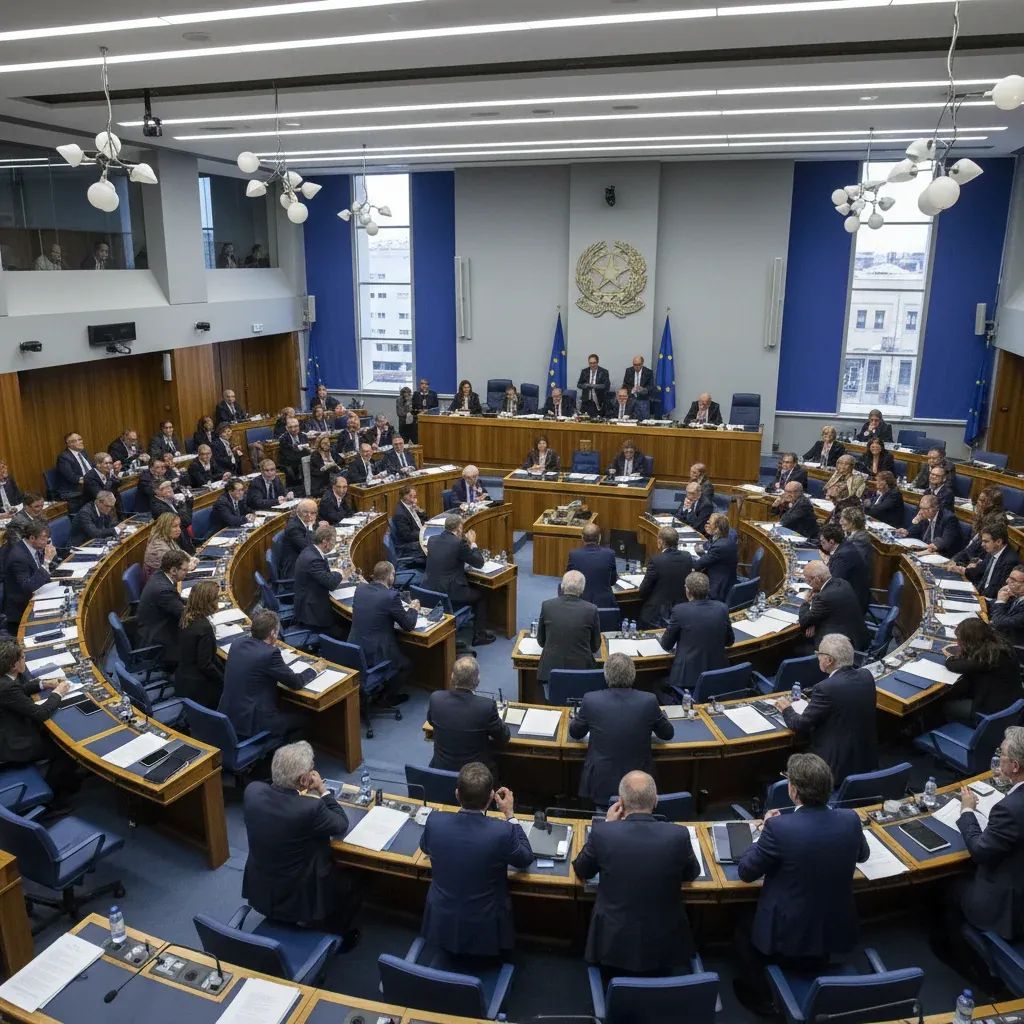
Italy's Constitutional Affairs Committee is advancing a contentious electoral law overhaul as the center-right coalition attempts to fast-track legislation before the summer recess, a move that opposition lawmakers have condemned as fundamentally anti-democratic and likely to fail constitutional scrutiny. The debate has intensified amid the disruptive political rise of Roberto Vannacci, whose new party threatens to fracture the governing coalition's unity.
Why This Matters:
• Constitutional concerns: The proposed system includes 70 fixed bonus seats at the Chamber and 35 at the Senate, mechanisms previously struck down by Italy's high court.
• Preferential voting removed: Blocked lists mean residents cannot rank individual candidates, only select party slates determined by leadership.
• Fast-tracked timeline: The text is scheduled for floor debate in the Chamber on June 26, with the majority aiming for passage before August.
• Vannacci factor: The general's Futuro Nazionale party, polling at 4.3%, is pressuring the coalition from the right and complicating legislative strategy.
Electoral System Overhaul Advances Despite Fierce Resistance
The Chamber of Deputies' Constitutional Affairs Committee is currently voting on hundreds of amendments to a proportional electoral system that would grant a fixed majority bonus to any list or coalition surpassing 42% of the vote in both houses. The proposal, dubbed "Melonellum" or "Bignami-bis" by political observers, eliminates single-member districts, abolishes runoff elections, and mandates that all lists designate a prime minister candidate before campaigning begins.
In June 2024, after the amendment deadline passed on June 11, the committee presidency ruled on 771 submitted proposals, declaring only one inadmissible and reducing the batch to 479 substantive amendments requiring votes. The session stretching into late evening marks a critical juncture, with the majority determined to move the bill to the full Chamber floor within days.
Five-Movement lawmaker Alfonso Colucci characterized the legislation as "an attempt to stay clinging to power" designed to obstruct "progressive forces working together from governing." His colleague at the Democratic Party, Andrea Casu, accused the coalition of "chasing after Vannacci," referencing the unpredictable impact of the general's independent political trajectory on established alliances.
Deep Constitutional Flaws Echo Past Failures
Opposition representatives have highlighted multiple structural defects that mirror the infamous Porcellum, Italy's 2005 electoral law that the Constitutional Court partially invalidated in Sentenza 1/2014. That landmark ruling struck down the fixed majority bonus and blocked lists, finding both mechanisms violated the principle of vote equality and limited citizen choice.
Democratic Party deputy Federico Fornaro declared the current text suffers from "structural constitutional deficits starting with the fixed-scale majority bonus, which are not fixable." He warned that the coalition's amendments fail to address fundamental problems: voters cannot identify candidates on lists containing 70 names at the Chamber and 35 at the Senate, and the prime minister designation infringes on presidential prerogatives guaranteed by Italy's constitution.
"We cannot afford to go vote with an unconstitutional electoral law, as happened three times with the Porcellum," Fornaro stated, urging the majority to halt proceedings. His party colleague Arturo Scotto described the proposal as "an electoral law born from fear of losing elections," labeling it "beyond even the fraud law" in its distortion of democratic principles.
The blocked list mechanism remains particularly contentious. Under the proposal, party leadership determines the order of candidates, and voters simply select a party symbol. This removes the preferential vote system that allows residents to rank individual representatives, effectively making parliamentarians accountable to party bosses rather than directly chosen by constituents.
The Vannacci Variable Disrupts Coalition Calculus
Roberto Vannacci's political ascent has emerged as an unforeseen complication for the center-right's legislative strategy. The former general, who secured significant votes in the 2024 European Parliament elections, formally launched Futuro Nazionale as his political movement. His platform emphasizes "remigration," nuclear energy, a flat tax rate for small and medium businesses, and culturally conservative positions that appeal to the coalition's most right-leaning voters.
Recent polling indicates Vannacci's movement could capture 4.3% of the electorate, enough to clear the threshold for parliamentary representation in a proportional system. The party has already attracted defectors from Lega and Forza Italia, signaling its capacity to poach support from established center-right parties.
For Prime Minister Giorgia Meloni's Fratelli d'Italia, Vannacci presents a strategic dilemma. Embracing his positions risks alienating moderate and liberal voters who form a crucial part of the coalition's electoral base. Excluding him entirely, however, could hemorrhage support among identity-focused conservatives who feel the government has failed to deliver on promises regarding security and immigration. Lega leader Matteo Salvini has publicly ruled out political agreements with Vannacci, while Forza Italia and Noi Moderati have maintained distance.
Colucci suggested that Vannacci's rise "scrambles this program, so we'll see if the majority actually wants to move forward" with the electoral reform, implying that internal coalition tensions might yet derail the legislation.
What This Means for Residents
For Italian citizens and foreign residents planning to naturalize and vote, understanding these electoral changes is crucial. The system residents vote under determines how much direct influence their individual choices have over parliamentary representation. Under blocked lists, voters select parties but have no say in which candidates occupy parliamentary seats—that decision rests entirely with party leadership. This represents a fundamental shift in how voters connect with their elected representatives, making the constitutional and practical implications of this debate central to democratic participation.
European Context Offers Mixed Precedents
Across European democracies, electoral approaches vary significantly. Greece operates a proportional system reinforced by a 50-seat bonus awarded to the top-performing list. Spain, Portugal, Croatia, and Bulgaria employ pure closed-list systems where parties determine parliamentary composition. Other democracies prioritize voter agency: Belgium, the Netherlands, Sweden, and Slovakia utilize flexible or open lists allowing preferential voting, while Ireland and Malta employ the single transferable vote, enabling citizens to rank candidates across party lines. This divergence shows that while various models exist across Europe, contemporary democratic practice increasingly favors systems preserving meaningful voter choice.
Timeline and Next Steps
The Constitutional Affairs Committee is scheduled to complete amendment votes by June 23, with a mandate vote for floor rapporteurs set for June 24. The full Chamber debate is calendared for June 26, and the majority leadership has indicated determination to secure final passage before the August parliamentary recess.
If approved by the Chamber, the legislation moves to the Senate, where it must pass in identical form before becoming law. Any amendments in the Senate would trigger a return to the Chamber, potentially extending the timeline. Given the Constitutional Court's history of striking down electoral mechanisms similar to those in the current proposal, legal challenges appear inevitable regardless of parliamentary outcome.
Opposition parties have signaled they will exhaust procedural options to delay or block the bill, filing hundreds of amendments and demanding extended debate time. Scotto's call to "rewind the tape, sit down and discuss" reflects a broader concern that rushing electoral reform without cross-party consensus risks repeating past mistakes that left Italy voting under systems later deemed unconstitutional.
For residents, the practical impact centers on how future parliaments are elected and whether individual voters retain meaningful influence over who represents them. The outcome will determine whether Italy adopts a system prioritizing governmental stability through engineered majorities, or one emphasizing proportional representation and direct accountability to constituents.


