
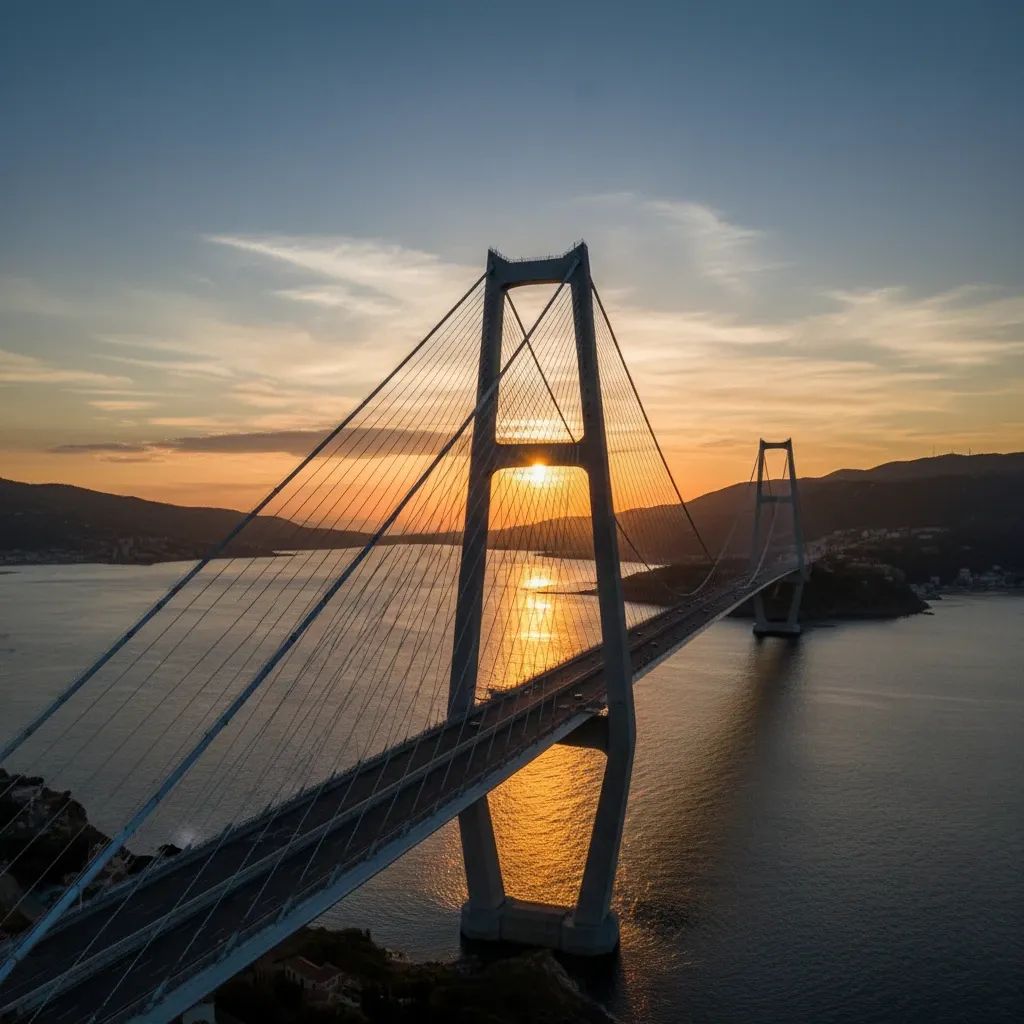
Italy's Infrastructure Minister Matteo Salvini has publicly accused prosecutors of launching "preemptive investigations" against major construction projects across the country, including the long-debated Strait of Messina Bridge, arguing that a culture of presumed guilt is paralyzing development and stalling billions of euros in public works.
Speaking at a video address commemorating the 80th anniversary of ANCE (Italy's National Association of Building Constructors), Salvini characterized the current investigative climate as inherently suspicious of anyone in the construction or political sectors. His comments land amid an ongoing corruption probe by the Rome Prosecutor's Office that has already ensnared three individuals linked to the Strait Bridge project—an €13.5 billion megaproject slated to connect Sicily with mainland Italy.
Why This Matters
• €13.5B at stake: The Strait Bridge, Europe's largest single infrastructure undertaking currently in planning, faces legal uncertainty despite government backing.
• Rome probe active: Three individuals—including a retired senior Court of Auditors judge—are under investigation for alleged attempts to manipulate oversight of the bridge's approval process.
• Broader pattern: Milan has seen roughly 150 construction sites halted due to investigations since mid-2025, with over €35B in accumulated investments in limbo and another €12B in future projects at risk.
The Corruption Investigation Casting a Shadow
The Rome Prosecutor's Office is currently investigating three people for corruption and disclosure of official secrets in connection with the Strait Bridge. The probe centers on allegations that the accused attempted to influence the Court of Auditors' review of the project's definitive approval in late 2025.
Among those under scrutiny: a former deputy president of the Court of Auditors who retired in February 2026, a lawyer who previously served on the board of Stretto di Messina SpA (the state-controlled company managing the project), and a businessman. Prosecutors, supported by the ROS Carabinieri (the paramilitary police's special operations unit), are analyzing seized documents, electronic devices, and personal communications to map a suspected network of influence.
According to judicial sources, the individuals allegedly sought to obtain confidential information about the Court's deliberations during the final quarter of 2025, when the CIPESS (the interministerial committee overseeing public investments) rejected the project as "deficient." The state company has formally distanced itself from the allegations, declaring itself entirely uninvolved.
What This Means for Residents and Investors
For those living in Sicily and Calabria, the Strait Bridge represents more than a symbol—it's a promised lifeline that could slash travel times, integrate labor markets, and unlock tourism revenue. Yet the bridge has been debated since the 1960s, with false starts and political reversals creating a cycle of hope and disappointment.
The current investigation adds another layer of uncertainty just as the project was gaining momentum. Final administrative approval is scheduled for late summer 2026, with construction meant to begin in the fourth quarter of this year. The full timeline envisions seven and a half years of work, aiming for operational service by 2034.
However, funding signals are mixed. The government's 2026 allocation was slashed from €1.1B to just €130M, raising questions about cash flow even as total project costs have ballooned from an initial €4.3B estimate in 2005 to the current €13.5B figure—more than triple the original projection.
For contractors, engineers, and suppliers counting on this and similar megaprojects, the legal climate is chilling. Salvini's remarks reflect a widespread industry frustration: that judicial scrutiny often precedes wrongdoing, effectively freezing plans before ground is broken.
Milan's Construction Freeze: A Parallel Crisis
The minister's critique extends beyond the Strait. In Milan, investigations launched in mid-2025 have paralyzed around 150 building sites, encompassing projects tied to the 2026 Winter Olympics in Milan-Cortina, including the Olympic Village student housing and the redevelopment of disused railway yards.
The Milan Prosecutor's Office is examining alleged irregularities in the authorization process and administrative handling of permits, questioning the entire urban development model that has transformed Milan into Italy's fastest-growing metropolitan economy. The combined value of stalled investments sits at more than €35B, with an additional €12B in planned future works now shrouded in doubt.
For Milan residents, the freeze has tangible consequences: delayed housing supply in a city already grappling with soaring rents, postponed public transit upgrades, and the reputational risk of Olympic venues facing completion delays.
A National Pattern: Bureaucracy Meets Judicial Activism
Italy's infrastructure bottleneck is not new. As of late 2020, the country counted 640 major incomplete works (worth roughly €4B) and over 400 projects blocked by red tape or legal disputes (valued at €27B), totaling more than 1,040 stalled initiatives. By early 2019, at least 28 large-scale projects were frozen, part of a broader tally of 49 blocked works.
This dynamic carries financial and strategic costs. Italy is one of the largest recipients of EU infrastructure funding, yet the risk of losing those allocations grows each time a project falters. Under the National Recovery and Resilience Plan (PNRR), strict timelines govern disbursement—missed deadlines can trigger clawbacks.
Anti-corruption enforcement is essential, and Italy's judiciary has played a critical role in exposing malfeasance. Yet the minister's argument—echoed by many in the construction sector—is that the balance has tipped: that the presumption of guilt precedes evidence, and that preventive investigations often substitute for risk-based enforcement.
How Other European Countries Handle Oversight
Across the EU, large public works undergo rigorous scrutiny, primarily through Environmental Impact Assessments (EIA) mandated by Directive 2011/92/EU and its 2014 amendment. The goal is twofold: protect the environment and avoid paralyzing development.
Several member states have adopted measures to streamline oversight without sacrificing accountability:
• Fixed timelines: The 2014 directive introduced specific deadlines for each assessment phase, improving predictability and enabling faster investment decisions.
• Early scoping consultations: Preliminary dialogues between project proponents and authorities narrow the focus of impact studies, concentrating resources on the most significant risks.
• Digitalization: Electronic contracting and permitting systems reduce administrative burden and accelerate approvals.
• Concurrent procedures: Some countries run design tenders and verification processes in parallel, shaving months off project timelines.
• Dedicated fast-tracks: France, Germany, and Spain have established expedited pathways for infrastructure tied to EU recovery funds, similar to Italy's "Decreto Semplificazioni" of 2020–2021.
The Italian model includes these elements on paper, yet enforcement remains fragmented and subject to regional variance. The judicial independence that protects rule of law also means prosecutors can launch inquiries without executive oversight—a feature Salvini characterized as a "small, politicized part of the justice system."
The Political Dimension: Salvini's Broader Message
Salvini's remarks were framed within a broader critique of Italy's governance challenges. He argued that "presumed guilt, obstructive bureaucracy, and a micro-segment of politicized justice" collectively prevent national progress. His language was direct: investigations are "ungenerous," especially those targeting Olympic-related projects, and in the case of the Strait Bridge, they are "preemptive"—opened not because of evidence, but because large projects inherently attract suspicion.
This rhetoric resonates with the right-leaning coalition currently governing Italy, which has pledged to cut red tape and accelerate infrastructure delivery. Critics, however, warn that weakening oversight could enable the very corruption the investigations aim to prevent, particularly in a sector historically vulnerable to organized crime infiltration in southern Italy.
The Road Ahead: Uncertainty Amid Ambition
Despite the judicial cloud, the Italian Cabinet continues to champion the Strait Bridge as a strategic priority for the country and Europe. Approval of the final design remains on track for late summer, and the construction kickoff is still slated for Q4 2026. If the schedule holds, the bridge could redefine connectivity in the Mediterranean, slashing the ferry crossing to a 3-minute drive and linking high-speed rail networks.
Yet the funding cut and the open investigation cast doubt on whether promises will translate to steel and concrete. For those living in the regions directly affected, the pattern is familiar: grand announcements, bureaucratic delays, legal entanglements, and eventual abandonment.
The outcome of the Rome probe will likely set a precedent. If prosecutors uncover genuine wrongdoing, it could justify the preventive approach Salvini decries. If the investigation concludes without charges, it may bolster his argument that Italian infrastructure is hobbled not by corruption, but by the fear of it.


