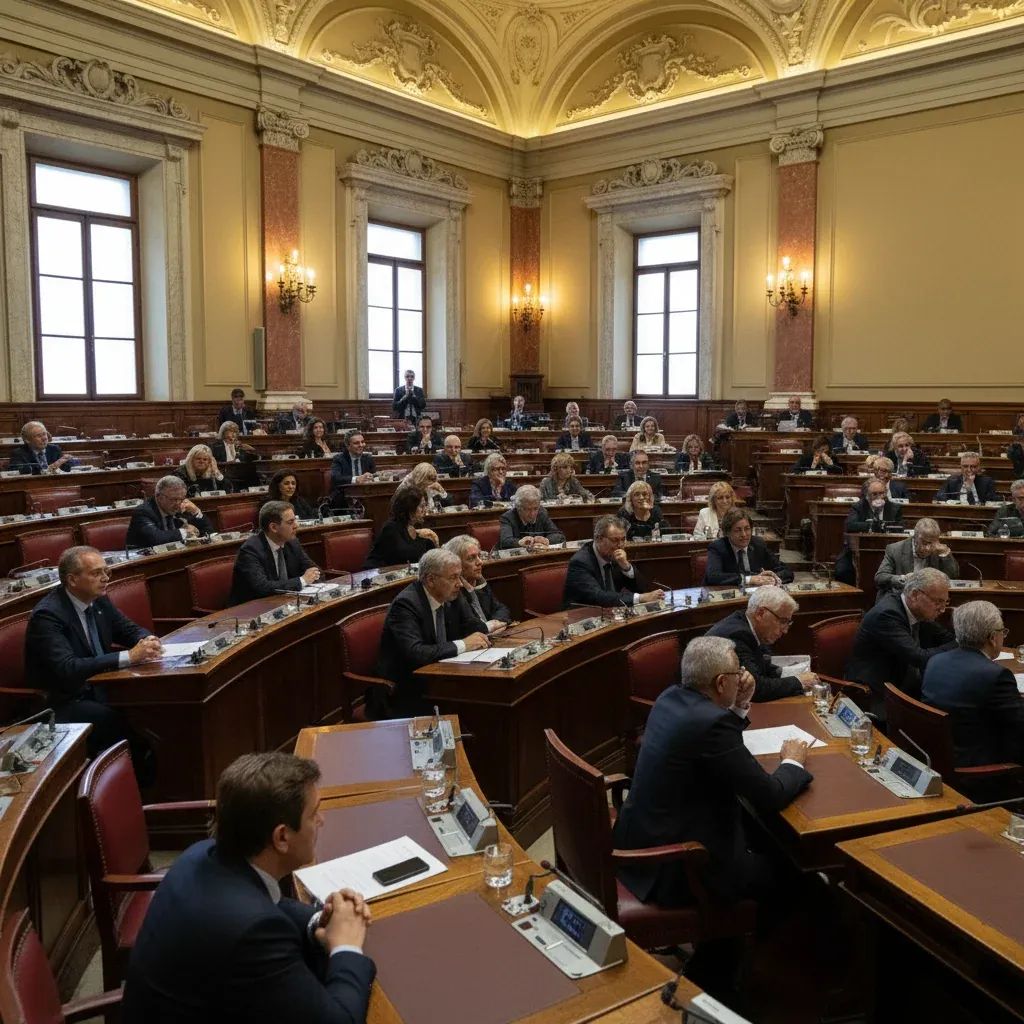
Italy's Lower House has greenlighted a controversial electoral reform known as the "Stabilicum", setting the stage for a high-stakes political showdown in the Italian Senate over the coming weeks. In July 2026, the legislation, which rewrites how Italians elect their representatives, now faces scrutiny in the Senate Constitutional Affairs Committee, where opposition forces plan to wage an aggressive campaign to derail or amend the government's proposal.
Why This Matters
• New voting system: The reform abolishes single-member districts and introduces blocked lists with no voter preference, meaning Italians lose the ability to choose individual candidates.
• Majority bonus at stake: Any coalition securing at least 42% of the vote would receive an automatic bonus of 35 Senate seats and 70 Chamber seats, potentially cementing parliamentary control for years.
• Timeline crunch: The Senate has roughly 10 working days before the summer recess to advance the bill, with final approval likely postponed until autumn.
• Political fractures exposed: The government coalition fractured during a secret ballot on candidate preferences, revealing internal tensions that could resurface.
What Changed in the Chamber Vote
On July 16, 2026, the Italian Chamber of Deputies approved the electoral overhaul with 217 votes in favor, 152 against, and 2 abstentions. The reform shifts Italy toward a proportional system with a hefty governability bonus: if a coalition or single party clears the 42% threshold nationally, it automatically gains enough seats to command a comfortable majority in both chambers—220 seats in the Chamber and 113 in the Senate. If no coalition reaches that mark, seats are distributed by pure proportional representation.
The most contentious feature is the elimination of voter preferences. Under the new system, parties present blocked plurinominal lists in which candidates are ranked by party leadership, and voters cannot reorder them. This provision sparked furious debate, with critics accusing the government of reducing democratic choice and concentrating power in the hands of party bosses.
An amendment to restore voter preferences—backed by Fratelli d'Italia (Brothers of Italy) and deputies aligned with General Roberto Vannacci, a polarizing figure in the Lega (League) orbit—failed narrowly in a secret ballot on July 15, 2026. The tally was 139 in favor and 233 against, after the Lega unexpectedly voted against its own rhetorical position, fracturing the governing coalition and delivering a symbolic blow to Prime Minister Giorgia Meloni.
Senate Strategy and Timeline
The bill arrives at Palazzo Madama (the Senate) next week, where it will be formally assigned to the Constitutional Affairs Committee chaired by Andrea De Priamo of Fratelli d'Italia. De Priamo has pledged to begin work "with enthusiasm and determination," while respecting the procedural rights of all political forces, including the opposition.
The center-left opposition bloc—comprising the Democratic Party (PD), Five Star Movement (M5S), and Alliance of Greens and Left (AVS)—plans to request a round of public hearings to scrutinize the text, likely scheduled for the week following the bill's assignment. These hearings could feature constitutional scholars, civil society organizations, and political analysts, providing a platform for opposition arguments about the reform's legitimacy.
Once the committee presidency sets the deadline for amendments, the real legislative battle begins. However, time is short: the Senate breaks for summer recess in roughly 10 days, leaving limited room for substantive debate. The center-right government aims to push the bill as far as possible before the pause, ideally leaving only the final floor vote for when Parliament reconvenes in September.
Opposition Tactics and Legal Concerns
The opposition entered the Chamber debate united and vocally hostile, branding the reform a "legge truffa" (electoral fraud law) and accusing Meloni of engineering a power grab. Elly Schlein, secretary of the PD, charged that the government had "betrayed Italians" and vowed to "send you home with any electoral law." Giuseppe Conte of the M5S warned that the majority bonus is "unconstitutional" and pledged that the opposition would not allow the government to "confuse the Quirinal Hill with Colle Oppio"—a reference to fears that Meloni's coalition seeks to weaken presidential prerogatives.
Riccardo Magi of Più Europa (More Europe) escalated the rhetoric further, calling the reform an "electoral coup d'état" that "prepares a regime." During the final vote, opposition deputies displayed banners reading "Meloni ha fallito" (Meloni has failed) and "Legge truffa", while Magi theatrically waved an oversized mock ballot in front of the government benches.
The opposition has filed suppressive amendments aimed at killing the entire bill, and they are expected to repeat this strategy in the Senate. Key targets include the majority bonus mechanism, which critics argue distorts proportionality and could violate Italy's constitutional principles of equal representation, and the blocked lists, which eliminate voter agency in candidate selection.
The Preferences Dilemma and Vannacci Factor
The failed preference amendment looms large over the Senate phase. Matteo Salvini, leader of the Lega and deputy prime minister, appeared lukewarm on the bill after the Chamber vote but unexpectedly revived the preferences issue, saying he hoped the Senate would "recover the possibility of indicating preferences in some form." This aligns him rhetorically with General Vannacci, whose supporters in the Futuro Nazionale (National Future) faction had championed the amendment and accused coalition partners of "stabbing the premier in the dark" during the secret ballot.
If Meloni's government decides to reintroduce the preferences amendment in the Senate, it could secure support from the "vannacciani" but risks another internal rupture with Forza Italia and the Lega, both of which have shown reluctance to back the measure despite public statements. The Senate rules, unlike those of the Chamber, do not allow secret ballots on amendments, which could change the political calculus and make coalition discipline easier to enforce—or defections more visible.
Alternatively, Meloni could lock down the text as approved by the Chamber, avoiding further controversy and expediting passage. This would prevent a third reading in the Chamber, which would be required if the Senate amends the bill. A third reading would reintroduce the risk of another secret ballot, complicating the government's control even if it invokes a confidence vote, since the final vote on legislation after a confidence motion remains secret under Chamber rules.
Impact on Residents and Political Stability
For Italians, the reform represents a significant shift in how political power is allocated. The 42% threshold for the majority bonus is relatively low by European standards, meaning a coalition could govern with a substantial parliamentary cushion even if a majority of voters opposed it. This raises concerns about proportionality and the effective disenfranchisement of minority voices.
The elimination of voter preferences also marks a cultural departure. Italian voters have historically valued the ability to choose individual candidates, and blocked lists concentrate power in party headquarters, potentially sidelining regional or grassroots concerns. Critics argue this could deepen public distrust in political institutions, particularly among younger voters and those disaffected by traditional party structures.
From a governance perspective, the reform aims to reduce parliamentary fragmentation and ensure stable majorities, a goal the center-right argues is essential for effective administration. Italy has cycled through 69 governments since World War II, and proponents of the Stabilicum contend that clearer electoral outcomes will reduce coalition instability and allow elected governments to implement their programs without constant renegotiation.
However, opponents warn that the combination of a large majority bonus and blocked lists could entrench incumbents, weaken parliamentary oversight, and tilt the balance of power away from the President of the Republic, who traditionally plays a mediating role in coalition formation and government crises. The opposition's references to the Quirinal—the presidential palace—underscore concerns that the reform could sideline the head of state's constitutional functions.
What Happens Next
The Senate Constitutional Affairs Committee will likely begin formal examination next week, with the deadline for amendments and the schedule for hearings to be determined by the committee presidency. The government coalition controls a majority in the Senate, but internal divisions and the opposition's procedural leverage—particularly the Senate's rules on committee amendments, which lapse if a vote on the rapporteur's mandate fails—mean the path forward is not guaranteed.
If the Senate approves the bill without changes before the summer break, it could return for a final floor vote in September. If amendments pass, the text must return to the Chamber for a third reading, delaying final approval and reopening political battles. Meloni faces a delicate balancing act: appeasing Vannacci's supporters without alienating Forza Italia and Lega, while fending off a united opposition that senses both moral high ground and tactical opportunities.
For now, the 10-day countdown to the summer recess has begun, and the Constitutional Affairs Committee will be the arena where the fate of Italy's electoral system—and the government's legislative credibility—hangs in the balance.