
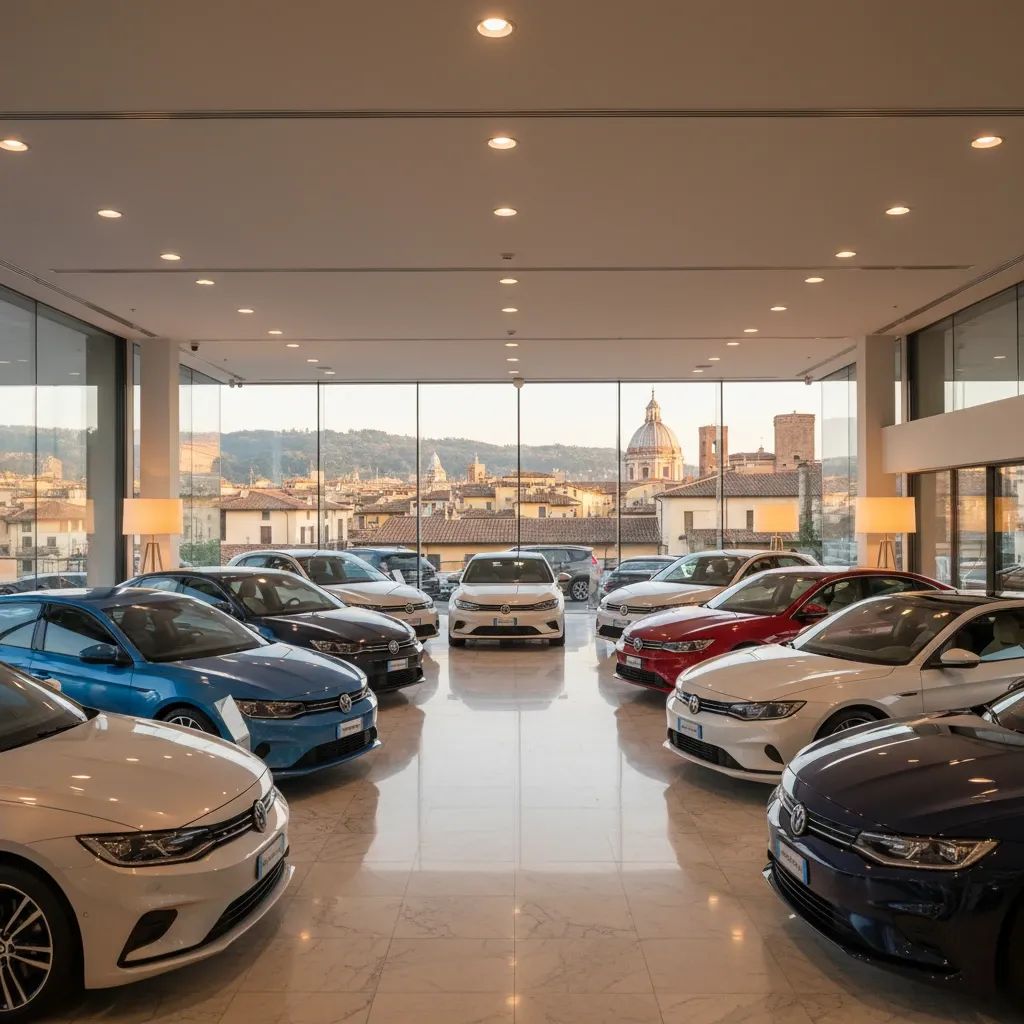
Italy's domestic auto sector posted 157,334 new registrations in February, marking a 14% climb compared to the same month last year—but scratch beneath the surface and the story becomes more complex, revealing a market propped up by short-term rentals, shifting subsidies, and a dramatic consolidation of power by Stellantis, which now commands over one-third of all sales.
Why This Matters
• Stellantis dominance: The Italian-French conglomerate nearly doubled the overall market growth rate, expanding its footprint to 34% market share versus 30.4% a year ago.
• Rental effect: Strip out short-term fleet registrations and the actual retail growth shrinks to roughly 9%, signaling weaker consumer appetite than headline figures suggest.
• Electric surge: Battery-electric vehicles (BEVs) jumped 80.5% year-on-year and captured 7.9% of February sales, fueled by income-capped subsidies worth up to €11,000 for households earning under €30,000 annually.
• Hybrids rule: More than half of all new cars sold last month carried some form of hybrid powertrain, while diesel slid to 6.5% share and gasoline fell to 20.2%.
Stellantis Tightens Its Grip
Stellantis delivered 53,592 units in February alone—a 27.7% increase—nearly twice the pace of the broader Italian market. Over the first two months, the group registered 100,108 vehicles, up 19.9%, lifting its cumulative share to 33.3% from 30.7% in the equivalent period of the previous year. When Leapmotor, a Chinese brand distributed through a Stellantis joint venture, is included, the combined footprint reaches 34%.
Fiat remains the single strongest nameplate, claiming 13.5% of the market in February with 21,269 registrations—a gain of 2.8 percentage points. The Fiat Panda—the refreshed version of the iconic model built at Pomigliano d'Arco—topped the sales chart with 12,603 units, followed by the Jeep Avenger and the Fiat Grande Panda, which added another 5,500 sales.
Other Stellantis marques showed mixed results. Opel jumped 32.4% to claim 2.55% share; Jeep edged up 4.6% to 4.31%; Alfa Romeo slipped slightly by 1.9% to 1.44%; while Peugeot contracted 3%, holding 4.72% of the market. Leapmotor posted a dramatic 2,196% surge to reach 5,006 units and a 3.2% slice, marking a historic breakthrough for the Chinese newcomer on Italian soil.
The Rental Reality Behind the Numbers
Dealers and industry analysts caution that the 14% headline growth overstates underlying retail demand. According to UNRAE (the national association of foreign auto importers), short-term rental companies accounted for a disproportionate share of registrations. Adjusted for this effect, retail growth would land closer to 9%—still positive but far less buoyant.
A February survey of concessionari (dealerships) found that 55% reported low foot traffic and disappointing order intake. Many cited elevated sticker prices, macroeconomic uncertainty, and confusion over the energy transition as headwinds. Despite government incentives, showroom visits have not translated into a sustained sales pipeline, raising questions about momentum in the quarters ahead.
Electrification Accelerates—With Caveats
Battery-electric vehicles climbed 80.5% to capture 7.9% of February's market, up from negligible volumes a year earlier. The spike traces directly to the MASE ecobonus scheme, which offers up to €11,000 for buyers with an ISEE (equivalent household income) below €30,000, or €9,000 for those under €40,000, provided an old vehicle is scrapped. Reservations opened in October, and many of those pre-bookings materialized as registrations in recent months.
Plug-in hybrids (PHEV) also gained traction, rising to 8.5% penetration, boosted by an expanding model lineup and revised fringe-benefit tax rules that favor low-emission company cars. Meanwhile, conventional full hybrids held 15.1% share and mild hybrids commanded 36.8%, together delivering a combined 51.9% of all February sales—a clear signal that Italian buyers favor electrified drivetrains even when pure battery power remains cost-prohibitive.
Conversely, traditional powertrains are declining. Diesel share fell to 6.5%, gasoline dropped to 20.2%, and LPG halved to 5.0%. This reshuffling reflects both tighter emissions standards and buyer anticipation of stricter urban access restrictions in major cities such as Milan, Rome, and Turin.
What This Means for Residents
For anyone living in Italy and considering a new vehicle, several practical takeaways emerge:
Timing matters: The current PNRR-funded ecobonus expires in June. After that, the government plans to redirect most automotive subsidies away from consumer rebates and toward industrial R&D, infrastructure, and retrofit programs. If you qualify by income, act before mid-year.
Hybrid sweet spot: With over half the market now hybrid, resale values for conventional petrol and diesel cars will likely soften further. Hybrid models offer broader urban access and better trade-in prospects.
Charging infrastructure lags: Although BEV sales are climbing, Italy has approximately 40% fewer public charging points per capita than the European average, according to UNRAE. Without accelerated rollout, range anxiety will cap electric adoption. Check local availability before committing to a full-electric model.
Price pressure persists: Dealers report that elevated transaction prices—even with subsidies—remain a barrier. Negotiate hard, especially toward month-end when sales targets loom.
The Road Ahead: Policy Pivot and Competitive Dynamics
From the current year through 2030, Italy's Ministry of Enterprise and Made in Italy has allocated roughly €1.6 billion to a new Automotive Fund. Unlike previous schemes, approximately €1.2 billion will flow to manufacturers for innovation, battery production, and supply-chain resilience, leaving only limited sums for direct consumer incentives. Post-June, expect targeted support for commercial light vehicles, L-category quadricycles, home wallbox chargers, social long-term rental, and retrofit kits for converting gasoline engines to LPG or methane—but no blanket rebates for passenger cars.
This policy shift reflects Rome's bet that industrial capacity, not point-of-sale subsidies, will secure Italy's position in the European automotive value chain as legacy combustion plants face obsolescence. It also aligns with Brussels' evolving stance: new EU rules may soon tie incentive eligibility to minimum thresholds of European content, further narrowing the field of qualifying models and potentially disadvantaging Asian imports.
Competitors are feeling the squeeze. Toyota matched the market's 14% growth to hold 7.1% share, while BYD surged 204.7% to claim 2.61%—a small but symbolically significant footprint for a Chinese pure-play. Across the broader European market, the Volkswagen Group saw mixed results, and Renault encountered headwinds with declining volumes.
Outlook: Stability, Not Euphoria
Industry forecasts suggest the market will remain on a modest growth trajectory, though it still trails pre-pandemic levels. Battery-electric and plug-in hybrid penetration is expected to inch upward by roughly one percentage point annually in coming years, assuming infrastructure investment keeps pace and subsidy uncertainty does not trigger another demand cliff.
For now, February's double-digit growth offers a veneer of confidence. Yet beneath the aggregate numbers lies a sector in flux: dominated by a single conglomerate, increasingly reliant on rental fleets, and navigating the messy middle stage of electrification—where subsidies expire faster than charging networks expand and where consumer wallets remain squeezed by inflation and stagnant wages. Those planning a purchase would do well to move decisively in the next four months, before the incentive landscape shifts again and the true cost of transition becomes unavoidable.


