
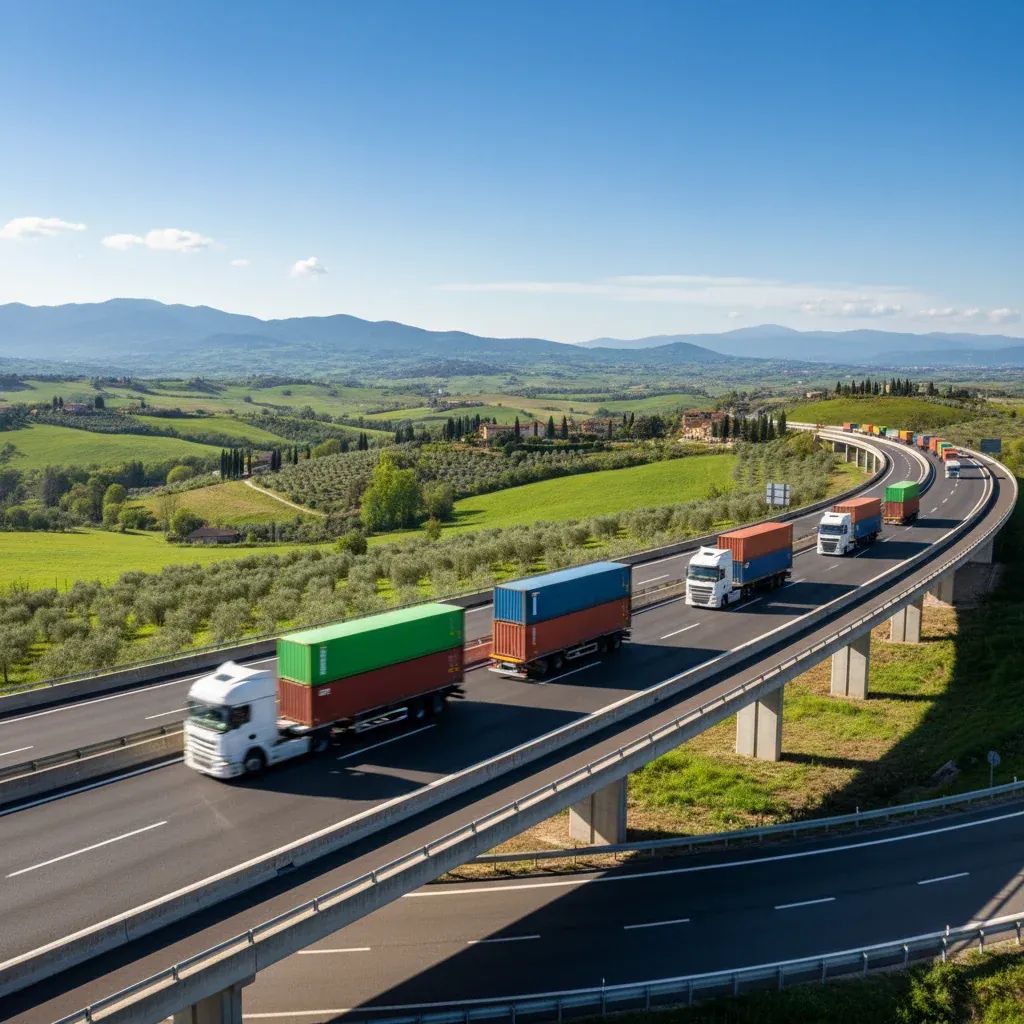
Italy's freight transportation network continues its overwhelming reliance on road haulage, with official Italy National Statistical Institute (Istat) data confirming that 92.1% of all domestic cargo—totaling 1.2 billion tonnes in 2024—moved by truck, while rail accounted for a mere 7.9% of total tonnage. This structural imbalance persists despite European Union targets to shift at least 30% of freight traveling over 300 kilometers to rail or waterways by 2030, highlighting the scale of the challenge Italy faces in meeting its Green Deal commitments while simultaneously delivering on promised bureaucratic relief for small businesses.
Why This Matters
• Environmental targets ahead: Italy's rail freight share (7.9% of tonnage in 2024) trails the EU average (17%) and countries like Austria (30%), placing decarbonization goals within a tighter window.
• Cost of inaction: Road dominance drives up logistics costs, congestion, and carbon emissions—factors that hit consumers and exporters alike.
• Bureaucracy windfall: A separate government decree cuts red tape for 800,000+ Italian enterprises, potentially saving each firm €1,500-2,000 annually and freeing up 30-50 hours previously consumed by paperwork.
• Infrastructure disruption ahead: Ongoing railway modernization work—part of the National Recovery and Resilience Plan (PNRR)—is expected to cause service disruptions through 2026, further straining rail freight operators.
The Road-Rail Divide in Numbers
Istat's 2024 transport survey documents the modal imbalance. Of the 1,205.1 million tonnes of terrestrial freight moved across Italy last year, the vast majority—1,110.5 million tonnes—traveled by heavy goods vehicle. Rail shifted just 94.6 million tonnes. When measured in tonne-kilometers (a metric combining weight and distance), the proportions shift: 86.9% of cargo-distance occurs on asphalt, with rail claiming 13.1%.
The divide becomes even sharper when distinguishing between domestic and international routes. For shipments confined to Italian territory, 96.8% of tonnage and 91.7% of tonne-kilometers rely on trucks. Rail, by contrast, is predominantly an international corridor: cross-border movements account for 62.3% of all rail freight tonnage in Italy, whereas for road transport, 97.6% of volume is purely domestic.
This pattern reflects structural constraints. Italy's rail network historically excels at long-distance, transnational freight—particularly intermodal containers moving between Northern European ports and Mediterranean terminals—but struggles to compete with trucks on shorter, last-mile routes within the peninsula.
Growth Trends Favor Asphalt Over Steel
Over the past decade (2014-2024), road freight volumes in Italy surged by 29.6%, more than double the 13.8% growth recorded for rail. Intermodal rail services—where containers shift seamlessly between truck and train—have expanded their share of the rail market from 45.8% in 2004 to 59.2% in 2024, yet this growth has not been enough to reverse the overall modal imbalance.
Within the EU27, Italy ranks fourth for rail freight (measured in tonne-kilometers, representing 6.1% of the bloc's total) and fifth for road freight (8.2% of the EU total). Germany leads in rail cargo at 33.2% of the European total, while Poland maintains a 20% rail modal share domestically—nearly double Italy's proportion.
The €2 Billion Bureaucracy Cut
While the freight sector grapples with modal shift challenges, Italy's Confederazione Nazionale dell'Artigianato e della Piccola e Media Impresa (CNA) welcomed a separate policy victory: the PNRR Decree, published in the Official Gazette on February 19, activates over 20 administrative simplifications affecting more than 800,000 small and medium enterprises, with potential benefits for over one million firms.
CNA calculates the measures will slash annual bureaucracy costs by approximately €2 billion, translating to savings of €1,500-2,000 per business. The decree is projected to reduce the average annual paperwork burden from 313 hours to 263 hours—a reduction of 30 to 50 hours per year per firm.
Key Simplifications for Business Owners
Signage permits: Businesses can now install storefront signs using a single Certified Notification of Commencement of Activity (SCIA) submitted to the municipal government, with a standardized national form replacing a patchwork of local requirements.
Data breach notifications: Micro-enterprises with fewer than five employees are exempt from notifying the Data Protection Authority (Garante per la protezione dei dati personali) for breaches involving non-sensitive information. A simplified self-assessment procedure replaces the old system, saving roughly €1,000 in compliance costs and 5-8 hours of administrative time.
Public procurement: Enhanced interoperability among government databases will reduce the number of documents contractors must submit when bidding for public tenders.
Hairdressers and beauticians: In cases of illness or verified health reasons, salon and spa owners may appoint a temporary technical manager holding the required professional qualification, avoiding the need to shutter the business during the owner's absence.
Freight haulage: Streamlined loading and unloading procedures are expected to cut waiting times by 30 hours annually, yielding savings of around €4,000 per operator.
CNA President Dario Costantini called the package "a principal reform the country, its businesses, citizens, and public administration all need," but cautioned that the simplification engine "must never stop." He noted that Italian firms still face a €40 billion annual bureaucratic burden and urged that every new regulatory requirement be paired with at least one offsetting simplification to prevent backsliding.
What This Means for Residents
For consumers and businesses in Italy, the dual realities of freight imbalance and bureaucratic reform create both risks and opportunities.
Freight costs and delivery times: The continued dominance of road transport keeps logistics costs elevated, particularly as fuel prices fluctuate and driver shortages intensify across Europe. Residents ordering goods or operating businesses dependent on timely deliveries may face persistent volatility in shipping rates and transit times.
Environmental compliance risk: Italy's lagging rail freight share presents a policy challenge for meeting EU climate targets. Should the country fall short of its 2030 modal shift goal, it could face financial penalties or reduced access to future EU infrastructure funding—costs ultimately borne by taxpayers.
Railway disruption through 2026: Approximately 4,000 construction sites are currently active across the national rail network, part of PNRR-funded modernization to bring Italian infrastructure up to European standards. These projects—while essential for long-term competitiveness—are causing repeated service interruptions, delays, and cancellations that undermine rail reliability. Freight operators report losing clients due to unpredictability, and industry observers expect conditions to remain challenging through late 2026 before improving in 2027.
Small business relief: Entrepreneurs and freelancers will directly benefit from reduced compliance burdens. The national standardization of procedures—especially for signage, data protection, and public procurement—removes friction points that previously consumed cash and time, potentially freeing resources for growth or investment.
The Green Deal Challenge
The EU's Green Deal and Sustainable and Smart Mobility Strategy set explicit targets: by 2030, at least 30% of freight traveling over 300 kilometers should move by rail or inland waterway, rising to 50% by 2050. The broader goal is a 90% reduction in transport emissions by mid-century.
Italy's current rail freight measured in tonnage stands at 7.9% according to Istat's 2024 data, though measured in tonne-kilometers the figure reaches 13.1%. Both metrics place Italy below the 17% EU average and well behind leaders like Austria (30%) and Germany (19%). The gap reflects how rail serves longer-distance and international corridors more effectively than short domestic hauls.
Why Rail Struggles to Compete
Cost disadvantage: Despite environmental benefits—one freight train replaces up to 50 heavy trucks on long-haul routes—intermodal rail remains more expensive than road transport for many shippers. Energy costs, access charges, and operational complexity erode rail's competitiveness.
Maxi-truck approval: Italy's recent authorization of Longer Heavier Vehicles (LHV)—trucks up to 25 meters long and 60 tonnes—further tilts the playing field toward road haulage by reducing per-unit trucking costs, undermining incentives to shift freight to rail.
Infrastructure gaps: Only 40% of Italian ports have direct rail connections, and fewer than one-third of airports are linked to the rail network. "Last-mile" and "penultimate-mile" rail access to industrial zones remains inadequate. Many lines cannot accommodate the 740-meter-long trains that are standard across Europe, and numerous tunnels lack clearance for 4-meter-high semitrailers on flatcars.
Funding cuts and uncertainty: The government reduced the "loco-carri" incentive—earmarked for rolling stock renewal—by approximately €70 million, forcing companies to revise investment plans. While the Ferrobonus portuale (a port rail incentive) was made permanent through December 31, 2030, providing €30 million over five years to subsidize rail switching operations at Italian ports, broader support mechanisms have faced intermittent cuts and suspensions.
International disruptions: Closures and capacity reductions at critical Alpine crossings—such as the Frejus rail tunnel (Valico di Modane) and the Gotthard Base Tunnel—have caused traffic to France to plunge 38.5% and highlighted the vulnerability of Italy's freight corridors.
What Comes Next
Italy's dual policy tracks—freight modal shift and bureaucratic simplification—will shape the business environment over the coming years. For the simplification package, the CNA has emphasized that maintaining momentum is essential: every new regulatory obligation should trigger at least one offsetting simplification to prevent the €40 billion bureaucratic burden from rebounding.
On the freight front, the Ferrobonus portuale offers a template for targeted intervention, but achieving the 2030 Green Deal target will require far more aggressive investment in rail infrastructure, rolling stock, and last-mile connections. The window for action is narrowing: with rail service disruptions expected to persist through 2026, the sector faces a critical test of whether modernization efforts will yield the reliability gains needed to lure cargo off the highways and onto the tracks.
For businesses and residents navigating Italy's logistics landscape, the takeaway is clear: road will remain the primary freight mode for the foreseeable future, with all the cost, congestion, and environmental trade-offs that entails. The bureaucracy cuts, meanwhile, offer tangible near-term relief—provided the government resists the temptation to pile new requirements onto the statute books.


