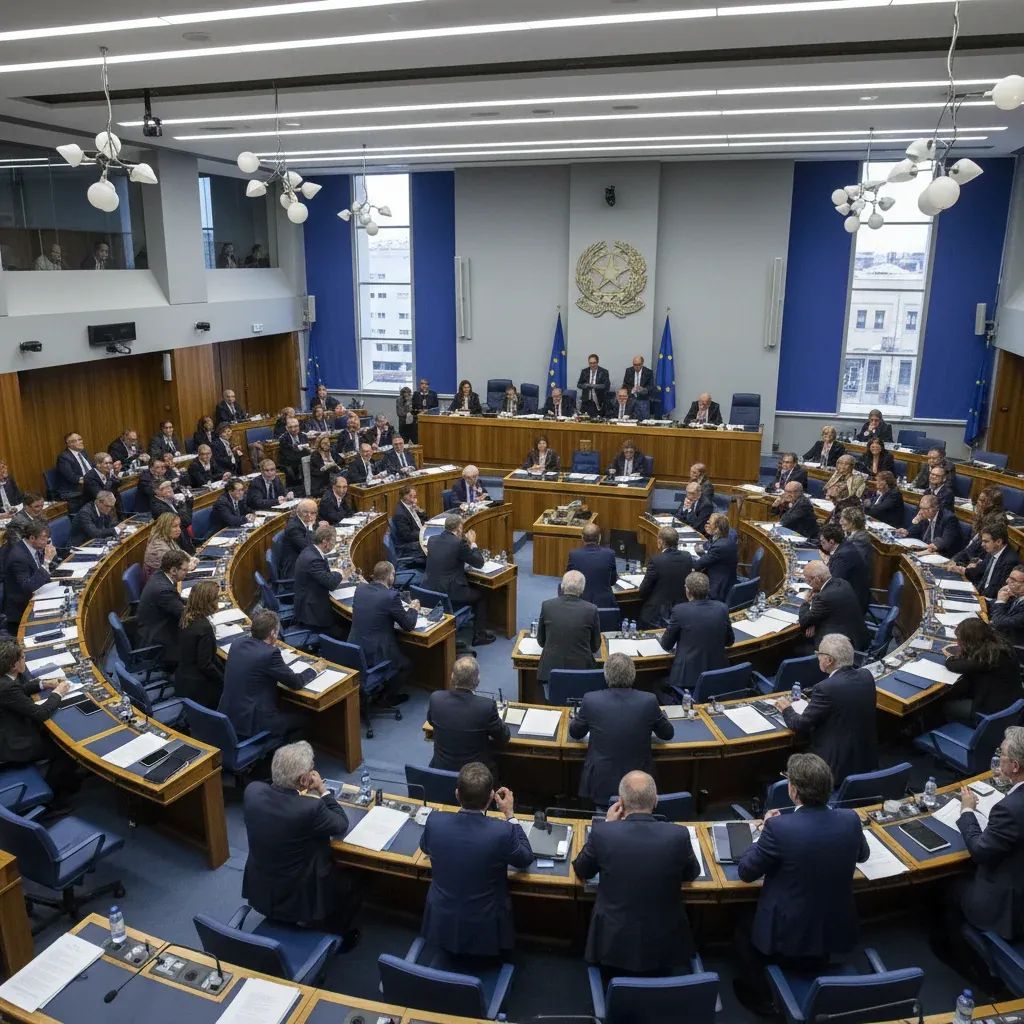
Italy's Coalition Confronts a Critical Test: Energy Windfall at Risk from Internal Divisions
The Italian government has secured approximately €7 billion annually for clean energy investments through 2028 from Brussels—a significant fiscal reprieve—precisely as its ruling coalition splinters over vaccine policy, electoral architecture, and self-defense liability. The convergence reveals a fundamental challenge: even with fresh European money available, the center-right alliance struggles to maintain cohesion to translate policy ambition into law. For residents, the stakes are immediate: whether this energy funding actually reaches households through efficiency programs depends entirely on political stability over the next four months.
Why This Matters for Residents:
• The European Commission approved energy spending flexibility (€7 billion annually through 2028) that offers Italy concrete tools to fund household efficiency upgrades—heat pump installations, building insulation, smart meter deployment—but only if the coalition remains functional long enough to deploy it. The government has signaled intent to channel funds into targeted rebates rather than blanket price caps, which means eligibility thresholds and application timelines will determine who benefits.
• A bill enabling radiati healthcare workers (approximately 2,000 professionals struck off the register for refusing COVID-19 vaccination) to petition for reinstatement has stalled after a clash between the Health Minister and his undersecretary, exposing serious cracks between Fratelli d'Italia and coalition partners. For patients, the practical concern is modest on the surface—fewer than 2,000 striking cases occurred—but if reintegration proceeds without clear professional standards, it could undermine public confidence in healthcare providers.
• The new electoral law, scheduled for Senate votes this summer, faces opposition accusations of trading southern economic equity for northern autonomy. This matters for residents because enhanced regional autonomy provisions could shift national healthcare funding allocation and social service competencies to individual regions, creating potential disparities in benefits availability across the country.
The Energy Gambit: Brussels Offers Buffer, Implementation Is Precarious
When Prime Minister Giorgia Meloni convened coalition leaders at Palazzo Chigi in July 2026, energy spending dominated the official agenda. The substantive issue is significant: the European Commission has restructured emissions trading rules and carbon adjustment mechanisms in ways that create both relief and pressure for Italy's energy-intensive industries.
The energy flexibility package—that €7 billion annual cushion—represents Italy's main diplomatic victory. The mechanism permits member states to allocate approximately 0.3% of annual GDP specifically for energy infrastructure and household efficiency measures. The rules explicitly prohibit using funds for fossil fuel subsidies or untargeted cash transfers. Rome has signaled intent to invoke this flexibility in 2027–2028, likely channeling money into targeted programs rather than direct price relief.
For residents, here's what this means practically: The government is expected to deploy funds through competitive rebate programs for heat pump installations (targeting households replacing gas heating), insulation grants for building retrofits, and grid modernization. Based on similar EU programs in Germany and France, heat pump rebates typically cover 30-50% of installation costs, with income thresholds limiting eligibility to households below €60,000-€80,000 annual income. Applications are usually processed through regional environmental agencies. However, because the coalition is fractious, timeline delays and funding allocation disputes are probable. Whether that money reaches ordinary Italians or flows primarily to corporate coffers depends on which faction controls spending decisions as autumn budgeting intensifies.
The Italian administration is simultaneously pressing Brussels for steeper industrial concessions, fearing its manufacturing base will lose competitiveness during the energy transition. Rome obtained €3.6 billion in dedicated compensation for energy-intensive firms to offset indirect carbon costs—designed to prevent industrial flight to non-EU jurisdictions. This industrial support is likely to proceed regardless of coalition stability because it requires EU coordination, not domestic parliamentary approval. For residents employed in energy-intensive manufacturing (chemicals, steel, ceramics), this support may translate into job preservation, though wage pressure will likely remain.
The Vaccine Reintegration Stalemate: When Health Policy Becomes Coalition Arithmetic
The July 2026 debates carried an unspoken tension: a bill to allow radiati medici—approximately 2,000 healthcare professionals struck off the register for refusing COVID-19 vaccination during the pandemic—to petition for reinstatement has been abruptly pulled from parliamentary consideration.
The amendment, authored by Fratelli d'Italia Deputy Alice Buonguerrieri, had cleared initial committee review. It establishes a 60-day window during which radiati practitioners can apply for reiscrizione (re-registration) if their administrative cases remain pending or if associated criminal convictions have been rehabilitated. Crucially, the bill does not mandate automatic restoration—it simply reopens the door to appeal.
Opposition parties—PD, M5S, Alleanza Verdi e Sinistra, Italia Viva, Azione, and +Europa—reacted with unified criticism, arguing the measure retroactively legitimizes anti-vaccine ideology within the medical profession. Major medical bodies, including the National Federation of Doctors' Orders (Fnomceo) and the Italian Society of Internal Medicine (SIMI), expressed concerns that the move violates professional standards and erodes public confidence in evidence-based medicine.
The coalition fracture, however, cuts deeper than partisan opposition. Health Minister Orazio Schillaci—a physician and technocrat—declined to endorse the amendment. Simultaneously, Undersecretary Marcello Gemmato defended it publicly in committee. Forza Italia has quietly signaled skepticism about the bill's scientific and political viability. Most significantly, the Quirinale (President Sergio Mattarella's office) has requested Schillaci's formal assessment—a procedural move signaling potential presidential concern if the measure advances.
For healthcare consumers, the practical stakes are modest on the surface: fewer than 2,000 striking-off cases occurred nationwide, and most were concentrated in Lombardy and Lazio. Patient access to primary care physicians remains largely unaffected. However, if reintegration proceeds without clear professional vetting standards, patients cannot confidently assess whether a physician underwent retraining before re-entering practice. Regional variations would matter: in areas with physician shortages (parts of southern Italy and smaller regions), reintegrated doctors might address access gaps; in regions with adequate staffing, the policy change may primarily benefit individual practitioners seeking reinstatement. The deeper import concerns political stability. If the bill resurfaces and passes over Schillaci's objections and presidential hesitation, it demonstrates Fratelli d'Italia's ascending dominance and the Health Ministry's declining veto power—a sign of potential governmental instability. If it dies quietly, the inverse holds true.
Electoral Architecture Advances Amid Regional Autonomy Concerns
The Italy Chamber approved a new electoral system in July 2026, sending it to the Senate this summer. The system awards a 70-seat bonus in the Chamber and 35 in the Senate to any coalition or party clearing 42% of the vote; absent that threshold, seats distribute proportionally.
The reform largely eliminates single-member districts outside Italy's special autonomy regions (Valle d'Aosta, Trentino-Alto Adige), replacing them with multi-member constituencies and blocked party lists.
Opposition leader Elly Schlein of the PD has repeatedly branded the package linked to the regional autonomy reform, which grants enhanced fiscal and administrative authority to northern regions. She argues the coalition is simultaneously advancing regional autonomy provisions that may shift healthcare funding and social service competencies to individual regions.
For residents, the practical concern is regional inequality: Enhanced autonomy for wealthy northern regions (Lombardy, Veneto, Piedmont) could create fiscal divergence. If northern regions gain independent healthcare financing authority and invest heavily in preventive services and specialty care, while central government maintains reduced compensatory investment in southern regions, healthcare access and quality may diverge geographically. Similarly, regional autonomy over education, housing, and employment services could create patchwork eligibility rules. Whether decentralized authority strengthens regional economies or exacerbates North-South disparities depends on implementation and whether the central government maintains robust investment in lagging areas. Currently, no firm commitments on compensatory funding have been announced.
The electoral law must pass the Senate by late summer to apply to 2027 general elections.
Security and Self-Defense: FdI Expands Crime Victims' Legal Shield
Running parallel to energy and vaccine rows, Fratelli d'Italia formally unveiled a bill targeting civil liability in self-defense scenarios. The legislation would prohibit crime victims from paying damages to perpetrators—a principle already embedded in Italy's legal code but frequently circumvented through judicial discretion.
The legislation targets scenarios in which homeowners or shopkeepers who wound intruders during burglaries are later sued for "excessive force" and forced to settle or lose in court. FdI Chamber leader Galeazzo Bignami framed the bill as clarifying existing protections, noting the civil code theoretically provides such shields but court interpretation has repeatedly forced victims into costly liability.
Deputy Prime Minister Matteo Salvini, speaking in July 2026, separately announced the League is preparing a broader "difesa sempre legittima" (always-legitimate defense) bill designed to account for the psychological state of victims confronting armed threats. The proposal aims to update 2005's self-defense protections to factor in threat perception and fear, rather than demanding absolute proportionality of response.
For residents, the practical effect would be narrower grounds for countersuit after a crime victim exercises force. However, crime victimization rates in Italy remain relatively stable (property crime has declined over five years; violent crime is low compared to other EU countries), so direct impacts on most households are limited. The primary significance is political: the proposal signals the government's prioritization of victim advocacy and public safety messaging, though legislative impact remains uncertain given judicial review concerns.
What This Means for Residents: Conditional Optimism with Institutional Risk
For ordinary Italians, the takeaway is conditional optimism mixed with institutional anxiety. The energy windfall from Brussels offers concrete leverage for targeted efficiency improvements. Residents should watch for announcement of heat pump rebate programs, insulation grant timelines, and income eligibility thresholds—these will signal genuine deployment of funds. If the government fractures before autumn budgeting, deployment timelines will slip.
The vaccine reintegration stalemate reveals internecine friction. If the bill resurfaces and passes, it represents coalition instability. If it dies quietly, political unity has held. Either outcome affects government productivity on energy deployment and infrastructure rollout.
The electoral reform's fate signals whether the coalition can align around institutional interests or whether partisan motives override pragmatism. Its passage would confirm coalition durability; failure would indicate fracturing.
The autonomy-versus-equity framing of regional reform touches on genuine concerns about north-south economic divergence. Residents in southern regions should monitor whether compensatory central government investment accompanies northern autonomy expansion. Without explicit funding transfers from north to south, regional inequality could widen.
Baseline: Coalition Durability Over Autumn Determines Energy Implementation
The stacked challenges—energy deployment logistics, vaccine policy compromise, electoral law finalization, and autonomy pre-intese negotiations—converge at a moment when legislative cohesion becomes critical. The coalition must navigate September and October without fracturing, or risk early elections under untested electoral rules.
Residents' practical experience hinges on whether the government translates its European energy windfall into voter-facing relief before internal contradictions destabilize governance. The €7 billion fiscal flexibility buys time, but only if political unity endures long enough to deploy it effectively through rebate programs, efficiency grants, and industrial support. For most households, the difference between a functioning coalition and a fractious one will materialize in 2027–2028 either as concrete rebate funding or delayed implementation.