
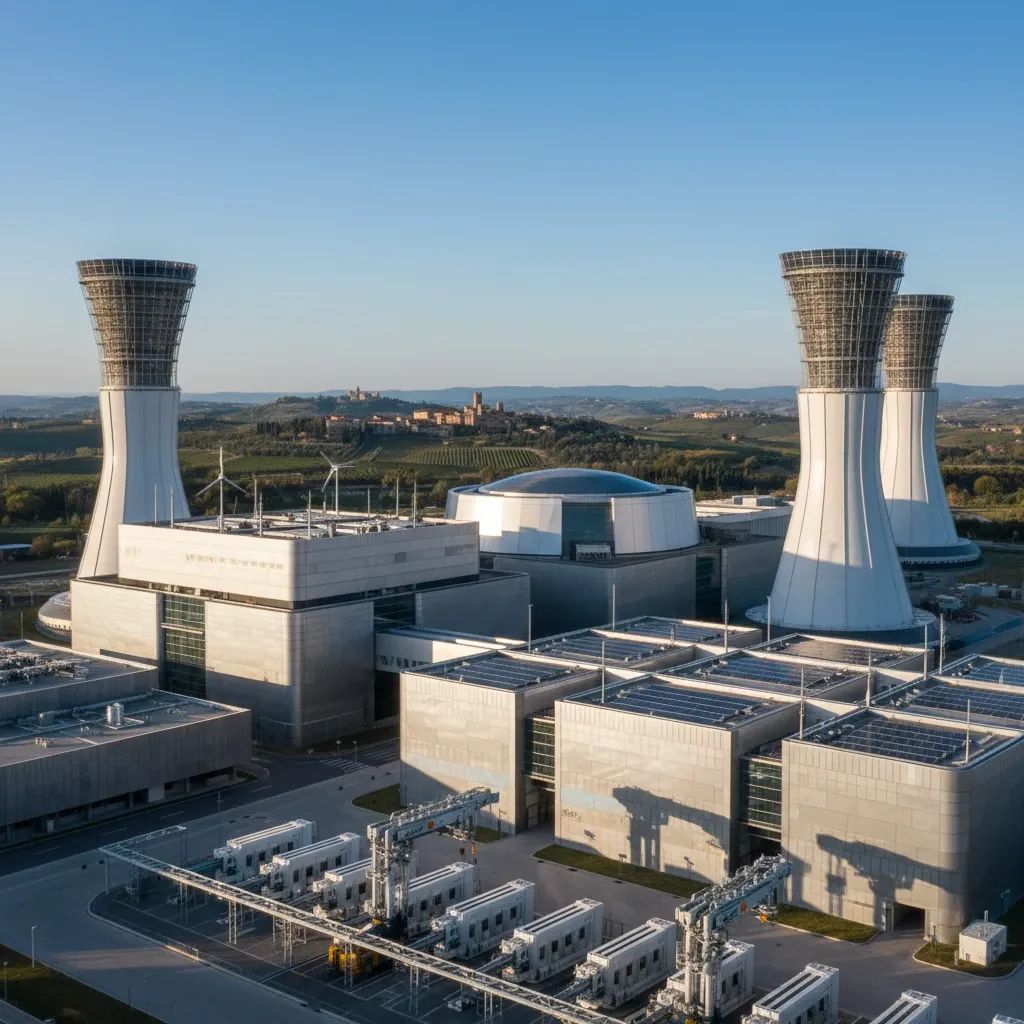
The Italian Chamber of Deputies has begun debating a framework law that could bring nuclear power back to Italy for the first time in nearly four decades, with a final vote expected next week. The government intends to pass the legislation before the summer recess, setting in motion a timeline for implementing decrees by year's end—a plan that has ignited fierce debate over costs, timelines, and whether the country should be resurrecting a technology twice rejected by Italian voters.
Why This Matters:
• Framework vs. reality: The bill grants the government authority to enact nuclear regulations via decree, but critics warn nuclear plants won't be operational until the 2040s at the earliest.
• Municipal opt-in: Municipalities can volunteer to host next-generation reactors, a provision designed to avoid territorial conflicts but raising concerns about economically fragile towns accepting facilities for financial incentives. Residents in potential regions—Lazio, Basilicata, Sardinia, Piedmont, Sicily, and Puglia—may see their municipalities approached for potential site studies, though no formal process has begun.
• Budget allocation: Just €20M annually for 2027–2029 is earmarked for infrastructure, an amount opposition parties characterize as symbolic rather than industrial.
• Referendum shadow: Two past referendums (1987, 2011) said no to nuclear; opponents are already discussing a third abrogative vote if the law passes.
How Italy Lost—And May Regain—Its Nuclear Industry
Italy once operated four nuclear reactors, but shut them all down following the 1987 referendum triggered by the Chernobyl disaster. A second referendum in 2011, held in the wake of Fukushima, reaffirmed public opposition. Since then, the country has relied on natural gas imports—primarily from Russia—and an expanding but still insufficient renewable energy sector.
The current bill, introduced by Prime Minister Giorgia Meloni's Cabinet and the Ministry of Environment and Energy Security, does not authorize construction of specific plants. Instead, it functions as an enabling law, delegating to the government the power to regulate next-generation nuclear technologies—including small modular reactors (SMRs) and fusion research—through subsequent decrees. Minister Gilberto Pichetto Fratin has described the legislation as "an important step toward a more secure, sustainable, and independent energy future."
The measure was submitted to the Chamber on October 17, 2025, and completed committee review on May 20, 2026. Four lawmakers from the ruling coalition parties serve as rapporteurs: Giampiero Zinzi (Lega) and Riccardo Zucconi (Fratelli d'Italia) for the Environment Committee, alongside Ilaria Cavo (Noi Moderati) and Luca Squeri (Forza Italia) representing the Industry Committee.
What This Means for Residents
If passed, the law will not result in any immediate construction. Rather, it opens the door for regulatory frameworks governing site selection, safety standards, waste management, and supply chain development. The government has allocated €6M for 2026 (with €1.5M already spent in 2025) for public information campaigns—a figure the opposition characterizes as insufficient for genuine public engagement.
One of the most contentious provisions allows municipalities to self-nominate as potential sites for nuclear facilities. Proponents argue this respects local autonomy and avoids top-down imposition. Critics, however, warn it could incentivize cash-strapped towns to accept reactors in exchange for subsidies, without proper consultation or environmental safeguards. No municipality has officially volunteered yet, but previous technical studies by Italy's National Research Council identified potential zones in Lazio, Basilicata, Sardinia, Piedmont, Sicily, and Puglia.
Another amendment that failed during committee review sought to limit nuclear use to civilian purposes only. Its rejection has alarmed environmental and left-leaning parties, particularly Alleanza Verdi e Sinistra (AVS), who have raised concerns that the government could pursue military applications, though officials have not indicated such plans.
Opposition Mobilizes Around Cost and Timing
The Five Star Movement (M5S), Democratic Party (PD), and AVS have mounted a coordinated critique centered on three pillars: exorbitant costs, glacial timelines, and the unresolved problem of radioactive waste.
Opposition lawmakers point to Flamanville-3 in France as a cautionary tale. The reactor, which began construction in 2007, remains incomplete and has ballooned to €13B in costs—more than ten times initial estimates. Similarly, the Hinkley Point project in the United Kingdom, launched between 2018 and 2019, has seen its price tag swell from £25B to £33B (approximately €38B).
According to International Energy Agency (IEA) data, the levelized cost of electricity (LCOE) for new nuclear plants in Europe stands at roughly $170–$220 per megawatt-hour (MWh), compared to about $50/MWh for solar and $60/MWh for onshore wind. For context, these cost differences could translate to variations in household electricity rates, though the impact would depend on Italy's final energy mix and regulatory decisions. Critics argue that diverting public funds to nuclear—particularly unproven SMR technology—will starve renewable energy projects that can deliver power far sooner and more affordably.
Italy also remains without a national repository for radioactive waste. The country is still working to identify a permanent storage site for legacy waste from its shuttered reactors, a process that has dragged on for years. Introducing new reactors, opponents say, compounds an already unsolved problem.
Europe's Nuclear Renaissance—And Its Growing Pains
Italy is not alone in reconsidering nuclear. The European Union included nuclear in its sustainable investment taxonomy in July 2022, and the European Commission recently committed €330M to advanced reactor research, including SMRs and fusion. Twelve EU member states operate nuclear reactors, and an Industrial Alliance for Small Modular Reactors was launched in February 2024, with Italy joining as an observer.
France leads the charge, pledging over €100M to revitalize its nuclear sector. The United Kingdom is betting on SMRs to bolster energy security. Poland and Romania are exploring their first reactors, while Finland successfully connected the Olkiluoto-3 reactor to the grid in 2022 after a 17-year construction saga.
However, the experience across Europe has been sobering. The median construction time for reactors commissioned in 2022 was 89 months (about 7.5 years), but major projects in Western Europe have taken far longer. Regulatory complexity, loss of construction expertise, and supply chain bottlenecks have all contributed to delays.
China and South Korea have managed faster builds—some reactors completed in 3 to 5 years—but European nations have struggled. Even optimistic projections suggest Italian reactors could not come online before the mid-2040s, by which point renewable capacity may have expanded significantly.
The Referendum Wildcard
Perhaps the most volatile element is the prospect of a third referendum. Italy's constitution allows citizens to hold abrogative referendums on existing laws, and opposition parties have signaled they may pursue this route if the legislation passes. Both previous referendums resulted in rejection of nuclear power, and opposition parties believe a third vote could have similar results.
The government has not proposed holding a consultative referendum before moving forward, a decision opposition lawmakers characterize as dismissive of popular will.
Timeline for Residents
For residents monitoring this issue, here is what to expect:
• 2026 - Framework law passed (expected)
• 2027-2029 - Regulations developed and implementing decrees drafted
• 2030s - Potential site selection and formal planning processes
• 2040s - Earliest possible reactor operation
What Happens Next
The Chamber of Deputies is expected to vote by early June. If the bill passes, it moves to the Senate. Government leaders aim to have the legislation signed into law before the August recess, enabling the Cabinet to draft the first set of implementing decrees by December 2026.
Those decrees will define licensing procedures, environmental review standards, and the role of national and European supply chains. Notably, the Ministry of Defense will participate in drafting these measures, a provision that has added fuel to concerns about dual-use applications.
For residents, investors, and businesses, the immediate impact is limited. No sites will be selected, no construction contracts awarded, and no reactors built for at least another decade. What the law does is reopen a legal and regulatory pathway that has been closed since the 1980s. Whether Italy ultimately builds a single reactor will depend on public opinion, municipal cooperation, financing arrangements, and the pace of renewable energy development in the meantime.
The debate in the Chamber has only just begun—but the battle over Italy's energy future is likely to extend well beyond the parliamentary chamber.


