
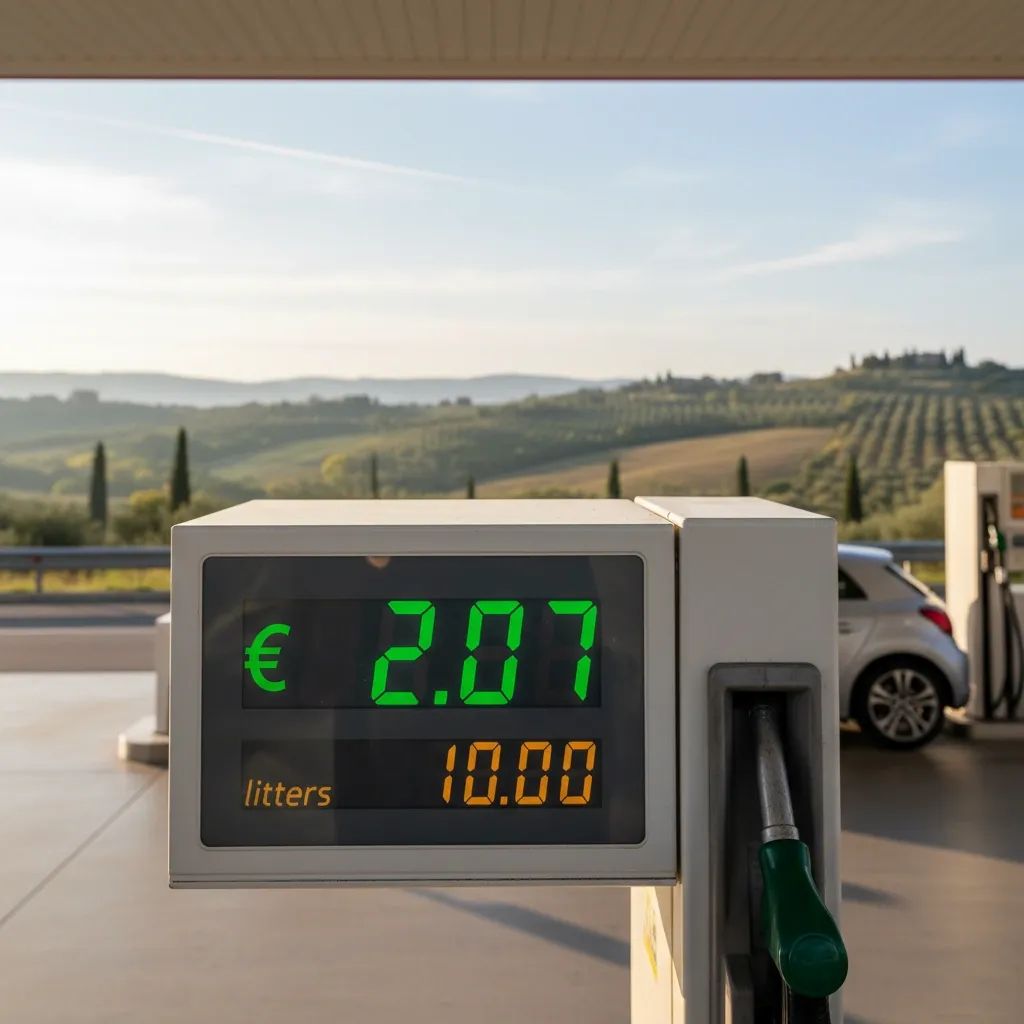
Italy's pump relief is about to change shape. After weeks of horizontal cuts—uniform reductions applied equally to all fuel types regardless of price movements—the Italian government is preparing a narrower lifeline: an excise reduction targeted mainly at diesel. This shift reflects a market where diesel and gasoline have finally reversed their traditional relationship, with diesel now commanding a significant price premium for the first time in three years.
Why This Matters:
• Diesel now costs more than gasoline — a reversal driven by geopolitical tension and the 2026 budget's tax realignment, making targeted relief a logical policy adjustment.
• Shorter extensions ahead — the government is considering extensions that could be shorter than previous multi-week windows, though officials have not yet confirmed the precise duration.
• The €500M question — each extension strains public finances; targeted approaches aim to maximize relief impact without unsustainable fiscal costs.
• May 1 deadline — the current 24.4-cent-per-liter cut expires Thursday, creating urgency for government action.
The Diesel Flip: Understanding What Changed in Italy's Fuel Market
For decades, Italians enjoyed cheaper diesel than gasoline—a deliberate policy choice encoded in tax law. Trucks, taxis, and rural commuters benefited from this subsidy, making diesel the fuel of necessity rather than luxury. That calculus changed dramatically in early 2026.
The 2026 Budget Law abolished preferential diesel taxation, aligning both fuels under the same excise structure for the first time. Simultaneously, crude oil disruptions tied to Middle East volatility sent wholesale prices rising unevenly. Diesel absorbed the larger increase.
By late March, self-service gasoline in Italian cities ranged between €1.78 and €1.80 per liter. Diesel, meanwhile, had breached €2.00 in most regions—with highway pricing exceeding €2.10. The price divergence was sharp: wholesale diesel prices spiked 16% in a single week during early March, catching logistics operators and agricultural producers off guard.
For a typical 50-liter tank, the gap now translates to roughly €23 more for diesel drivers compared to spring 2025, according to consumer research group Codacons. Over a year, that premium amounts to over €200 in additional direct costs for households relying on diesel vehicles.
Why the Government Is Recalibrating Its Approach
Prime Minister Giorgia Meloni used a Tuesday press conference to signal a policy shift. The government, she explained, is "following the negotiating table" to assess crude price trajectories and fiscal capacity. Rather than extending uniform relief, officials are evaluating "a further extension" that could be "shorter than previous ones" and weighted toward diesel. Meloni explicitly noted that the government "has not yet defined the precise timing" of any extension.
Her reasoning was straightforward: blanket cuts no longer match market reality. Diesel has suffered proportionally more, so directing relief toward it produces "a better distributed impact" than spreading relief equally across two diverging fuel prices.
This marks a significant acknowledgment that horizontal subsidies—applied uniformly to all fuels regardless of their individual price trajectories—may not represent optimal policy. The shift signals growing recognition that the blunt-instrument approach Italy has deployed since the Draghi government first slashed excises in March 2022 following Russia's invasion of Ukraine needs refinement.
Meloni offered no specifics on timing or magnitude. Formal guidance from the Italy Revenue Department (MEF) has not yet been released. Her comments indicate action is under consideration before May 1, when the current reduction expires.
What This Actually Costs Italy—And Where the Money Comes From
Each excise extension drains approximately €500M from state coffers. Multiple renewals since 2022 have accumulated public debt exceeding €1B, creating fiscal pressure for an administration already constrained by EU deficit rules.
The government has funded these measures through multiple channels: excess VAT revenue generated at elevated pump prices, proceeds from EU carbon credit auctions (the ETS system), and reduced discretionary spending across various budget lines. Opposition politicians have flagged these trade-offs as consequential—directing resources to fuel relief while constraining spending in other areas.
Italy's Tax Structure and Enforcement
Italy's excise tax design creates layered costs for consumers. The base excise is approximately €0.7284 per liter for both fuels, but 22% VAT applies to this excise amount itself, creating compound taxation. When global crude rises, this layered structure amplifies the impact at retail pumps.
The Italy Financial Police (Guardia di Finanza) operates a "Mister Prezzi" price-monitoring initiative to detect speculative behavior at retail stations. However, these efforts address symptoms rather than structural issues: Italy maintains some of Europe's highest fuel taxation, with excises and VAT combining to account for 57–60% of final pump prices. Even with relief measures, Italian drivers face premium costs compared to neighboring countries.
The Cascading Effect: Why Fuel Costs Matter Beyond the Gas Station
Italy's freight ecosystem depends almost entirely on diesel. Roughly 86% of merchandise moves by road, making truck fuel prices a direct factor in inflation across groceries, manufactured goods, and services. When diesel prices rise, that cost permeates supply chains, reaching grocery shelves and utility invoices within weeks.
Codacons calculated that during the spring holiday period (April 25–May 1), Italians collectively spent €1.43B more on fuel compared to the same window in 2025. That expenditure represented resources diverted from other household spending—money that otherwise would have circulated through retail, hospitality, and personal services.
The agricultural and fishing sectors face particular vulnerability. Diesel powers irrigation systems, tractors, and fishing vessels; a modest 25-cent-per-liter increase translates to roughly €9,000 annually for a single heavy-duty vehicle, with larger operations facing exponentially higher costs. The government has deployed temporary tax credits to cushion impacts, though industry groups warn that temporary measures cannot substitute for structural reform.
For the trucking industry, the arithmetic is direct. A small logistics firm operating five commercial trucks faces annual fuel bill increases exceeding €45,000 under current market conditions. National carriers managing fleets of hundreds of vehicles absorb six-figure costs. While excise cuts provide temporary relief, the unpredictable duration of extensions creates planning challenges—operators cannot reliably commit to long-term pricing strategies when government relief expires without clear renewal timelines.
What Happens After May 1: The Countdown Clock
As of April 28, the current excise reduction—formalized via Decree-Law No. 42 of April 3, 2026—expires at midnight on May 1. Without renewal, pump prices will increase as excises revert to standard rates and corresponding VAT charges reinstate.
Meloni's indication that an extension is under active consideration suggests the government intends to prevent a price cliff, but the structure of that extension remains undetermined. Diesel-weighted relief represents a meaningful departure from the uniform approach used since 2022.
The real unknown is crude market behavior. If global tensions ease and barrel prices retreat, the government may conclude that relief is no longer necessary. If geopolitical friction persists, political pressure for renewed extensions will intensify. The next few weeks will be decisive both for markets and for Italian household budgets heading into summer.
What Residents Should Monitor
When will the decision be final? The government is expected to announce its decision before May 1, but watch official sources for updates as the deadline approaches.
Where to find official announcements: Monitor the Ministry of Economy and Finance (MEF) official website (www.mef.gov.it) and the Revenue Department (Agenzia delle Entrate) for formal decrees and guidance.
For diesel drivers: If targeted relief is implemented, the reductions will apply automatically at the pump—no claims or applications required. Monitor pump price displays to confirm reductions are reflected.
For households: Any extension details, duration, and magnitude will be announced officially. Current pump prices in your region serve as a baseline for comparison.
For residents, the essential takeaway is this: relief is being actively considered, but reconfigured and likely narrower than previous approaches. The government is racing against a May 1 deadline to finalize its decision. Any changes will take effect through automatic pump price adjustments once formally announced.


