
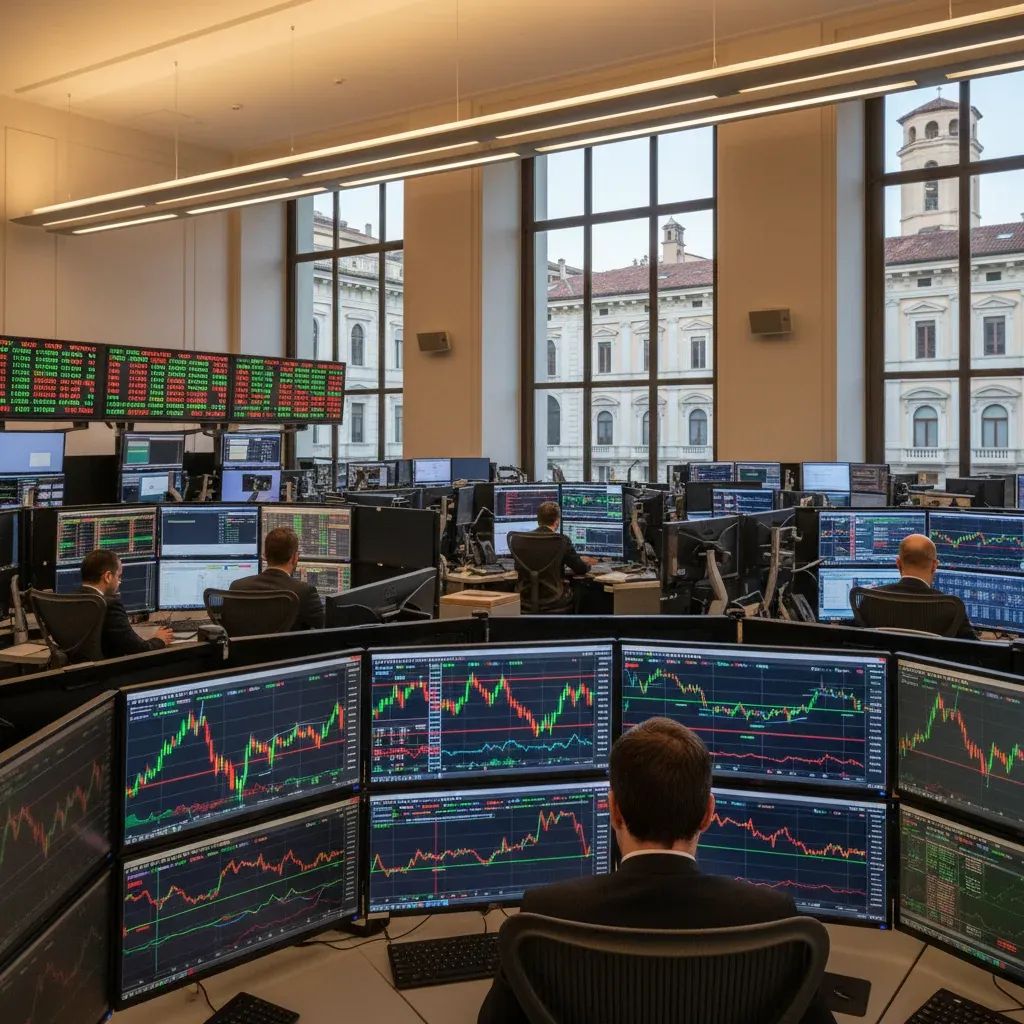
Italy's stock exchange has closed the first trading session of the week in positive territory, climbing 0.27% to 52,959 points on the FTSE MIB index, even as broader European markets struggled with direction and tech stocks faced renewed pressure. The divergence underscores a shift in investor sentiment favoring defense and industrial equities over high-valuation AI-linked shares, particularly as Fincantieri surged 11.4% following a transformative €600M acquisition spree in the underwater technology sector.
Why This Matters
• Defense stocks are soaring: Fincantieri, Leonardo, and Avio posted double-digit or high single-digit gains as military spending accelerates amid geopolitical tensions.
• Tech sector under pressure: AI-linked stocks like Prysmian dropped 2%, reflecting regulatory concerns and profit-taking after months of rallies.
• Energy prices stabilizing: Oil and gas declined as Strait of Hormuz flows resumed normally, easing earlier supply fears.
• Banking consolidation: Banco BPM jumped 2.15% after Crédit Agricole raised its stake above 29%.
Italy Outperforms as Europe Stumbles
While Piazza Affari notched modest gains, the broader European session closed in mixed fashion. Paris's CAC-40 slipped 0.33% to 8,479 points, London's FTSE-100 fell 0.26% to 10,651 points, and only Frankfurt's DAX managed a thin 0.15% advance to 25,817 points. The pan-European STOXX 600 shed a quarter of a percentage point, weighed down by weakness in technology and energy-related names.
Across the Atlantic, Wall Street opened with optimism: the Dow Jones added 0.22% to 53,019 points, the Nasdaq jumped 0.81% to 26,049 points, and the S&P 500 gained 0.44% to 7,517 points. The contrast suggests that U.S. investors remain confident in AI-driven growth narratives, while European markets are pricing in regulatory headwinds and elevated interest rate uncertainty.
Fincantieri's Strategic Leap Fuels Defense Rally
Italy-based shipbuilder Fincantieri delivered the session's standout performance, rocketing 11.4% after unveiling plans to acquire four specialized underwater technology companies: Next Geosolutions, WSense, Graal Tech, and Defcomm. The approximately €600M investment aims to create the first vertically integrated operator in the underwater domain, spanning everything from autonomous drones to subsea communications and geoscience services.
This move is designed to accelerate Fincantieri's growth trajectory, with the underwater business segment projected to generate significant revenue and earnings growth. The acquisitions are expected to meaningfully boost the group's profitability and per-share metrics over the coming years.
Leonardo followed suit with a 4.55% gain, and Avio climbed 2.61%, both benefiting from rising European defense budgets as NATO members expand military procurement in response to ongoing conflicts in Ukraine and heightened tensions in the Middle East. Defense spending across NATO remains elevated as members modernize military capabilities and equipment procurement.
Tech and AI Stocks Face Regulatory and Valuation Pressures
On the opposite end of the spectrum, shares tied to artificial intelligence and tech infrastructure retreated sharply. Prysmian, a cable manufacturer exposed to data center and AI infrastructure demand, fell 2.08%, while STMicroelectronics also faced selling pressure. Investors are taking profits after months of exuberant gains and awaiting upcoming earnings reports, most notably from Samsung, as a barometer for the sustainability of AI valuations.
Regulatory frameworks for AI across Europe are also weighing on sentiment, with companies facing mounting compliance obligations and costs for risk management and transparency requirements. Combined with concerns about monetary tightening from the European Central Bank, this creates a challenging environment for growth stocks. Higher borrowing costs disproportionately hurt tech stocks, whose future cash flows are discounted more heavily in a rising-rate environment. The combination of regulatory uncertainty and monetary tightening is prompting a sector rotation out of tech and into cyclical, defensive, and commodity-linked equities.
Banking and Automotive Sectors Show Strength
Banco BPM led banking stocks higher with a 2.15% gain after Crédit Agricole increased its stake above the 29% threshold, signaling confidence in the Italian lender's strategic positioning and M&A potential. The move adds to speculation about further consolidation in Italy's fragmented banking landscape.
In the automotive sector, Ferrari advanced 2.22% and Stellantis rose 1.77%, shrugging off a "reduce" recommendation from HSBC analysts. The luxury and mass-market automakers are benefiting from resilient consumer demand and improving supply chain conditions, even as Europe's manufacturing economy shows uneven growth.
Energy and Utilities Lag Amid Oil Price Weakness
Energy-linked stocks underperformed as crude oil prices continued their decline. West Texas Intermediate (WTI) fell 0.55% to $68.30 per barrel, and Brent slipped 0.43% to $71.80, with traders reassured by the resumption of normal flows through the Strait of Hormuz and OPEC+'s announcement that it will increase production by 188,000 barrels per day starting next month.
Natural gas also retreated, with Amsterdam TTF futures down 1.13% to €44.60 per megawatt-hour. The easing of supply fears is a double-edged sword for Italian utilities: while lower input costs may support margins, the sector's attractiveness as an inflation hedge has diminished. Italgas fell 1.66%, Terna dropped 1.55%, and A2A declined 1.4%.
What This Means for Residents
For investors in Italy, the session highlights the importance of sector rotation and portfolio diversification. Defense and industrial stocks are enjoying a structural tailwind from increased military spending and strategic infrastructure investment, making them a core holding for those seeking domestic exposure with geopolitical resilience. Fincantieri's underwater acquisitions illustrate how Italian industrial champions are positioning for long-term growth in dual-use (civil and military) technologies.
Conversely, tech and AI stocks face a period of consolidation amid regulatory and monetary headwinds. Investors should monitor upcoming earnings reports from major chipmakers closely, as these will set the tone for the sector's near-term trajectory.
For savers and fixed-income investors, the 10-year Italian government bond yield held steady near 3.71%, with the spread over German Bunds stable at 77 basis points. This suggests that Italy's fiscal credibility remains intact despite broader eurozone monetary tightening. However, with markets remaining sensitive to inflation dynamics, bond volatility could increase if price pressures prove more persistent than expected.
Currency and Broader Market Outlook
The euro weakened slightly against the dollar, trading at $1.1420, reflecting divergent monetary policies between the ECB and the Federal Reserve. A softer euro can support Italian exporters, particularly in the automotive, machinery, and luxury goods sectors, by making their products more competitive in dollar-denominated markets.
Looking ahead, Italy's markets are likely to remain sensitive to three key factors: the pace of ECB monetary policy, the trajectory of energy prices (particularly if geopolitical tensions flare again), and the sustainability of the AI investment boom. The upcoming earnings season will be pivotal in determining whether Europe's tech sector can justify its valuations or if the current correction has further to run.
For now, Piazza Affari's resilience reflects Italy's unique positioning—benefiting from defense sector momentum, a relatively balanced industrial base, and banking sector consolidation—even as the broader European market navigates a challenging mix of slowing growth, persistent inflation, and geopolitical uncertainty.


