
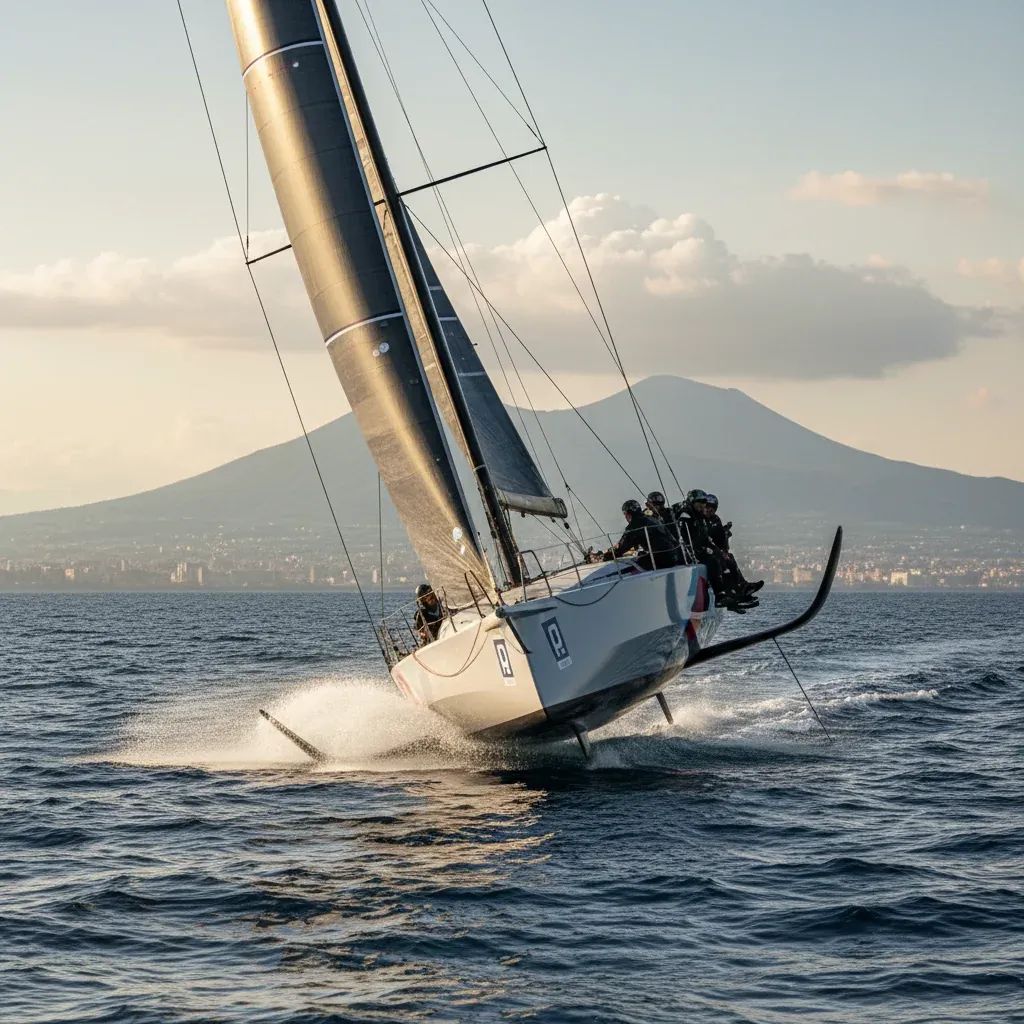
The Italy Sports Ministry has officially positioned the 2027 America's Cup in Naples as far more than a sailing race—it is being framed as a €1.2 billion urban transformation tied to one of the most polluted industrial sites in southern Europe. In a symbolic ceremony aboard the Nave Amerigo Vespucci in New York, the America's Cup trophy was displayed to mark Italy's first-ever hosting of the event, with Sports Minister Andrea Abodi and Sport e Salute President Marco Mezzaroma emphasizing the regatta's role as a catalyst for the long-stalled Bagnoli cleanup.
Why This Matters
• Historic first: The 38th America's Cup will take place in Italy for the first time, with races scheduled for spring and summer 2027 in the Gulf of Naples.
• Infrastructure bet: The Italian government has committed €1.22 billion through 2029 for the Bagnoli remediation, with €200M allocated for 2027 alone—the year of the Cup.
• Economic projection: Studies estimate the event will generate between €690M and €1B in economic impact, drawing 1.5M to 5M visitors over two months.
• Operational hub: The Palazzo dell'Immacolatella became Sport e Salute's official Naples headquarters on July 1, 2026, signaling the event's operational phase has begun.
The Bagnoli Gamble
The Bagnoli-Coroglio waterfront, once home to the sprawling Italsider steel plant, has languished for decades as a symbol of failed promises and toxic contamination. The government's strategy hinges on using the America's Cup as a deadline-driven forcing mechanism to accelerate cleanup and infrastructure work that might otherwise drag on indefinitely.
According to official timelines, the €1.22B remediation budget will be disbursed in stages: €28M in 2024, €90M in 2025, €100M in 2026, €200M in 2027, and €400M each in 2028 and 2029. The funds target both terrestrial and marine environmental cleanup, new roads and utilities, and the construction of team bases, public viewing areas, a superyacht marina, and eventually a 120-hectare green park.
The race bases for international teams will be built on this reclaimed land, creating a visible countdown to completion. The project is managed by Naples Mayor Gaetano Manfredi in his capacity as Special Commissioner for Bagnoli, working alongside the national government, Campania Region, and the state investment agency Invitalia.
Abodi, speaking in New York, framed the endeavor as part of Prime Minister Giorgia Meloni's government strategy to use major sporting events as vehicles for regional development. He described Bagnoli as undergoing "an extraordinary relaunch operation already underway, supported by significant public investments that will leave a lasting legacy in terms of infrastructure, opportunities, and growth."
What This Means for Residents
For Neapolitans, the America's Cup represents both opportunity and risk. The short-term disruption will be real: construction zones, potential maritime traffic restrictions in the Gulf, and heightened security measures. However, Port Authority officials have downplayed concerns about ferry disruptions to Ischia and Procida, noting that tourist traffic naturally dips during peak regatta months.
The fiscal incentives introduced via Decree-Law 38 of March 27, 2026, are designed to reduce operational costs for teams, organizers, and international athletes. There has been discussion of establishing a tax-free zone in Naples to attract private investment tied to the event, though details remain unconfirmed.
Longer term, the city stands to gain permanent infrastructure upgrades: modernized roads, a revitalized waterfront district, and a marina capable of hosting high-end tourism. Whether these benefits materialize depends on execution speed and whether post-event maintenance funding follows through.
The Soft Power Play
The ceremony in New York—with the America's Cup trophy aboard Italy's iconic training vessel—was carefully choreographed to project Italian maritime heritage on a global stage. Abodi emphasized that the event "speaks a universal language, capable of uniting tradition and innovation, education and future."
Luna Rossa, the Italian challenger, began training in Naples waters in 2026, a full year ahead of the competition. The Youth and Women's America's Cup regattas will run parallel to the main event, adding a talent development dimension.
Mezzaroma underscored the "system Italy" narrative: "The 2027 event will be much more than a sailing competition—it is an opportunity to show the world our country's system, the beauty of the Gulf of Naples, and a regeneration that, thanks to joint work by the government, Campania Region, Naples Municipality, and Invitalia, is returning to the city one of the most fascinating stretches of coastline in the Mediterranean."
The Race Course and Timing
The official race area will stretch between Castel dell'Ovo and Posillipo, with Mount Vesuvius as a backdrop and the islands of Capri and Ischia framing the horizon. The Louis Vuitton Cup (challenger selection series) and the Match finale will take place during spring and summer 2027, with the final Match beginning on July 10, 2027.
This marks only the third time the Cup has been held in the Mediterranean, following Valencia in 2007 and 2010, and the first time in Italian waters. Naples previously hosted America's Cup World Series events in 2012 and 2013, which drew over 1M spectators and demonstrated the city's ability to manage large-scale sailing events.
Comparisons and Cautions
The 2024 Barcelona edition generated an estimated €1.03B in economic impact and supported 12,872 job equivalents. However, historical analysis of events like the 2013 San Francisco Cup suggests that ex-ante projections often overestimate net benefits, with minimal long-term impact on local employment and retail sales.
Napoli faces unique infrastructure challenges compared to previous host cities, many of which had established marine facilities. The city must simultaneously remediate contaminated land, build new facilities, upgrade transport networks, and coordinate security across urban, maritime, and air domains. The public-private coordination required is formidable, involving multiple levels of government and private stakeholders.
Still, the political and financial commitment appears robust. The Meloni government has staked significant capital—both fiscal and reputational—on delivering a successful event that showcases southern Italy's capacity for renewal.
Legacy Questions
The ultimate test will be whether Bagnoli's transformation outlasts the event itself. Previous mega-event hosts have struggled with post-competition facility maintenance and repurposing. The €1.22B remediation plan extends through 2029, two years beyond the Cup, suggesting a timeline that accounts for post-event work.
Sport e Salute's establishment of a permanent operational headquarters at the Palazzo dell'Immacolatella, including ground-floor exhibitions on Naples' maritime history and Italian emigration, signals an intent to embed the event's legacy in the city's cultural infrastructure.
For residents and businesses, the key indicators to watch over the coming year will be the pace of construction in Bagnoli, the rollout of transport improvements, and whether promised tax incentives translate into tangible commercial opportunities. The 2027 America's Cup is being sold as a once-in-a-generation chance to reset Naples' trajectory—but delivery timelines are tight, and the margin for error is slim.


