
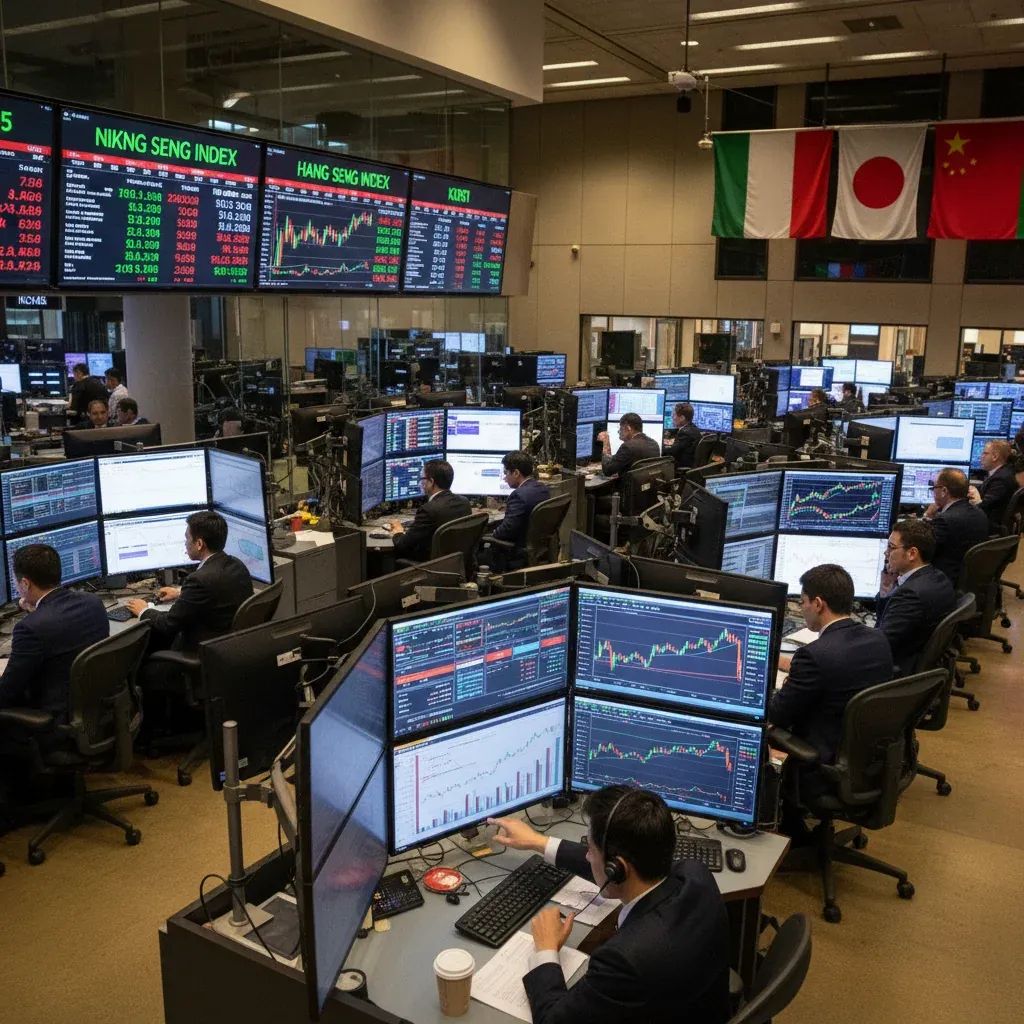
Italy's Milan Stock Exchange surged more than 3% in a sweeping rally that saw European equity markets climb sharply after U.S. President Donald Trump signaled an imminent end to conflict in the Middle East. The optimism propelled banking and technology shares to multi-week highs while commodity prices tumbled on expectations that critical supply routes would soon reopen.
Why This Matters
• Italian investors saw immediate gains: Milan's FTSE MIB jumped 3.1%, the strongest performance among major European indices, with bank stocks leading the charge.
• Energy costs are dropping: Natural gas prices fell nearly 4%, offering potential relief for Italian households and businesses facing elevated utility bills.
• Government borrowing costs eased: The spread between Italian 10-year bonds and German equivalents tightened to 85 basis points as risk appetite returned.
Banking Sector Powers Italian Rally
The Milan Stock Exchange delivered its best single-session performance in weeks, driven overwhelmingly by financial institutions. UniCredit climbed 5.6%, while Intesa Sanpaolo added 4.1% and Banco BPM rose 3.7%. Regional player BPER Banca gained 3.5%, and even state-rescued Monte dei Paschi managed a 2.4% advance.
Across the broader European market, the banking sector gained 3.7%, the strongest sectoral performance of the day. Analysts attribute the surge to a combination of factors: declining geopolitical risk premiums, expectations for more stable interest rate policy in the eurozone, and relief that a prolonged energy crisis may be averted.
The pan-European Stoxx 600 index rose 2.2%, with Madrid up 2.9%, Frankfurt advancing 2.1%, London gaining 1.8%, and Paris climbing 1.7%. Technology shares also performed strongly, adding 2.6% as the sector benefited from both risk-on sentiment and a weaker U.S. dollar.
Strait of Hormuz Reopening Shifts Commodity Markets
Market attention has pivoted sharply to the anticipated reopening of the Strait of Hormuz, the narrow waterway through which roughly one-fifth of global oil supply flows. While Trump's announcement of a peace breakthrough has yet to materialize into a formal ceasefire agreement, traders are pricing in the prospect that shipping lanes will normalize within weeks rather than months.
That expectation sent natural gas prices in Europe down 3.9% to €48.77 per megawatt-hour, a welcome development for Italy, which remains heavily reliant on imported energy. Crude oil also retreated, with West Texas Intermediate (WTI) falling 1.6% to $99.76 per barrel and Brent declining 0.9% to $103. The pullback reflects trader confidence that supply disruptions tied to Middle Eastern instability will ease, though prices remain elevated by historical standards.
Utility companies, which benefit from lower input costs, rallied 2% across Europe. However, energy producers and service firms took a hit. Eni, Italy's state-controlled oil major, dropped 2.6%, while oilfield services companies Saipem and Tenaris each lost 1%.
Defense and Infrastructure Stocks Shine
Leonardo, Italy's aerospace and defense giant, soared 7%, the top performer on the Milan exchange. Buzzi, a cement and construction materials producer, jumped 6.4%, while Prysmian, the cable manufacturer, rose 5.6%.
Bond Markets Reflect Declining Risk Premium
Beyond equities, the bond market signaled a meaningful shift in investor sentiment. Italian government bonds saw yields decline as demand increased, reflecting reduced concern about fiscal stress or eurozone fragmentation. The BTP-Bund spread, a key barometer of Italy's borrowing risk relative to Germany, has now dropped to levels not seen since early 2024.
Meanwhile, gold—traditionally a haven asset—barely moved, edging up just 0.1% to $4,738 per ounce. The muted response suggests that while some investors remain cautious, the overwhelming sentiment is one of risk appetite rather than flight to safety.
The U.S. dollar weakened against major currencies, including the euro, as traders recalibrated expectations for Federal Reserve policy and global growth. A softer dollar typically benefits European exporters and reduces the cost of dollar-denominated imports, including energy.
Outlook and Remaining Uncertainties
The current rally hinges on the assumption that Trump's Middle East peace initiative will translate into concrete results. If diplomatic efforts stall or if violence flares anew, markets could reverse course rapidly. The timeline for Strait of Hormuz normalization remains uncertain, and it could take weeks for tanker traffic to resume at pre-crisis levels.
Investors will be watching for official confirmation of ceasefire terms, statements from oil producers, and shipping data from the Gulf region. Until those pieces fall into place, today's gains remain speculative—a bet on peace rather than a response to it.


