
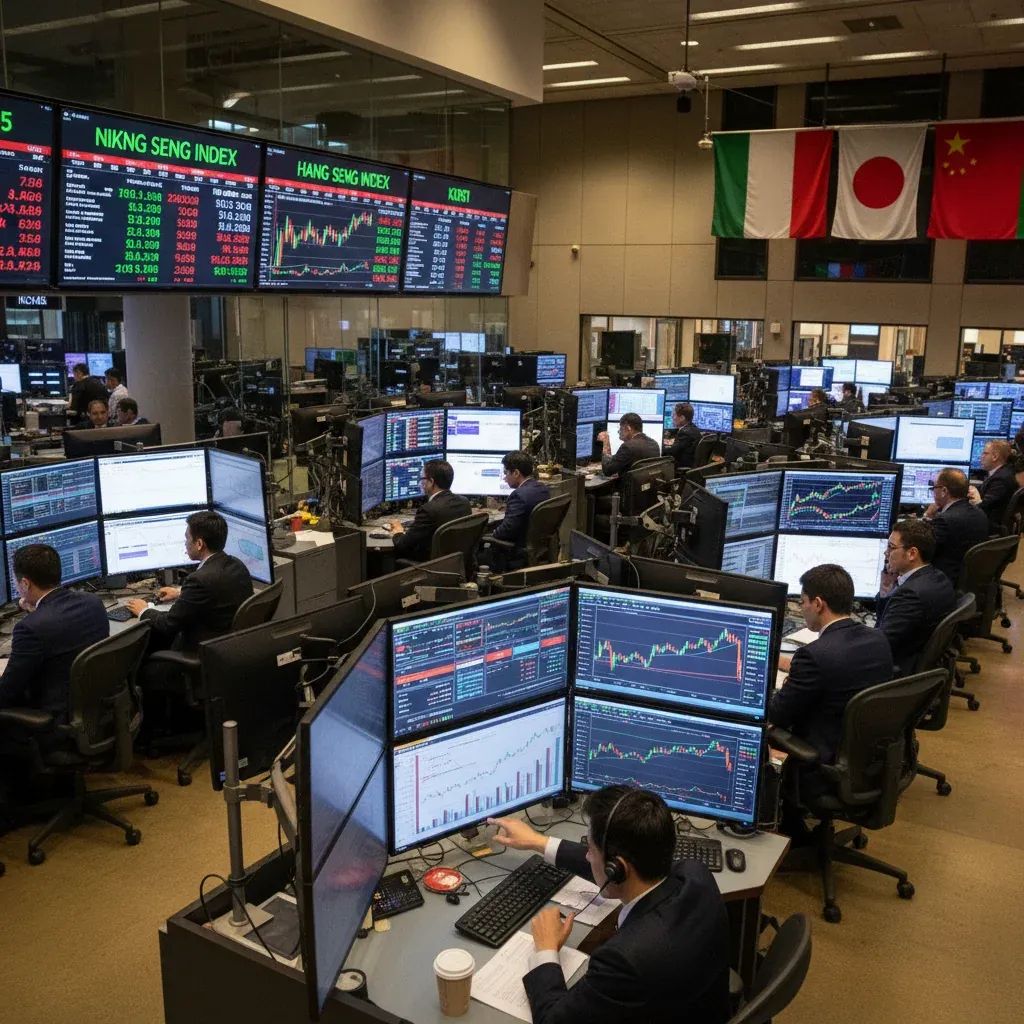
The Italy Stock Exchange closed sharply higher on Tuesday, surging 1.22% to 44,887 points on the FTSE MIB index, outpacing its European peers as energy stocks rallied amid escalating tensions in the Middle East that have pushed oil prices beyond $102 per barrel.
Why This Matters
• Portfolio impact: Energy giants Tenaris and Eni jumped more than 3.5% each, driven by supply disruptions from the Iran conflict and the blockade of the Strait of Hormuz.
• Borrowing costs easing: The spread between Italian 10-year bonds (BTP) and German Bunds narrowed to 75 basis points, with Italy's benchmark yield settling at 3.65%.
• Banking consolidation: UniCredit's ongoing bid to cross the 30% threshold in Germany's Commerzbank is reshaping the European banking landscape, with shares gaining modestly amid regulatory scrutiny.
• Energy bills surging: Italian electricity costs jumped over 50% in early March, a critical concern for households and businesses relying on gas-fired generation—directly offsetting any investment gains for many residents.
Energy Sector Dominates as Geopolitics Reshapes Markets
The Italy FTSE MIB delivered the strongest performance among major European indices on March 17, with the energy complex leading gains in a session marked by geopolitical anxiety and commodity price surges. European markets collectively rose 0.63% on average, but Milan's exchange stood out with its 1.22% climb, reflecting the outsized weight of energy and utility stocks on Piazza Affari.
Tenaris, the steel pipe manufacturer critical to oil and gas infrastructure, soared 3.6%, while state-controlled Eni advanced 3.5%. The twin drivers: crude oil prices hovering above $102 for Brent and European natural gas (TTF) climbing to €52.80 per megawatt-hour following Iranian attacks on energy infrastructure and the continued chokepoint at the Strait of Hormuz. The International Energy Agency has flagged a production shortfall of at least 8M barrels per day in March, intensifying supply fears.
Eni's recent strategic wins—including two major gas discoveries in Libya and a landmark agreement with Venezuela's PDVSA for the offshore Cardón IV field—have bolstered investor confidence. The company also secured a €9B revolving credit facility with 40% oversubscription, signaling strong institutional backing. Tenaris, meanwhile, suspended the second tranche of its $1.2B share buyback program on March 3 due to market volatility, though it had already completed most planned repurchases. The firm proposed a dividend of $0.89 per share for 2025, with a balance of $0.60 per share payable May 20.
Utilities and Automakers Join the Rally
Beyond hydrocarbons, Italy's utility sector posted solid gains, with Enel up 2.7% and A2A advancing 0.7%. A2A's 2025 results exceeded margin expectations, reinforcing confidence in the sector's infrastructure modernization push. The Italian multiutility sector deployed approximately €5B in investments during 2025, focusing on renewable energy expansion and water infrastructure upgrades funded partly by Italy's National Recovery and Resilience Plan (PNRR). Revenues across the segment grew 5%, with profits reaching €6.4B, though debt levels have risen in tandem.
Hera climbed 2%, while telecom infrastructure specialist Inwit gained 2.6%. The broader utility index has shown resilience despite recent regulatory turbulence, including the "Decreto Bollette" announcement in February that briefly pressured valuations.
In the automotive sphere, Stellantis rebounded sharply with a 3% gain, shaking off recent production concerns tied to semiconductor availability and European demand softness. Luxury carmaker Ferrari added 1.4%, maintaining its premium valuation despite macroeconomic headwinds.
Banking Sector Navigates UniCredit-Commerzbank Saga
Italy's banking stocks posted mixed but generally positive returns, with investors closely monitoring UniCredit's cross-border ambitions. The Milan-based lender, which already holds approximately 28% of Germany's Commerzbank (26.04% directly plus total return swaps), formally launched an offer on March 16 to exceed the 30% takeover threshold under German law. The proposed exchange ratio of roughly 0.485 UniCredit shares per Commerzbank share values the German bank at around €30.80 per share—a 4.1% premium to its March 13 closing price—and implies a total valuation of €34.9B.
Commerzbank's management has rejected the offer as "uncoordinated" and underpriced, with CEO Bettina Orlopp reaffirming the bank's independence strategy. The German government, which retains a 12.72% stake, has consistently opposed a full takeover, viewing Commerzbank as systemically important. The formal offer is expected in early May, with completion anticipated by mid-2027, pending regulatory clearance from German authorities and the European Central Bank.
Despite the standoff, UniCredit shares edged up 0.5%, while Intesa Sanpaolo gained 1.1% and Banco BPM rose 1.5%. Mediobanca and Monte dei Paschi (MPS) advanced 2.2% and 2.1%, respectively, as investors recalibrated expectations for sector-wide consolidation across Europe.
What This Means for Residents
For Italians with exposure to domestic equities—whether through direct shareholdings, pension funds, or investment vehicles—the market's performance offers a mixed picture:
• Energy and utility holdings are benefiting from structural tailwinds (renewable transition, infrastructure investment) and cyclical factors (geopolitical supply shocks). However, volatility in gas and electricity prices remains a double-edged sword: while utilities profit from higher throughput, households and businesses face elevated energy bills.
• Banking sector consolidation could eventually lead to more competitive cross-border services and stronger balance sheets, but near-term uncertainty may weigh on valuations. UniCredit's aggressive European expansion signals confidence in long-term profitability but also exposes shareholders to regulatory and political risk.
• Sovereign borrowing costs are stabilizing, with the BTP-Bund spread tightening to 75 basis points—a positive signal for Italy's fiscal sustainability and potentially lower mortgage rates over time.
Defense Stocks Lag Amid Profit-Taking
In a notable divergence from the broader rally, defense stocks retreated. Shipbuilder Fincantieri dropped 2%, and aerospace giant Leonardo slipped 0.7%, despite the sector's strong year-to-date performance (Leonardo shares are up approximately 17% year-to-date in 2026). The pullback appears technical, driven by profit-taking after a sustained rally fueled by rising European military budgets. Italy's defense budget for 2026 is set at a record €33.95B, up 2.8% year-over-year, though the government remains cautious pending clarity on the EU's €14.9B SAFE (Security Action For Europe) fund and potential activation of the National Escape Clause to increase spending without breaching deficit limits.
Amplifon Tumbles on Analyst Concerns
The session's biggest loser was hearing aid retailer Amplifon, which plunged 10% following S&P's confirmation of its credit rating and stable outlook after the acquisition of GN Hearing. Analysts expressed concerns over integration costs and market saturation, triggering a sharp selloff. The stock had already declined 14.3% on March 16, extending its losses to a two-day drop exceeding 23%.
Payment processor Nexi rose 1.5%, spirits maker Campari gained 1%, and telecom incumbent TIM surged 3%, reflecting renewed optimism about the company's network separation strategy. Semiconductor manufacturer STMicroelectronics dipped 0.4%, while cable maker Prysmian was nearly flat at +0.06%.
European Context and Fed Watch
Milan's outperformance came as the broader Eurostoxx 600 rose 0.9%, with markets treading carefully ahead of the U.S. Federal Reserve's two-day policy meeting, which began March 17. While rates are expected to remain unchanged, investors are focused on updated projections for growth and inflation. The Reserve Bank of Australia raised rates by 25 basis points to 4.1% earlier in the session, adding to global monetary tightening concerns.
Italy's inflation data for February showed a 0.7% month-on-month increase and 1.5% year-on-year, complicating the European Central Bank's rate trajectory. German investor confidence, as measured by the ZEW index, disappointed in March, underscoring uneven recovery dynamics across the eurozone.
Outlook: Volatility Likely to Persist
The Italy stock market's resilience in the face of geopolitical turmoil and monetary policy uncertainty reflects its sectoral composition—heavy in energy, utilities, and banks, all of which benefit from higher commodity prices and interest rate stability. However, the sustainability of these gains hinges on developments in the Middle East, European regulatory decisions on bank mergers, and the pace of the energy transition.
For now, Milan's exchange remains a standout in Europe, but investors should brace for continued volatility as macroeconomic crosscurrents intensify. The interplay between energy security, inflation management, and fiscal discipline will define Italy's market trajectory through the spring and beyond.


