
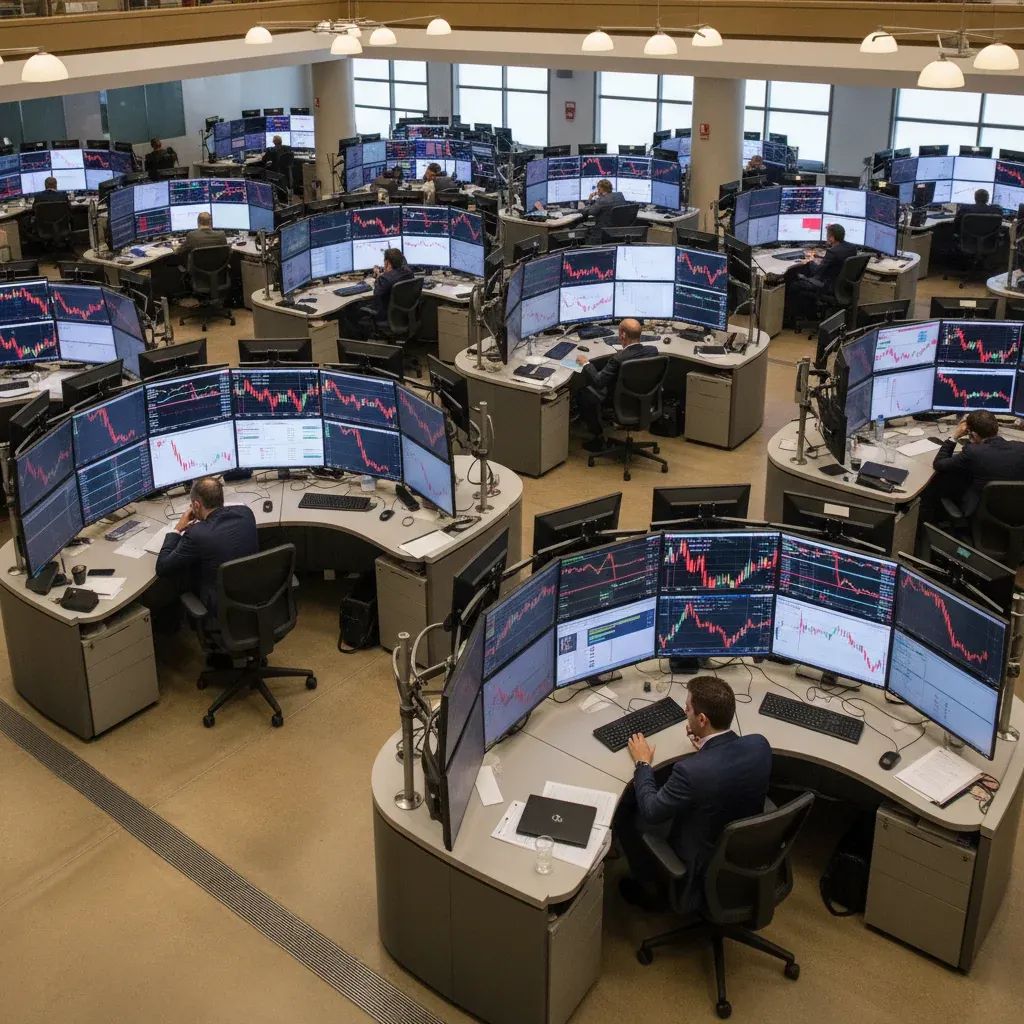
The Italy Milan Stock Exchange opened sharply lower as crude oil prices surged following a U.S. Navy seizure of an Iranian cargo vessel near the Strait of Hormuz, a move that plunged global energy markets into fresh turmoil and reignited fears over one of the world's most critical shipping corridors.
Why This Matters:
• Oil prices jumped by over 5–6% within hours of the operation, with Brent crude hitting $95.38 per barrel and WTI reaching $89.04.
• Italy's energy stocks rallied while banks and industrials faced sharp sell-offs, reflecting a flight to commodity-linked assets.
• The Strait of Hormuz remains largely blocked since late February 2026, threatening a fifth of global oil supply.
• Negotiations between Washington and Tehran collapsed after the USS Spruance intercepted the sanctioned vessel "Touska" on April 19.
How the Seizure Unfolded
According to official statements from U.S. Central Command (CENTCOM), the guided-missile destroyer USS Spruance intercepted the Iranian cargo ship Touska in the Gulf of Oman after the vessel allegedly attempted to breach a U.S. naval blockade imposed on Iranian ports on April 13. The Touska had been subject to sanctions by the U.S. Treasury Department and was operating in violation of those restrictions.
After six hours of repeated warnings that the Iranian crew allegedly ignored, American forces fired on the ship's engine room to disable its propulsion. U.S. Marines then boarded and took control of the vessel. CENTCOM released video footage of the operation, which rapidly circulated across international media.
Iran's response was immediate and forceful. Tehran's Foreign Ministry condemned the action as an "act of armed piracy," and Iranian media outlets reported that the Islamic Republic had launched drone strikes against U.S. naval assets in retaliation. The incident further destabilized an already fragile ceasefire and derailed diplomatic efforts hosted by Pakistan earlier this month.
Market Reaction in Milan
The FTSE Mib index shed 1.38% at the opening bell, closing at 48,193 points as traders digested the implications of renewed Middle Eastern tensions. Banking stocks bore the brunt of the selloff, with Intesa Sanpaolo falling 1.6%, UniCredit down 1.2%, and BPER Banca sliding 0.9%. Banco BPM lost 0.2%, though Monte dei Paschi and Mediobanca bucked the trend, gaining 0.5% and 0.6%, respectively.
Industrial names also suffered. Stellantis dropped 1.4%, while cement producer Buzzi fell 2%. Luxury goods were not spared, with Brunello Cucinelli and Moncler each shedding 0.6%. Insurers Unipol and Generali declined 0.7% and 0.4%, reflecting broader risk-off sentiment.
Energy and utility stocks, however, soared. Eni surged 2.6%, Saipem climbed 1.9% after announcing a contract for a new biorefinery in Priolo, Sicily, and Tenaris advanced 1.3%. Multi-utility firms also benefited, with A2A up 0.7%, and Hera and Italgas each gaining 0.5%.
The benchmark 10-year Italian bond yield held at 3.72%, and the spread between Italian BTPs and German Bunds remained stable at 74 basis points, indicating that sovereign debt markets, for now, are weathering the geopolitical shock without major disruptions.
European Bourses Follow Suit
Across Europe, equity indices opened in negative territory. Paris's CAC 40 fell 1.32%, Frankfurt's DAX dropped 1.28%, and London's FTSE 100 declined 0.47%. Analysts attributed the weakness to a combination of heightened geopolitical risk and speculation that central banks might reconsider interest rate cuts if oil-driven inflation resurges.
Government bond yields across the eurozone ticked higher as investors priced in potential monetary policy adjustments. The synchronized selloff underscored how dependent European economies remain on stable energy supplies from the Middle East.
What This Means for Residents
For those living in Italy, the immediate concern revolves around fuel costs and inflation. Italy imports a significant share of its energy needs, and prolonged disruption in the Strait of Hormuz—through which roughly 20% of the world's crude oil passes—could translate into higher gasoline and diesel prices at the pump within weeks.
Utility bills may also climb if natural gas prices follow crude oil's trajectory. The Italy Ministry of Energy Transition has not issued new guidance, but past episodes of Middle Eastern instability have led to retail energy price spikes that ripple through household budgets.
Investors holding portfolios weighted toward Italian energy equities may see short-term gains, but those exposed to financials, industrials, or consumer discretionary sectors could face continued volatility. Advisors recommend maintaining diversification and monitoring developments closely.
Small and medium enterprises reliant on imported raw materials or international shipping may encounter supply chain delays and higher freight costs, particularly if insurance premiums for maritime transit rise further. The Italian Confederation of Business (Confindustria) has flagged these risks in recent briefings.
Geopolitical Context: A Standoff with No Clear Exit
The seizure of the Touska is the latest flashpoint in a conflict that erupted on February 28, 2026, when Iran effectively closed the Strait of Hormuz following U.S. and Israeli airstrikes on Iranian infrastructure. Since then, the Islamic Revolutionary Guard Corps (IRGC) has attacked at least 22 merchant vessels, laid mines, and issued threats to foreign-flagged ships.
A two-week ceasefire was announced on April 7, and initial talks in Islamabad on April 11–12 ended without agreement. Iran briefly reopened the Strait on April 8 and again on April 17, only to reimpose restrictions citing the U.S. naval blockade. On April 18 and 19, IRGC patrol boats allegedly fired on commercial ships, including an Indian-flagged tanker.
Iran's First Vice President stated on April 20 that the security of the Strait cannot be assured as long as Iranian oil exports remain under restriction. Meanwhile, U.S. President Donald Trump has threatened to destroy key Iranian facilities if the waterway remains closed and no deal is reached.
International actors are scrambling for solutions. Bahrain has drafted a UN Security Council resolution authorizing member states to use all necessary means to ensure free transit, and France is exploring the possibility of an international maritime mission. The Institute for the Study of War warned that any acceptance of Iranian control over the Strait would represent a major strategic defeat for Washington and undermine freedom of navigation principles.
Historical Precedent: Volatility, Then Recovery
Past crises in the Strait of Hormuz offer instructive lessons. During the Iran-Iraq War (1984–1988), the so-called "Tanker War" saw reciprocal attacks that cut Iranian oil exports in half and reduced Gulf shipping by 25%. Insurance premiums surged, and supply bottlenecks emerged.
The First Gulf War (1990–1991) triggered an even sharper response: Brent crude spiked from $15 to nearly $40 per barrel within months. Stock markets initially plunged but recovered well before hostilities ended, as clarity replaced uncertainty.
The current crisis has already driven Brent above $95 per barrel, the highest in over two years, and WTI above $89. Yet history suggests that once the contours of a resolution—or at least a stable status quo—become visible, markets tend to stabilize quickly. The challenge is predicting when that moment will arrive.
Outlook: Uncertainty Dominates
As of this writing, the Pakistan-mediated negotiations appear stalled. Iran's Foreign Ministry has signaled no intention to participate in further talks, citing ceasefire violations and the U.S. blockade. Washington shows no sign of lifting restrictions until Tehran reopens the Strait unconditionally.
For Italy and Europe, the stakes are high. Any prolonged interruption threatens to reignite inflation just as central banks had begun to consider easing. Supply chains, already fragile after pandemic-era disruptions, face renewed strain. Energy security, a cornerstone of European policy since the Russia-Ukraine conflict, is once again in jeopardy.
Traders and households alike are left watching the same narrow waterway, hoping diplomacy can defuse a standoff that has already reshaped global energy markets and rattled financial stability from Milan to Frankfurt to New York.


