
The United States Navy launched a selective naval blockade of Iranian ports on April 13, 2026, at 16:00 CET, a move that immediately sent crude oil prices above $104 per barrel and natural gas surging on European markets. For residents and businesses across Italy, the geopolitical shock translates into one stark reality: fuel costs at the pump are about to climb sharply, eroding household budgets and threatening to paralyze the country's road freight network.
Why This Matters
• Pump prices will rise imminently: Italy's fuel industry association Unem confirms that retail gasoline and diesel prices must increase within days to reflect the crude oil surge, even though prices remained stable on the day of the blockade at €1.78/liter for gasoline and €2.16/liter for diesel.
• Truckers plan nationwide strike: The Unatras national coordination body will convene Friday, April 17, to vote on a total halt to road transport services in response to diesel costs that have already erased profit margins.
• Jet fuel shortage looms for summer: Europe imports 50% of its aviation fuel, with 10M tons annually refined in the Gulf region—April and May supplies are covered, but June onward is uncertain, raising the prospect of grounded flights during peak travel season.
• Stock markets wobbled: Milan's FTSE MIB closed down 0.17% as energy stocks rallied while luxury, auto, and banking sectors bled value.
The Hormuz Stranglehold and Its Italian Echo
The blockade follows the collapse of U.S.-Iran peace talks in Islamabad. President Donald Trump ordered the Navy to "seek and interdict every vessel in international waters that has paid a toll to Iran," while threatening to destroy Iranian-laid mines in the strait. Approximately 20% of the world's seaborne oil and liquefied natural gas flows through this narrow passage daily, making it the single most critical chokepoint in global energy logistics.
Following the announcement, Brent crude surged 7.12% to $102.03 per barrel, while the U.S. WTI benchmark climbed 8.28% to $104.57. Natural gas futures on the Amsterdam TTF exchange closed up 6.4% at €46.40 per megawatt-hour, with intraday volatility reaching peaks above €47.50—a level not seen since the early months of the Ukraine war.
Italy does not source most of its crude directly via Hormuz, but the global nature of petroleum markets means any supply disruption triggers an immediate worldwide price spike. Gianni Murano, president of Unem, was unequivocal: "From the signals I see in Brent and international diesel pricing, prices will have to rise again, because they are climbing quite vigorously in recent hours."
What This Means for Italian Motorists and Businesses
Retail fuel prices had held steady for three consecutive days following a brief dip tied to a short-lived Trump-announced truce. Gasoline averaged €1.78 per liter in self-service mode on national highways, while diesel sat at €2.16—figures that already represented a 10–15 cent increase since January due to Middle East tensions that predated the blockade. Unem's forecast suggested these numbers were about to jump further, with the diesel hike particularly acute.
For Italian households, every 10-cent increase in gasoline costs roughly €5 more per tank. For haulage companies operating on razor-thin margins, the diesel surge is existential. Unatras, the umbrella group representing Italy's road freight operators, announced that the entire sector is "oriented toward blocking road transport services." A national executive committee meeting on April 17 was set to determine whether to proceed with a full stoppage.
Truckers are demanding immediate tax credits on fuel purchases and a six-month deferral of fiscal and social security contributions. Without relief, they warn, supply chains feeding Italy's manufacturing heartland and retail networks will seize up. Regional sources in Lombardy, which anchors Italy's industrial core, expressed concern to ANSA that both the European Commission and the national government had done little since the Ukraine war began to build "antibodies" against energy speculation and price spikes.
The Aviation Fuel Crisis: A Silent Emergency
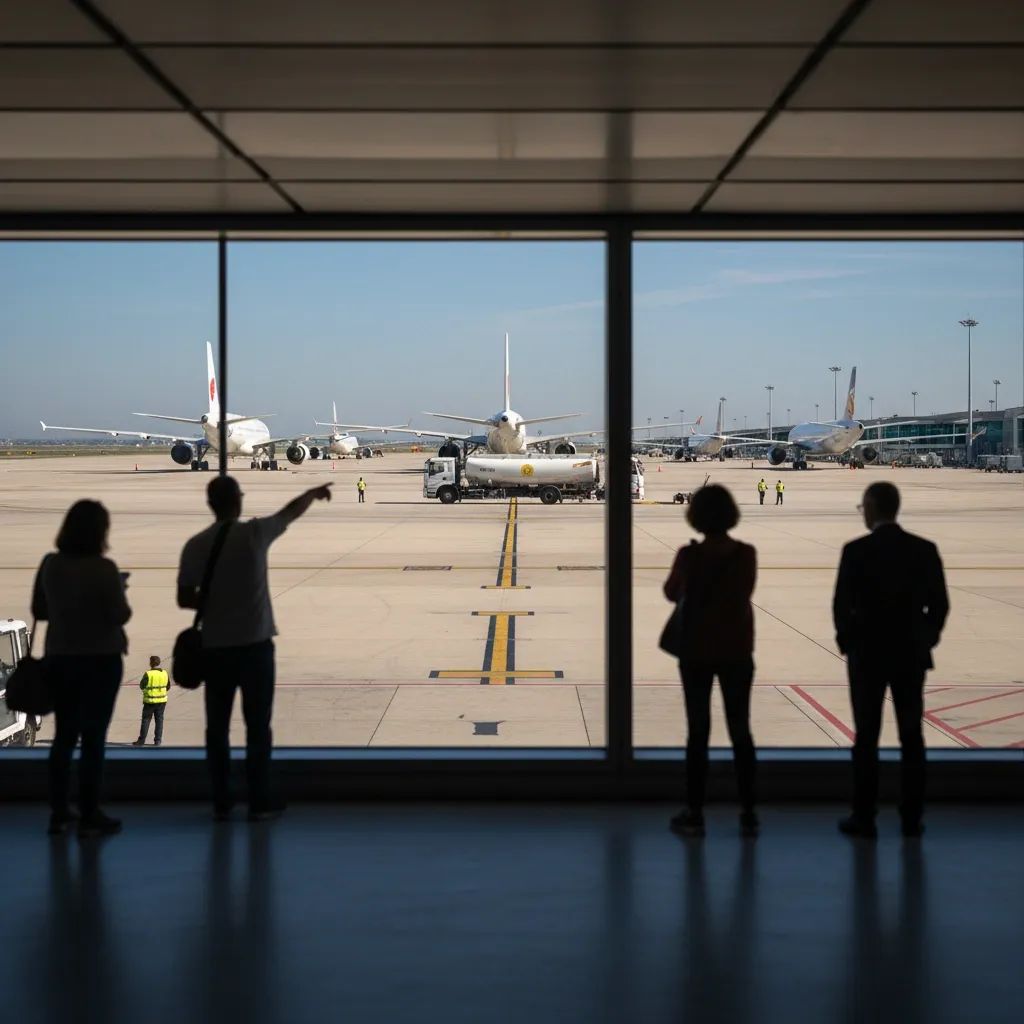
While gasoline and diesel dominate headlines, the real emergency is jet fuel, according to Murano. The European Union plus the United Kingdom consumes roughly 20M tons of aviation kerosene annually, and 10M tons—fully half—are refined in Gulf facilities that can no longer ship product through Hormuz. Europe has shuttered 35 refineries over the past decade, leaving the continent structurally dependent on imports for approximately 50% of its jet fuel needs.
"For April and May, we are covered," Murano explained. "After that, we don't know." The implication is clear: Italians planning summer holidays by air face a genuine risk of grounded flights if refineries in the Gulf remain cut off and European production cannot compensate.
Italy operates approximately 10 refineries that produce jet fuel, but aggregate EU refining capacity had dropped by 400,000 barrels per day in 2025 alone. Industry projections suggest total European capacity could shrink by 5M barrels per day by 2050—nearly half the 2024 baseline of 13M barrels daily. Meanwhile, aviation fuel is one of the few refined products with growing demand over the next decade, creating a structural mismatch.
The EU's ReFuelEU Aviation regulation mandates that suppliers blend 2% sustainable aviation fuel (SAF) starting that year, rising to 6% by 2030 and 70% by 2050. Yet current EU SAF production capacity stood at only 0.24M tons, a mere 10% of the volume needed to meet the 2030 target. Building roughly nine e-SAF plants across Europe could reduce import dependence and strengthen energy sovereignty, but costs remain prohibitively high and timelines stretch years into the future.
Market Tremors: Milan and the European Bourses
European equity markets opened sharply lower on news of the blockade, though most indices pared losses by the close. Milan's FTSE MIB shed 0.17%, Frankfurt fell 0.5%, Paris dropped 0.3%, and London declined 0.2%. Amsterdam bucked the trend, edging up 0.2%. Budapest surged 4.9% following the electoral defeat of Viktor Orbán and the victory of challenger Peter Magyar.
Energy stocks rallied as crude prices soared: Eni gained 1%, Saipem rose 0.53%, while international majors Shell (+1.9%), BP (+1.6%), and TotalEnergies (+1.5%) all posted solid gains. Defense contractors also advanced, with Leonardo up 1.3%, Rheinmetall adding 1.25%, and Thales climbing 1.1%.
In contrast, luxury and automotive sectors bled value. Stellantis dropped 2.6%, Ferrari and Volkswagen both slid 1.65%, while Cucinelli tumbled 3.9% and Moncler fell 2.3%. Banks retreated across the board: UniCredit lost 1.55%, Mediobanca 1.7%, Intesa 1.05%, and Banco BPM 0.85%.
The BTP-Bund 10-year spread tightened slightly to 79.5 basis points from an opening 80.1, with Italian yields rising 1 basis point to 3.85% and German yields climbing 0.8 basis points to 3.06%. The dollar strengthened to €0.8557, reflecting flight-to-safety flows amid geopolitical uncertainty.
The Geopolitical Chessboard and Italy's Exposure
Iran condemned the blockade as an "illegal act of piracy," warning that any threat to its ports would trigger a broader regional response endangering all Gulf ports. The International Maritime Organization (IMO) secretary general stated that no country has the legal right to block navigation in the Strait under international maritime law governing freedom of navigation and innocent passage.
The United Kingdom and Spain both declined to participate in the blockade. British Prime Minister Keir Starmer emphasized that the UK's priority is opening the Strait to bring down energy prices. French President Emmanuel Macron announced that France and the UK will host a conference on a multinational defensive mission to ensure passage through the waterway. China, a major buyer of Iranian crude, expressed concern over escalation.
Italian Foreign Minister Antonio Tajani was in Beirut facilitating dialogue between Israel and Lebanon, and voiced support for U.S.-Iran diplomacy. Pakistan's prime minister claimed a ceasefire was "ongoing" and efforts continued toward a deal, despite the breakdown in Islamabad.
Trump's demands reportedly included an Iranian freeze on uranium enrichment for 20 years, a proposal Tehran countered with a single-digit timeframe. The U.S. president vowed to destroy Iranian-laid mines and interdict vessels paying transit fees, while paradoxically insisting Iran "wants a deal."
Structural Vulnerabilities and the Long View
Italy's energy dependence on global markets remained acute despite diversification efforts since the Ukraine conflict began. The country imports 43% of its jet fuel from Gulf states, relying on slow maritime supply chains with narrow delivery windows. Strategic reserves exist but function as a temporary cushion, not a long-term solution.
Lombardy regional sources, speaking to ANSA, expressed concern that little has been done since February 2022 to insulate Italy from energy speculation. The European Commission and national government had "failed to build the right antibodies" against price shocks, they noted, leaving Italy exposed each time geopolitical crises flare.
The trucking sector's threats were not idle. In February and March 2022, during an earlier fuel price surge, Sicilian haulers blockaded ports and highways around Catania, Palermo, Gela, and Termini Imerese, while peers in Sardinia staged rolling protests outside Olbia and Cagliari. In Puglia, demonstrators occupied a highway rest stop near San Severo. The current crisis, with diesel already above €2.16, had reignited those grievances.
Unatras members were demanding credito d'imposta (tax credit) mechanisms and six-month contribution deferrals, tools the government had deployed during the pandemic but had been slower to activate for energy shocks. Without swift intervention, Italy's manufacturing and retail distribution networks—heavily dependent on just-in-time trucking—risked severe disruption.
The Road Ahead
Murano insisted there is no immediate risk of fuel shortages at Italian pumps. "For April and May, coverage is guaranteed," he said. "After that, oil should still be sourced even with Hormuz closed, and domestic refined production is sufficient to cover demand. There are no problems for diesel or marine fuel oil either."
The caveat, however, is price. "Certainly, the price rises, because Asian demand is added in—they no longer receive supply from the Gulf," he noted. With Brent and WTI both trading above $100, and natural gas at elevated levels, the inflationary ripple effects were set to compound across sectors: transport, food distribution, manufacturing inputs, and consumer goods.
For the days ahead, Italians faced a waiting game. Pump prices were expected to climb in the coming days, truckers were set to vote Friday on a strike that could empty supermarket shelves, and summer travelers might confront the novel risk of grounded aircraft. The Hormuz blockade, launched on April 13, 2026, at 16:00 CET, had once again exposed the fragility of Europe's energy architecture—and Italy's place within it.


