
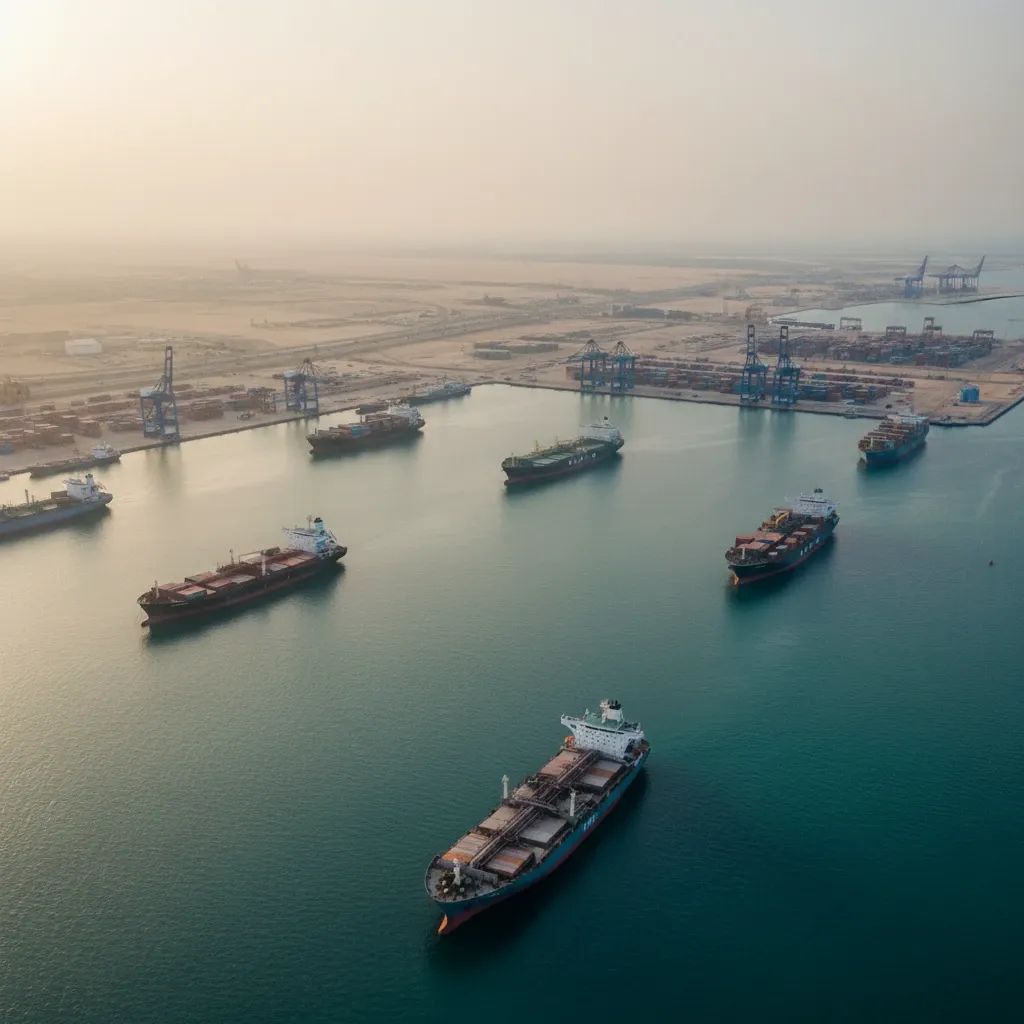
The Iran Revolutionary Guard has effectively paralyzed commercial navigation through the Strait of Hormuz, triggering a sharp spike in global energy prices that will hit Italian households and businesses hard. While not a formal legal blockade, the Iranian warnings and military escalation following US and Israeli airstrikes have brought maritime trade through the world's most critical oil chokepoint to a near standstill.
Why This Matters
• Fuel prices set to surge: Brent crude jumped 10% to $80 per barrel in weekend trading, with analysts forecasting it could reach $100–$120 if the disruption lasts more than a week.
• Italy's energy vulnerability exposed: Nearly 45% of Italian LNG imports came from Qatar in 2024, most of which transit Hormuz. With EU gas storage at just 31% (Italy mirroring this low level), the country faces a direct supply squeeze.
• No quick workaround: Alternative shipping routes around the Cape of Good Hope add 10–14 days and up to $400 per container in costs, while Gulf pipeline capacity can reroute only 15–20% of the oil that normally passes through the strait.
The Strait That Moves 20% of Global Oil
The Strait of Hormuz is a 21-mile-wide channel between Iran and Oman connecting the Persian Gulf to the Arabian Sea. On any given day, roughly 20 million barrels of crude oil and one-fifth of the world's LNG pass through this waterway. The buyers are overwhelmingly Asian—China, India, Japan, and South Korea accounted for 69% of crude flows in 2024—but European markets, especially for gas, depend on it too.
While Asian buyers dominate Hormuz traffic, Europe—and Italy in particular—faces acute exposure through its LNG dependency.
Iran has long treated Hormuz as a geopolitical lever. The Iranian Revolutionary Guard Corps (IRGC) broadcasts VHF radio warnings stating "no vessel is authorized to pass," a tactic designed to raise the economic cost of conflict without requiring Tehran to sustain a full naval blockade it likely cannot maintain against US forces. The strategy is less about defeating the US Navy and more about creating what analysts call an "economic trap": making the price of war so high that adversaries recalculate their moves.
Marine tracking data from Marine Traffic shows the immediate impact. At least 150 tankers carrying crude and LNG are anchored in open water on both sides of the strait, clustered off the coasts of Iraq, Saudi Arabia, and Qatar. Major shipping lines—Maersk, MSC, CMA CGM, and Hapag-Lloyd—have suspended transits. One tanker, the Palau-flagged Skylight, was struck by a missile or drone near Oman's coast, and its crew evacuated. Airspace across most Gulf states is closed, complicating crew rotations and emergency response.
What This Means for Italy
Italy's energy security is tightly linked to what happens in the Persian Gulf. The country imports a substantial share of its natural gas in liquefied form, and Qatar supplied 45% of Italian LNG in 2024, a volume nearly impossible to replace on short notice. Italy also ranks among European nations most dependent on Gulf crude, alongside Spain.
Right now, EU gas storage sits below 31%, compared to 40% a year ago. Germany is at 20.5%, France at 21%. Italy mirrors this low inventory. If Hormuz remains inaccessible for weeks, the Dutch TTF benchmark—the European gas price reference—could exceed €90 per megawatt-hour, translating directly into higher heating and electricity bills for Italian households and manufacturers.
Beyond gas, any prolonged disruption will raise the cost of diesel, gasoline, and jet fuel. Italy's refineries source a mix of crude, and even indirect exposure through global price contagion will be felt at the pump. The Italian automotive sector, already contending with fragmented supply chains, faces additional cost pressure from higher energy input prices and more expensive logistics.
OPEC+ Responds, But Markets Remain Skeptical
The OPEC+ cartel convened virtually over the weekend and announced an increase of 206,000 barrels per day starting in April, a figure above the 137,000 analysts expected before the crisis. The statement made no mention of Iran or the military strikes, instead citing "stable global economic outlook" and "solid market fundamentals."
Eight member states will shoulder the increase: primarily Saudi Arabia, the United Arab Emirates, Kuwait, and Iraq—the very countries that depend most heavily on Hormuz for export access. Analysts view the move as symbolic rather than substantive.
"It's a signal, not a solution," said Jorge Leon of Rystad Energy. "If oil cannot transit through the Strait of Hormuz, an additional 206,000 barrels per day does little to ease the market. Logistics and transit risks matter more than production targets right now."
Homayoun Falakshahi of Kpler goes further, warning that prolonged regional conflict could push crude above $120 per barrel. The cartel will reconvene on April 5, 2026, and may attempt further increases, but the underlying problem is geographic, not volumetric.
The Search for Alternative Routes
Shipping companies are scrambling to reroute, but all alternatives carry heavy penalties in time and cost.
The Cape of Good Hope diversion around southern Africa adds 10 to 14 days to Asia-Europe routes and increases freight costs by $200–$400 per twenty-foot container due to fuel, crew wages, and vessel positioning. War-risk insurance premiums, which spiked to $150,000–$500,000 per voyage during the Red Sea crisis, remain elevated. Freight rates on Asia-Europe lanes have stabilized at levels 25–35% higher than pre-crisis norms.
For crude oil, a handful of pipelines can bypass the strait, but their combined capacity handles only 15–20% of the daily 20 M barrels that normally transit Hormuz:
• Saudi Arabia's East-West Pipeline (Petroline): 5 M barrels per day capacity, with about 2.6 M available for rerouting.
• UAE's Habshan-Fujairah Pipeline: 1.8 M barrels per day.
• Iraq's IPSA Pipeline through Saudi Arabia: 1.65 M barrels per day.
• Iran's Goreh-Jask Pipeline: Nominal 300,000 barrels per day, inconsistently used.
Qatar's LNG exports have no alternative. The emirate's liquefaction terminals are all on the Persian Gulf side, meaning every cargo must pass through Hormuz. This is why European gas markets are so jittery: there is no Plan B for Qatari LNG.
Kuwait and Bahrain have zero pipeline alternatives and depend entirely on the strait for sea access.
Political Calculus and the "Economic Trap"
From Tehran's perspective, the strait is a pressure point calibrated to inflict maximum economic pain with minimal direct military confrontation. Iran has deployed drones, mini-submarines, and naval mines around the waterway, rendering transit extremely risky even without a formal blockade.
US President Donald Trump dismissed concerns in a Fox interview, saying, "I'm not worried about anything. I just do what's right. In the end, it works." The US Navy does not recognize Iranian claims to restrict passage and has historically contested such moves, but Washington faces a dilemma: any military operation to reopen the strait could escalate into broader conflict, and the economic fallout—higher fuel prices, supply chain chaos—would reverberate globally.
Iran itself is not immune. The country depends entirely on maritime routes for its own crude exports, primarily to China. A complete shutdown would devastate Tehran's revenues. This mutual vulnerability explains why the current situation is best described as a high-stakes standoff rather than an outright closure.
What Italy Can Expect Next
Energy analysts at Barclays and ICIS agree that if Hormuz remains effectively closed for more than a few days, Brent crude will approach or exceed $100 per barrel when European markets open Monday. Ajay Parmar, head of refining and energy at ICIS, warned that a prolonged interruption could push prices beyond that threshold, with knock-on effects for inflation, transport costs, and consumer spending across the EU.
For Italy, the immediate concern is securing alternative LNG supplies and managing gas inventory through the tail end of winter. The government may need to activate emergency protocols, including demand reduction measures for industrial users and public information campaigns on energy conservation.
Italian households may want to review their energy contracts and consider fixed-rate options before prices adjust, typically within 30–60 days of crude price spikes. Locking in current rates now could protect budgets from the volatility ahead.
Longer term, the crisis underscores the fragility of Europe's energy architecture. Italy's reliance on a single supplier for nearly half its LNG imports—routed through a geopolitically volatile chokepoint—is a structural vulnerability that policymakers cannot ignore. Diversification of supply sources, expansion of regasification capacity, and strategic storage expansion will likely dominate energy policy discussions in Rome and Brussels in the months ahead.
The situation remains fluid. Markets will react Monday morning, and the next OPEC+ meeting on April 5 will test whether the cartel can offer more than symbolic gestures. For now, Italy—and much of Europe—waits to see whether diplomacy, military posturing, or sheer economic pressure will reopen the world's most important oil highway.


