
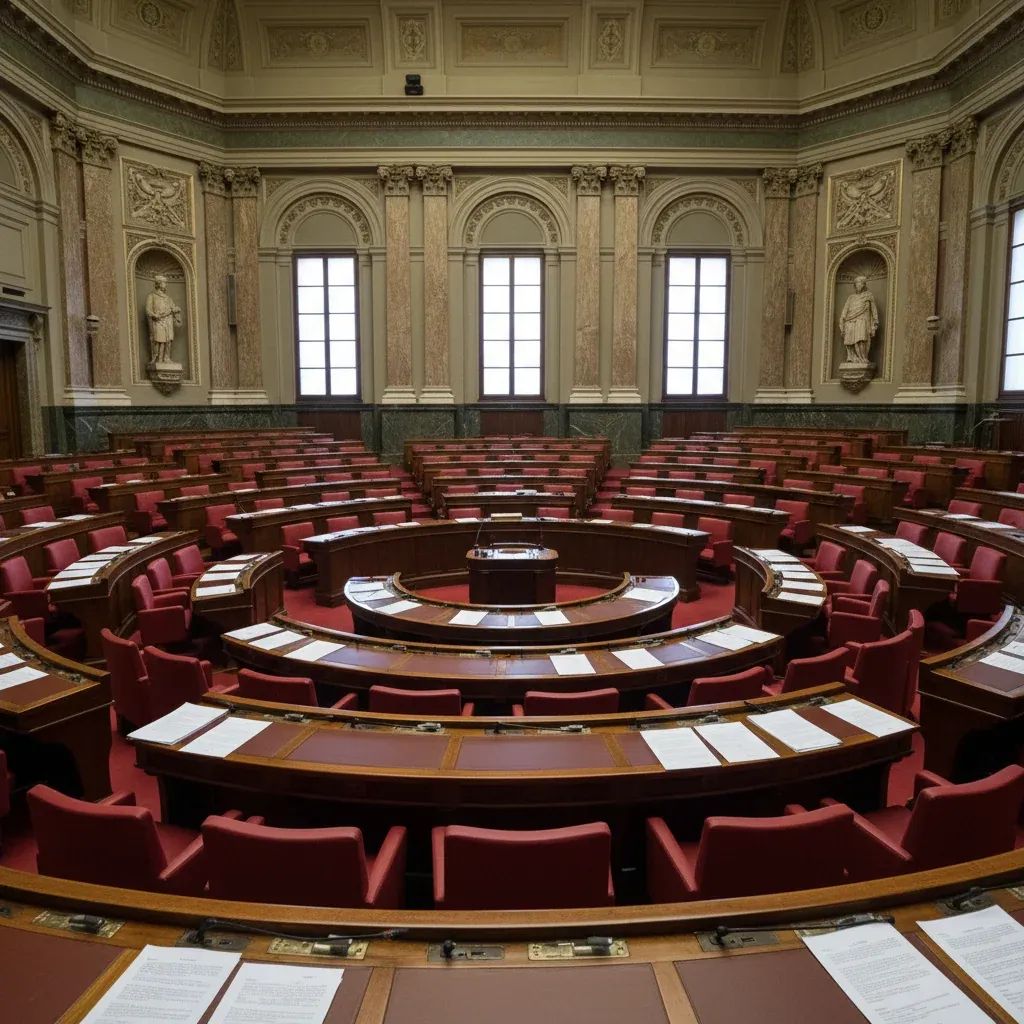
Germany and France have jointly proposed a radical shift in how the European Union manages its expansion eastward, proposing that countries in the Western Balkans and Moldova be granted observer status in EU institutional meetings well before formal membership. The initiative, unveiled just ahead of an EU-Balkans summit in Tivat, Montenegro, represents an attempt to inject momentum into a notoriously slow accession process that has left candidate nations waiting for decades. The proposal awaits formal consideration by the European Commission, which must draft implementing measures.
Why This Matters
Note: The following points describe the proposal's intended effects if adopted and implemented by the EU Commission and member states.
• Institutional access without voting rights: Under the proposal, candidate countries would participate in ministerial councils and technical sessions on issues where they have already aligned with EU standards, providing real-time insight into Brussels decision-making.
• Merit-based incentives: The proposal links tangible benefits—including potential single market access similar to the European Economic Area (EEA) Plus model—to concrete reform milestones.
• Timeline acceleration: Montenegro aims to finalize negotiations by the end of 2026 and join the EU by 2028, while Albania targets closure by late 2027.
The Franco-German Blueprint
The non-paper circulated by Berlin and Paris calls on the European Commission to draft proposals enabling gradual participation by candidate states in Brussels institutions. "We must provide incentives for gradual and merit-based integration and streamline the current process, making it more efficient," the document states.
Under the proposed plan, representatives from the Western Balkans—encompassing Albania, Bosnia and Herzegovina, Kosovo, Montenegro, North Macedonia, and Serbia—along with Moldova, would gain seats at selected EU meetings. They would observe proceedings, contribute technical input, and follow policy dossiers closely, but hold no voting power. The aim is to transform accession from an abstract goal into a visible, concrete trajectory.
The proposal also envisions opening portions of the EU single market to candidates before full membership, contingent on meeting specific reform benchmarks. This echoes the EEA Plus framework and is designed to reward progress in areas such as the rule of law, judicial independence, anti-corruption measures, and democratic institution-building.
Where Candidate Countries Stand in 2026
The accession landscape is marked by stark variation in progress and political hurdles.
Montenegro
Montenegro leads the pack. It has opened all negotiating chapters and provisionally closed roughly half, entering the treaty drafting phase in April 2026. The country's government has set an ambitious target: conclude negotiations by year-end and accede to the EU by 2028. However, challenges persist in Chapters 23 and 24, which cover the judiciary, fundamental rights, justice, freedom, and security.
Albania
Albania is close behind. It has opened all negotiating clusters and recently met interim benchmarks for Cluster 1 (Fundamentals), which includes democratic institutions, public administration reform, the rule of law, and economic criteria. Tirana aims to wrap up talks by the end of 2027 and potentially join by 2030. Judicial independence and corruption remain sticking points.
Serbia
Serbia's negotiations, launched in 2014, face deeper political complexities. Belgrade has provisionally closed just two chapters—science and research, and education and culture. Key obstacles include dialogue with Kosovo, alignment with the EU's Common Foreign and Security Policy (particularly regarding Russia), and rule-of-law reforms. Serbia currently aligns with only 63% of EU foreign policy positions.
North Macedonia
North Macedonia's path is blocked by bilateral disputes within the EU, notably with Bulgaria, which demands constitutional amendments to recognize the Bulgarian minority. Brussels is urging Skopje to implement agreed commitments to break the impasse.
Bosnia and Herzegovina
Bosnia and Herzegovina gained candidate status in December 2022, and the EU Council decided in March 2024 to open negotiations—but the framework hinges on full implementation of reforms. The country confronts deep internal divisions and has yet to open any negotiating chapter.
Kosovo
Kosovo remains the furthest from membership. It applied in December 2022, but the Council has not formally begun reviewing its candidacy. Five EU member states still do not recognize Kosovo's independence, and normalization with Serbia remains a critical hurdle.
Moldova
Moldova secured candidate status in June 2022 and formally opened negotiations in June 2024. The country has made "excellent progress" on Chapter 26 (Education and Culture) and substantial headway in two-thirds of all chapters, particularly in fundamentals, external relations, and the internal market. Chișinău aims to provisionally close negotiations by early 2028 and prepare for entry by 2030. The process unfolds against a backdrop of geopolitical pressure from Russia, including disinformation campaigns and political interference.
What This Means for Residents
For those living in Italy, the Franco-German proposal carries several implications. The EU's expansion eastward is not merely a diplomatic exercise—it directly shapes the bloc's economic stability, security posture, and internal governance.
Geopolitical stability: Integrating the Western Balkans and Moldova into EU structures would reduce the risk of instability on Europe's periphery, particularly amid Russian influence in the region. A more secure eastern flank translates to greater overall EU security.
Economic opportunities: Expanding the single market to include these countries before full membership would open new markets for Italian businesses, particularly in manufacturing, infrastructure, and services. The Growth Plan for the Western Balkans, which aims to integrate the region into the EU economy ahead of formal accession, could create trade and investment opportunities.
Migration and mobility: Closer integration may eventually lead to visa liberalization and labor mobility, affecting migration flows into Italy. The proposal's emphasis on rule-of-law reforms and democratic standards seeks to mitigate concerns about uncontrolled immigration and organized crime.
EU budget and contributions: Enlargement raises questions about financial contributions from net payer countries like Italy. The plan's merit-based structure is designed to ensure that candidate countries meet rigorous standards before accessing full benefits, theoretically limiting fiscal strain.
Debate and Pushback
The proposal has sparked debate across Europe. Supporters argue that observer status would provide a learning window for candidate nations, allowing them to measure their distance from EU norms in real time and rendering the accession path more tangible.
Critics, however, warn that observer status without voting rights offers limited influence and risks becoming a symbolic gesture rather than a substantive reform. Some Eastern European voices have raised concerns about double standards, pointing out that the EU's willingness to fast-track Ukraine and Moldova reflects geopolitical priorities rather than a consistent merit-based approach, potentially undermining incentives for Balkan candidates.
Additionally, the EU faces internal challenges in absorbing new members. The prospect of 35 member states, 35 commissioners, and over 1,000 members of the European Parliament raises questions about institutional efficiency and decision-making, particularly regarding the use of national vetoes. A Eurobarometer survey has shown that European citizens worry about uncontrolled immigration, increased crime and terrorism, and the cost to taxpayers.
Reactions from Candidate Countries
While detailed official reactions remain limited, the general sentiment among candidate nations is cautiously positive. The Western Balkans and Moldova have endured long, often frustrating accession processes, and any mechanism promising faster, more visible integration is likely to be welcomed.
Albania and Montenegro, both making rapid strides, view the proposal as validation of their reform efforts and a potential accelerator toward membership. Bosnia and Herzegovina sees it as a source of concrete incentives tied to structural change. Serbia, balancing EU aspirations with its Kosovo dispute and relations with Russia, is likely to evaluate the proposal cautiously. North Macedonia, stalled by bilateral vetoes, may see observer status as a way to maintain momentum despite political roadblocks.
Moldova, under the pro-European leadership of President Maia Sandu, has embraced the EU path as a matter of both identity and security. The deputy prime minister recently stated that Moldovans are "already Europeans in heart and mindset," and the proposal offers a tangible signal of Brussels' commitment at a time when Russian interference remains a live threat.
The Road Ahead
The Tivat summit on June 5, 2026, served as a platform for EU leaders to discuss the Franco-German blueprint alongside representatives from candidate countries. The proposal now awaits formal consideration by the European Commission, which must draft implementing measures.
Whether observer status proves to be a genuine catalyst for reform or merely a symbolic step will depend on how Brussels structures participation, enforces conditionality, and manages the political dynamics within the EU itself. For candidate nations, the proposal offers a chance to move from the waiting room into the corridors of European power—even if the door to full membership remains locked until all conditions are met.
For Italy and other EU members, the question is whether this incremental approach can balance the bloc's strategic need for expansion with the practical demands of integration, fiscal discipline, and institutional coherence. The answer will shape not only the future map of Europe, but also the daily realities of those living within it.


