
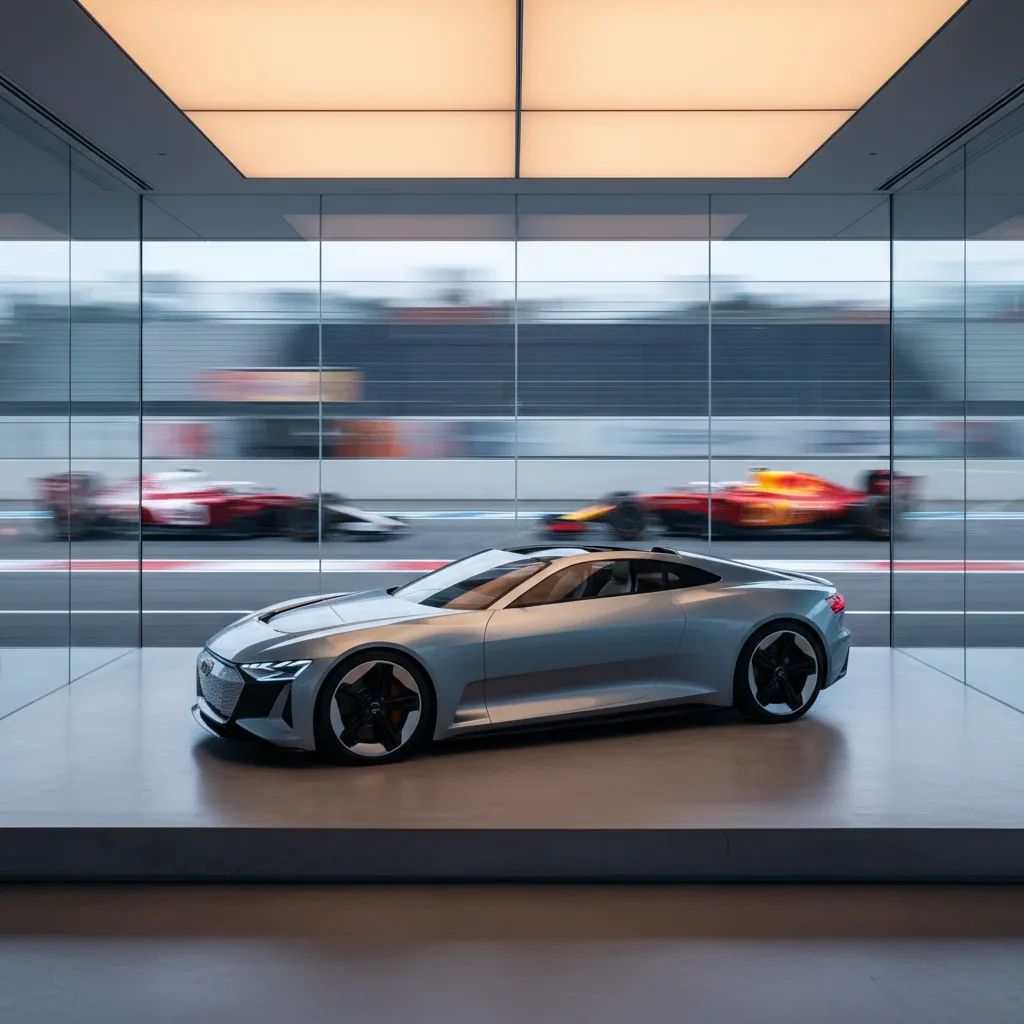
Ferrari, the iconic automaker based in Maranello, has laid out an aggressive product roadmap that will see the company release an average of 4 new models annually between 2026 and 2030—a total of roughly 20 vehicles spanning internal combustion engines (ICE), hybrids, and pure electrics. This multi-technology approach positions Ferrari to appeal to diverse customer preferences while navigating Europe's tightening emissions regulations, a strategy that could offer lessons for Italy's broader automotive sector as legacy carmakers grapple with electrification mandates.
Why This Matters
• Product diversity: Ferrari will maintain V6, V8, and V12 engines alongside hybrids and battery-electric vehicles (BEVs), preserving choice for enthusiasts.
• First electric model: The company's inaugural fully electric Ferrari—provisionally dubbed "Ferrari Elettrica" or "Luce"—will begin deliveries in late 2026, following a spring reveal.
• Revenue target: Ferrari aims to hit €9 billion in net revenues by 2030, supported by cumulative investments of approximately €4.7 billion over the five-year period.
• Dividend approved: Shareholders have greenlit a €3.615 dividend per share, totaling around €640 M in distributions.
A Balanced Powertrain Mix Through 2030
CEO Benedetto Vigna outlined the split at a shareholder meeting: by 2030, roughly 40% of Ferrari's lineup will remain ICE-powered, another 40% will be hybrid, and the final 20% will be battery-electric. That marks a notable revision from the company's 2022 Capital Markets Day, when Ferrari projected 40% BEVs and only 20% ICE by decade's end.
The shift reflects a cooler-than-expected market for high-performance electric sports cars. In fact, Ferrari has postponed its second BEV launch to at least 2028, citing insufficient demand. That mirrors moves by rivals such as Lamborghini, which has pushed its first pure-electric model beyond 2030 and will focus exclusively on plug-in hybrids through the end of the decade.
Vigna has framed the approach as "technological neutrality," arguing it would be "arrogant" to dictate a single powertrain choice to clients who value the visceral experience of naturally aspirated V12s or the immediacy of electric torque. Ferrari intends to let customers decide, rather than front-running regulatory deadlines.
The 2026 Electric Debut: Technical Specifications
The Ferrari Elettrica will be the brand's most radical departure yet. Set for a spring 2026 design unveiling—following an October 2025 reveal of its technical underpinnings—the car will enter production by year-end with the following headline figures:
• Power output: Over 1,000 horsepower in boost mode
• Acceleration: 0–100 km/h in 2.5 seconds
• Top speed: 310 km/h
• Range: 530 km on a single charge
• Battery: 122 kWh structural pack, designed and assembled in-house at Maranello, with 85% of cell mass positioned as low as possible for optimal center of gravity
• Motors: Four electric units (two front, two rear) delivering all-wheel drive
• Weight: Approximately 2,300 kg
• Dimensions: A four-door, four-seat grand tourer stretching roughly 5 meters in length, with a 2.96 m wheelbase
• Chassis: 75% recycled aluminum
• Suspension: Active 48V third-generation system
• Sound signature: Amplified mechanical vibrations—no artificial audio—to preserve Ferrari's acoustic identity
Ferrari will produce batteries, inverters, and electric motors at a new "E-Building" facility in Maranello, aiming to improve energy density by 10% every two years. The engineering draws heavily on the company's Formula 1 expertise, where hybrid powertrains have been mandatory since 2014.
What This Means for Italian Automotive Jobs and Supply Chains
Ferrari's commitment to in-house electric-component manufacturing could bolster specialized engineering employment in Emilia-Romagna, a region already home to Italy's "Motor Valley." By contrast, many mass-market carmakers have outsourced battery production to Asian suppliers, raising concerns about value-chain migration.
The company's dual-track strategy—preserving ICE and hybrid production lines while scaling up electric capacity—also offers a buffer against regulatory uncertainty. European Union rules currently ban new ICE passenger-car sales from 2035, but an exemption exists for vehicles running e-fuels (synthetic hydrocarbons). Vigna has emphasized Ferrari's interest in zero-emission fuels, which could extend the commercial life of its V12 engines and sustain supplier networks for pistons, exhaust systems, and turbochargers.
For Italian component suppliers, this translates to more predictable order books through 2030. Firms producing catalytic converters, fuel injectors, and transmission parts face existential risk if automakers pivot entirely to batteries and electric motors. Ferrari's 40% ICE target keeps those suppliers in the game—at least within the luxury segment.
Competitive Positioning: Ferrari Versus Porsche and Lamborghini
Ferrari's roadmap sits between the aggressive electrification push of Porsche—which targets over 80% BEV sales by 2030—and the go-slow posture of Lamborghini, owned by Volkswagen Group's Audi division.
Porsche already sells the all-electric Taycan and Macan EV, with battery versions of the Cayenne, 718 Boxster/Cayman, and a new seven-seat SUV (codename K1) slated for launch by decade's end. Yet even Porsche has extended ICE lifecycles for certain models after disappointing Taycan and Macan EV uptake, and it plans to keep the 911 gasoline-powered indefinitely using e-fuels.
Lamborghini has gone further, canceling plans for a pure-electric supercar before 2030 after CEO Stephan Winkelmann labeled EV development a "costly hobby" given weak customer appetite. The brand's Lanzador concept, originally envisioned as a BEV, will now debut as a plug-in hybrid GT. Even the next-generation Urus SUV will retain a combustion engine paired with electric assist.
Ferrari's middle path—20% BEV, 40% hybrid, 40% ICE—acknowledges that ultra-high-net-worth buyers prize driving emotion, exhaust note, and mechanical engagement as much as zero-emission credentials. For clients spending €300,000 to €2 M on a car, range anxiety and charging infrastructure matter less than brand heritage and sensory experience.
Lifestyle Expansion and Flagship Retail Openings
Beyond the garage, Ferrari is deepening its lifestyle and experiential offerings to engage both active owners—whose ranks have grown 20% since 2022—and over 400 M global fans who may never buy a car. New flagship stores are planned for London and New York, while bespoke "Tailor Made" centers will open in Tokyo and Los Angeles, allowing clients to personalize everything from stitching patterns to paint formulations.
This vertical integration into luxury goods, collectibles, and branded experiences mirrors strategies at LVMH and Hermès, which have appointed executives to Ferrari's board. Non-executive director Delphine Arnault, daughter of LVMH chairman Bernard Arnault, and Francesca Bellettini, CEO of Gucci parent Kering's Saint Laurent, bring expertise in high-margin brand extensions that can generate revenue without diluting automotive exclusivity.
Ferrari's guiding principle remains producing one car fewer than market demand, ensuring multi-year waiting lists and sustained residual values—a formula that has kept operating margins above 25%, industry-leading by any measure.
Financial Outlook and Shareholder Returns
Shareholders at the April meeting reconfirmed Chairman John Elkann and CEO Benedetto Vigna as executive directors and approved a suite of non-executive appointments, including Piero Ferrari (the founder's son and 10% stakeholder), Sergio Duca, Maria Patrizia Grieco, Michelangelo Volpi, and former NASA engineer Tommaso Ghidini.
The board received renewed authority to issue new ordinary shares and buy back up to 10% of outstanding stock over the next 18 months, tools that provide flexibility for employee equity plans and capital management.
The €640 M dividend equates to a payout ratio in line with Ferrari's policy of returning cash while funding capital expenditure for electrification and facilities expansion. Analysts project the company will grow revenues at a 5% compound annual rate, reaching €9 billion by 2030, driven by price increases, product-mix enrichment (more limited-edition Icona and special-series cars), and lifestyle revenue, which currently represents a low-single-digit share of sales but is expanding rapidly.
Sustainability Commitments and Carbon Neutrality
Ferrari has pledged to cut Scope 1 and 2 greenhouse-gas emissions by over 90% in absolute terms by 2030, relative to a 2021–2024 baseline, and to achieve carbon neutrality across operations within the same timeframe through renewable-energy procurement. The company is installing additional solar capacity at Maranello and sourcing green electricity for the E-Building, which will assemble battery modules using 75% recycled aluminum in chassis structures.
For Scope 3 emissions—generated during vehicle use—Ferrari is banking on a mix of hybrid efficiency gains, e-fuels, and the gradual uptake of BEVs. The relatively low production volumes (Ferrari shipped fewer than 14,000 cars in 2024) mean total lifetime emissions are modest compared to mass-market manufacturers, but the symbolic importance of a luxury brand embracing decarbonization carries weight in policy and investor circles.
What Comes Next
Ferrari will reveal interior details of the Elettrica in early 2026, followed by the full design premiere in spring and first customer deliveries by October 2026. Meanwhile, the pipeline of ICE and hybrid models continues unabated: recent launches include the Purosangue SUV, the hybrid SF90 XX Stradale, and updated iterations of the 296 GTB/GTS.
The company's ability to command seven-figure price tags while investing billions in electrification—without eroding margins or brand mystique—sets it apart in an industry grappling with rising R&D costs, slowing EV adoption, and geopolitical supply-chain pressures. For Italian policymakers and industry stakeholders, Ferrari offers a case study in how heritage, engineering excellence, and disciplined scarcity can coexist with the energy transition—provided the customer base values emotion as much as regulation demands efficiency.


