
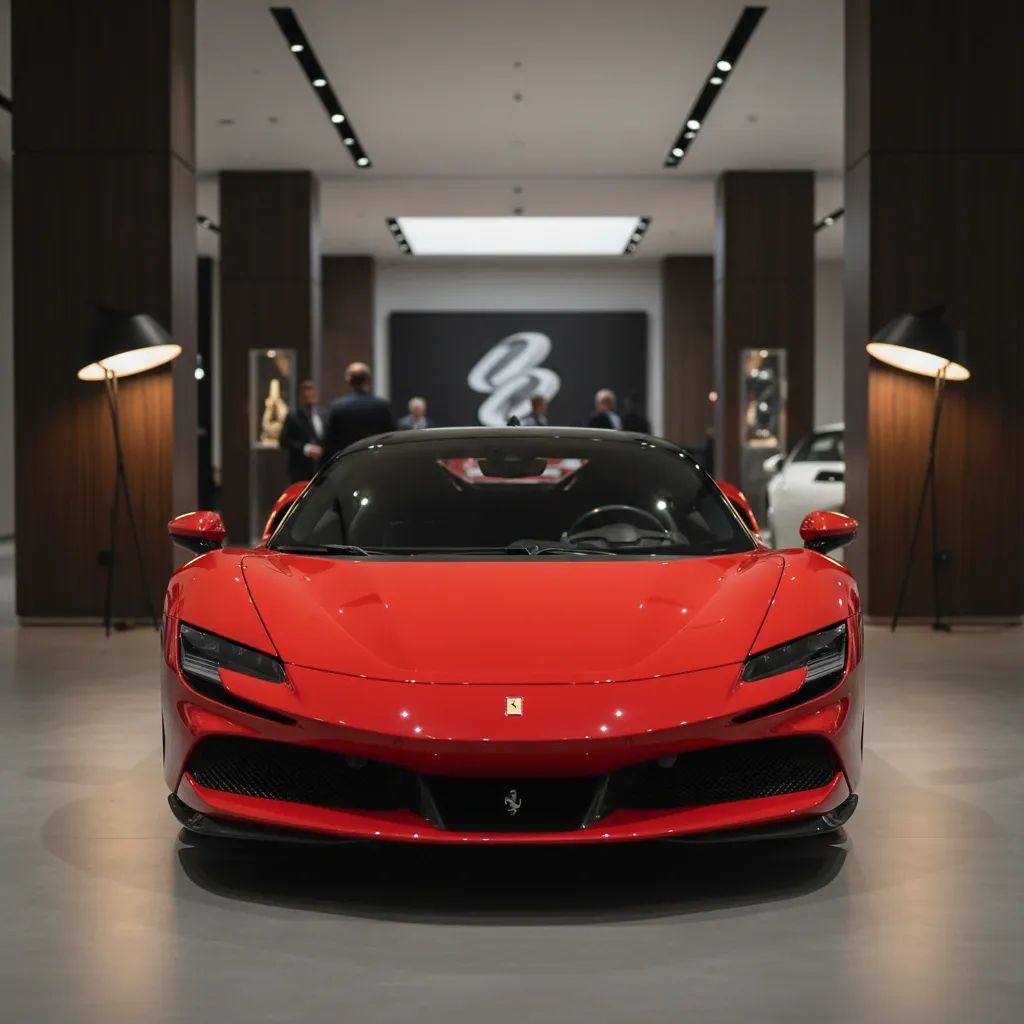
The Italy-based luxury automaker Ferrari, headquartered in Maranello in the Emilia-Romagna region, continues to demonstrate that its true mastery lies not on the racetrack, but in the boardroom—a paradox that has allowed the Prancing Horse to build a global empire of 400M fans despite selling fewer than 350,000 cars since its founding. For Italy's economy, Ferrari represents one of the nation's most valuable exports, generating billions in revenue while cementing the country's status as a luxury goods powerhouse.
Why This Matters
• Business triumph over racing drought: Ferrari hasn't won a Formula 1 driver's championship since 2007, yet its financial results keep breaking records, with net revenues targeting €6.7B in 2026.
• Production philosophy pays off: By deliberately producing fewer cars than demand—keeping wait times beyond two years—Ferrari maintains brand desirability that no competitor has matched.
• Electric pivot without dilution: The first full-electric Ferrari arrives late 2026, part of a portfolio shift that will see 60% hybrid and electric models by year-end while preserving exclusivity.
The Counterintuitive Model That Built a €6.7B Brand
When Gianni Agnelli handed Ferrari's presidency to Luca Cordero di Montezemolo in 1991, the Maranello factory was drowning in debt. The solution Montezemolo engineered was radical: sell something more valuable than horsepower. He repositioned Ferrari to trade in realized childhood dreams rather than just supercars.
The Wall Street Journal's podcast series "Acquired" recently dissected this strategy, describing Ferrari's transformation as "the fusion of Hermès luxury with Manchester United passion." By 1997, the company returned to profitability while manufacturing fewer vehicles—a business model that defied conventional automotive wisdom.
This approach established Ferrari as a luxury house first and car manufacturer second. The proof is in the numbers: 84% of new Ferraris sold in 2025 went to existing owners, reflecting a carefully curated allocation system that treats each buyer as an initiated member rather than a customer. Personalization programs like "Tailor Made" have become substantial revenue engines, with dedicated centers opening in Tokyo and Los Angeles by 2027.
The brand's lifestyle division exemplifies this diversification strategy. Ferrari aims to double revenues from luxury goods, museums, and experiential parks by 2026 compared to 2019 levels. Flagship stores launched in London and New York this year position the Cavallino alongside global fashion houses, extending the brand far beyond engine displacement and lap times.
What This Means for Investors and Enthusiasts
For those tracking Italy's most iconic export, the business case is straightforward: Ferrari vehicles function as appreciating assets, not depreciating machinery. The company's "controlled growth" model targets a 9% compounded annual growth rate through 2026, driven by richer product mixes and enhanced personalization rather than volume increases. Operating margins hover near 28%, exceptional for the automotive sector.
The company's electrification roadmap shows technological pragmatism. By 2030, the product lineup should comprise 40% internal combustion, 40% hybrid, and 20% electric vehicles. This "technological neutrality" allows Ferrari to continue developing distinctive powertrains across all formats, with strategic components designed in-house to preserve uniqueness.
Carbon neutrality by 2030 forms another pillar, with commitments to slash Scope 1 and 2 greenhouse gas emissions by at least 90% in absolute terms. For luxury consumers increasingly conscious of environmental impact, this positions Ferrari as both aspirational and responsible.
The Racing Reality That Doesn't Hurt Sales
While Ferrari's business thrives, its Formula 1 program remains a source of competitive pressure. The team continues development efforts to close performance gaps with rivals like Mercedes ahead of upcoming races. Yet despite Formula 1 struggles, Ferrari's financial success demonstrates that motorsport results no longer drive the company's profitability—a shift that would have seemed impossible decades ago when racing victories defined the brand.
The introduction of Lewis Hamilton to the Ferrari driver lineup adds emotional significance to the program, yet underscores a key reality: the brand's value proposition to consumers rests on exclusivity, heritage, and lifestyle positioning rather than championship trophies. Endurance racing success provides some sporting consolation, but Formula 1 remains the brand's emotional core, even if no longer its financial engine.
The Montezemolo Legacy That Competitors Can't Replicate
The strategic foundation laid during Montezemolo's 1991-2014 presidency explains why Ferrari's business model remains immune to sporting struggles. He understood that selling 330,000 cars to 400M fans created a scarcity dynamic no marketing budget could purchase. His famous mandate—produce "always one car fewer than demand"—created perpetual waiting lists that function as social proof of the brand's desirability.
This philosophy differentiates Ferrari from rivals like Lamborghini and Pagani. Lamborghini caps annual production around 8,200-8,500 units despite demand allowing more, supplementing exclusivity with "Few-Off" limited editions like the Veneno and Centenario. Pagani sits at the ultra-exclusive extreme, with founder Horacio Pagani refusing to exceed 40 vehicles annually, positioning each as functional sculpture.
Ferrari operates at larger scale—approximately 13,700 deliveries in 2023—but maintains comparable mystique through client selection, personalization reaching 100% of customer cars, and strict rules governing modifications and resale. The company's relationship with customers resembles luxury watchmakers like Patek Philippe more than traditional automakers: you don't simply buy a Ferrari; the brand determines if you're worthy of ownership.
The Verdict for Italy's Crown Jewel
The podcast hosts summarized Ferrari's competitive position succinctly: other racing teams may beat the Scuderia on track, other manufacturers may challenge Ferrari on roads, but no competitor has surpassed the Cavallino brand itself. That intangible advantage—built through seven decades of deliberate scarcity, emotional resonance, and business discipline—constitutes Ferrari's true moat.
For residents and investors watching Italy's automotive sector, Ferrari demonstrates how legacy brands navigate disruption. Electrification, sustainability mandates, and shifting luxury consumption patterns haven't forced Ferrari to abandon its core identity. Instead, the company extends that identity across new technologies and product categories while maintaining the production discipline that created its mystique.
The Formula 1 struggles may frustrate tifosi, but Maranello's executives likely sleep soundly. Their real competition isn't other racing teams—it's maintaining the dream that keeps 400M fans devoted to a brand that has sold them nothing, and may never will.


