
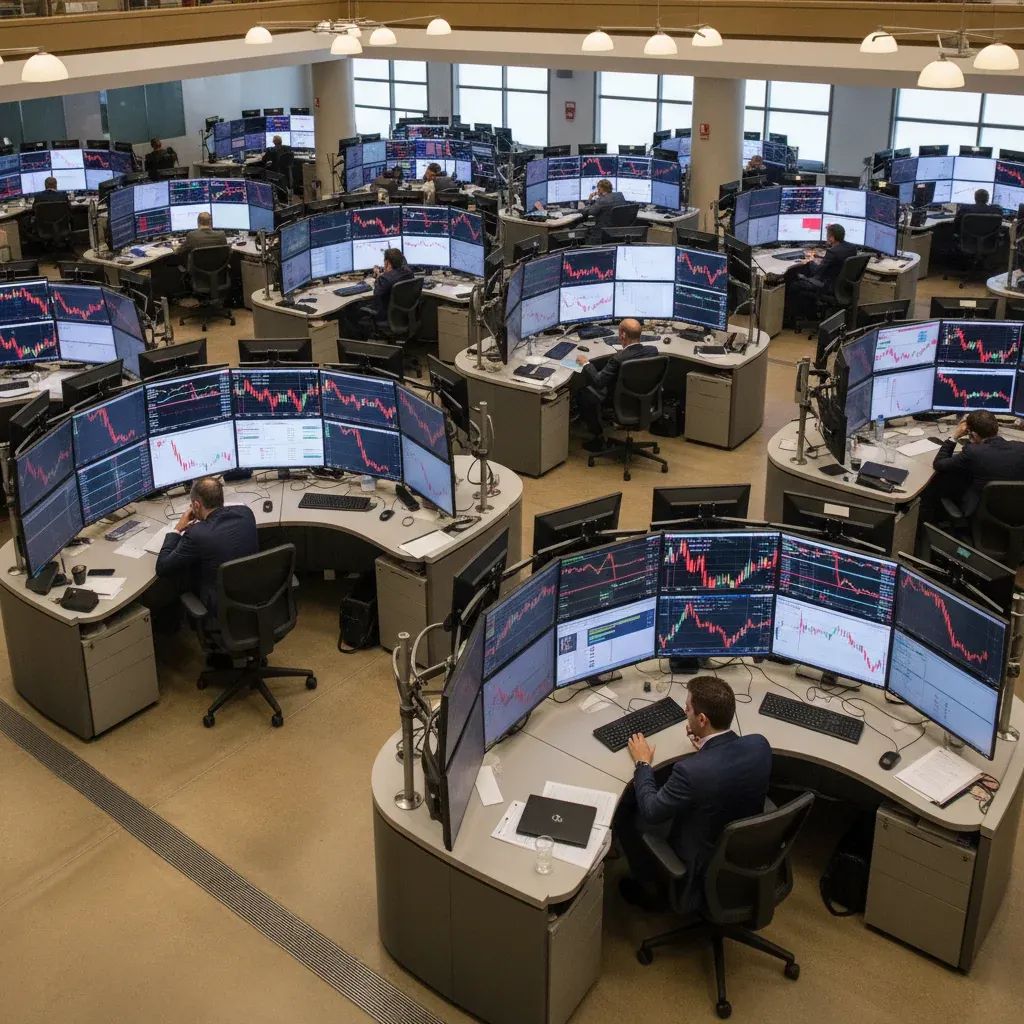
European stock markets have shed €918 billion in market capitalization over the course of a single week, as the escalating Middle East conflict triggers a cascade of investor panic, oil price surges, and renewed fears of stagflation across the continent. For Italy and its neighbors, the fallout means a potential squeeze on household energy bills, uncertain central bank policy, and mounting risks to export-driven industries.
Why This Matters
• Energy costs are spiking again: Oil has jumped over 30% in a week, with Brent crude breaching $90 per barrel. Gas futures climbed 5.2% to €53.39 per megawatt-hour, threatening to push inflation back above the European Central Bank's 2% target.
• Italian equities took a beating: Milan's FTSE Mib index fell 6% over the week and closed down 1.02% today, reflecting broader losses across European exchanges.
• Monetary policy is now in limbo: Markets are increasingly pricing in the possibility of interest rate hikes later in the year—a sharp reversal from earlier expectations of rate cuts.
• Supply chain risks are multiplying: Concerns are growing about potential disruptions to critical energy infrastructure, with particular focus on global oil and gas shipping routes.
The Geopolitical Trigger
The immediate catalyst for the market turmoil has been the escalating conflict in the Middle East, which has intensified tensions across the region. Energy markets have reacted sharply to concerns about potential disruptions to oil and gas supplies, particularly given the strategic importance of the Strait of Hormuz and key energy-producing facilities in the region.
Global oil tankers have already been rerouted to avoid conflict zones, adding delays and logistical costs to an already strained supply chain. Qatar's Energy Minister, according to reports in the Financial Times, has warned of risks to hydrocarbon production and shipment if regional tensions persist. These supply concerns have caused acute alarm in European capitals and trading floors alike.
The Stoxx 600 index, which tracks major companies listed across European bourses, closed at 598.69 points on Friday, down 1% on the day and reflecting the week's broader rout. Other key benchmarks registered similar losses: Germany's DAX 40 fell 4.65%, France's CAC 40 declined 4.9%, Spain's IBEX 35 dropped 4.35%, and London's FTSE 100 shed 5.74%. The Euro Stoxx 50, a blue-chip gauge, lost 6.21% over the five trading days.
What This Means for Residents
For individuals and businesses operating in Italy, the implications are stark and multifaceted. The energy-intensive manufacturing sector—particularly steel, chemicals, and logistics—faces the most immediate pressure. Italy's reliance on natural gas for electricity generation makes it especially vulnerable to price shocks. Industrial production costs are set to climb, squeezing margins and threatening competitiveness.
Households should brace for higher utility bills in the coming months if gas and electricity prices continue their upward march. While Italy has diversified its gas supply away from Russia since the 2022 Ukraine crisis, the country remains dependent on imports from Algeria, Azerbaijan, and liquefied natural gas (LNG) terminals. Any disruption to global energy markets could tighten the global LNG market, pushing spot prices higher and forcing Italian utilities to pass on costs.
Transport and logistics companies are already feeling the strain from diesel price increases. Airlines, trucking firms, and shipping lines all operate on thin margins, and a sustained rise in fuel costs typically leads to surcharges passed on to consumers. Retailers and manufacturers that depend on just-in-time inventory systems could face delays and additional expenses as shipping routes face longer transit times.
Stagflation Specter Returns
The confluence of rising energy prices and weakening economic activity has rekindled fears of stagflation—a toxic mix of stagnant growth and high inflation that plagued Western economies in the 1970s. Antonio Patuelli, president of the Italian Banking Association (ABI), pointed to three specific risks: soaring energy costs (already significant before the latest spike), sharp declines in equity markets, and higher costs for international trade.
Economic simulations suggest the Eurozone could see GDP growth reduced by 0.1 to 0.2 percentage points if oil and gas prices remain elevated. While Europe has built stronger automatic stabilizers since previous energy shocks, the continent's export-oriented economies—Italy included—are ill-equipped to absorb prolonged disruptions in global supply chains.
Inflation data released in February showed headline inflation in the Eurozone at 1.9%, just below the ECB's target, with core inflation (excluding energy and food) at 2.4%. However, analysts now expect headline inflation to surge back above 2% as the energy shock filters through to consumer prices. Morgan Stanley estimates that even a sustained increase in oil prices could delay any further monetary easing and potentially force the ECB to reconsider its policy course.
Central Bank Dilemma
The European Central Bank held its benchmark deposit rate at 2% in early February, pausing after a series of rate cuts aimed at supporting a sluggish recovery. Markets had anticipated further easing throughout 2026, but that scenario is now under serious threat. As of early March, money markets have begun pricing in the possibility of interest rate increases later in the year, with the magnitude and timing dependent on how energy prices evolve and how the Middle East situation develops.
Jose Luis Escrivá, governor of the Bank of Spain and a member of the ECB's Governing Council, described a rate hike at next week's meeting as "very unlikely," emphasizing the need for time to assess the full impact on inflation. Nevertheless, he acknowledged that effects are inevitable. Should oil prices climb significantly—a scenario some analysts consider plausible depending on geopolitical developments—the ECB will face intense pressure to prioritize price stability over growth support.
Across the Atlantic, the Federal Reserve confronts a similar bind. U.S. labor market data for February showed a surprising loss of 92,000 jobs, with the unemployment rate ticking up to 4.4%. The Trump administration has reportedly pressed the Fed to cut rates and stimulate the economy, but rising oil prices complicate that calculus. Morgan Stanley analysts noted that "even a sustained pressure on oil prices could delay rate cuts," leaving the Fed trapped between political demands and inflation risks.
Sectoral Winners and Losers
Not all sectors are suffering equally. Defense contractors and oil majors have seen their share prices climb as geopolitical risk premiums rise and energy revenues swell. Conversely, airlines, automotive manufacturers, and consumer discretionary firms are under acute pressure. Technology stocks and cyclical sectors have exhibited heightened volatility as investors reassess growth outlooks in light of potential stagflation.
Within Italy, the financial sector has shown resilience compared to industrial peers, but banks remain exposed to indirect risks—particularly if energy shocks tip the economy into recession and credit quality deteriorates. Retail investors who piled into equities during the post-pandemic rally are now facing steep unrealized losses, and wealth managers are advising caution and diversification into safe-haven assets such as gold and U.S. Treasuries.
Lessons from Past Crises
Historical precedent offers both caution and some reassurance. Markets have historically proven resilient to geopolitical shocks, often recovering within 12 months as the immediate uncertainty fades. After Russia's invasion of Ukraine in February 2022, European indices initially plunged but clawed back much of their losses within weeks. The S&P 500 recovered its initial decline within a month. However, the energy crisis that followed proved more durable, with gas prices remaining elevated through 2022 and into 2023.
The key variable this time is the duration and intensity of the conflict and its impact on energy supplies. A swift de-escalation could allow markets to stabilize and energy prices to retreat. But a prolonged crisis coupled with significant disruptions to global energy infrastructure could produce a sustained supply shock with deeper and longer-lasting consequences for European economies.
The Road Ahead
Policymakers, investors, and households across Italy now face a period of acute uncertainty. The ECB's next meeting will be closely watched for signals on how seriously officials are taking the inflation threat. Fiscal authorities may need to consider targeted relief measures for vulnerable households and industries if energy costs continue to climb.
For now, the immediate economic damage is measurable: nearly €1 trillion in lost equity value, oil at levels not seen in recent months, and a monetary policy outlook that has shifted dramatically in a matter of days. The coming weeks will determine whether this is a temporary panic or the opening chapter of a more fundamental economic disruption.


