
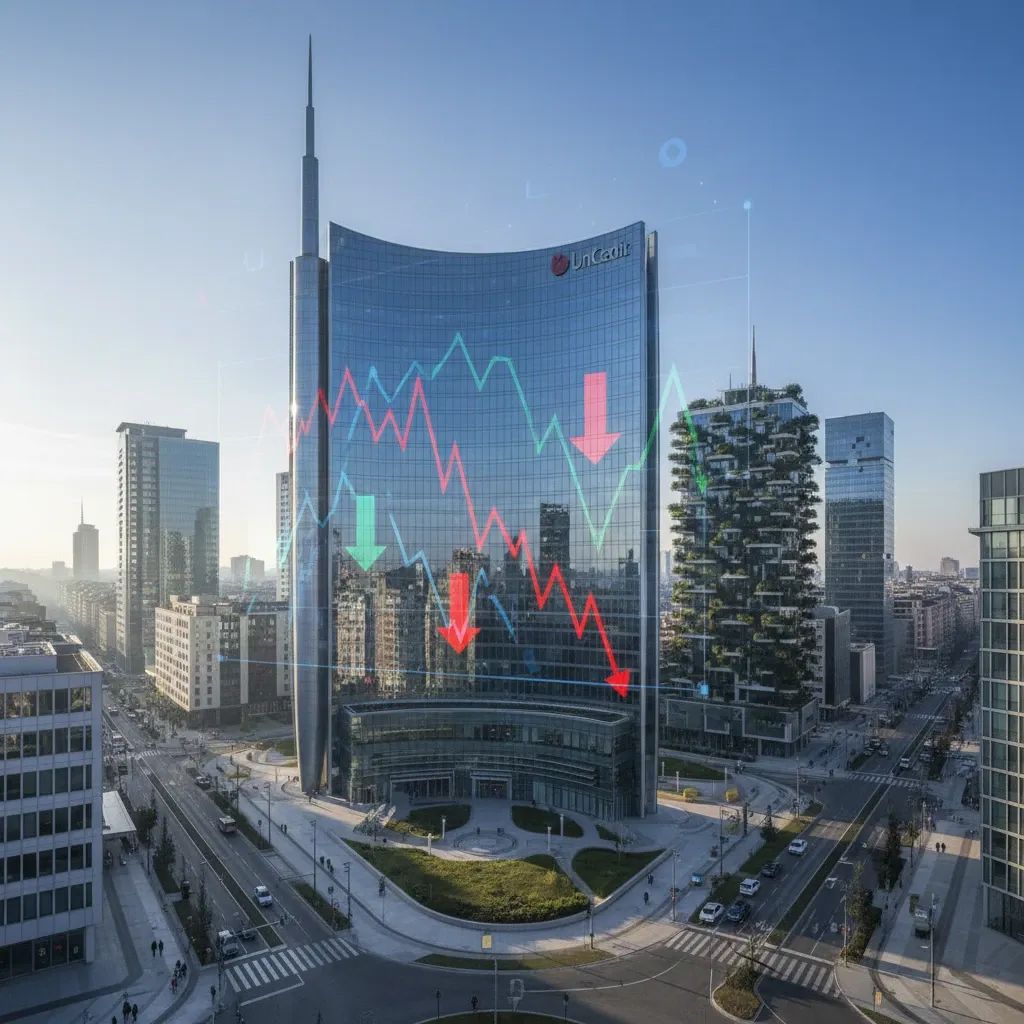
Italy's stock market has plunged over 4% as Middle Eastern conflict sends energy prices soaring, threatening household budgets and industrial competitiveness across the peninsula. The Milan Stock Exchange led European losses on Tuesday morning as investors fled risk assets following a major escalation in the Iran-USA-Israel confrontation and the effective closure of the Strait of Hormuz, a chokepoint for global oil and gas shipments.
Why This Matters:
• Energy bills set to spike: Gas prices jumped 32% to €58.92 per megawatt-hour, threatening to add hundreds of euros to annual household costs.
• Banking and insurance portfolios hit hard: Major Italian financial institutions lost 4-6%, eroding pension fund values and retail investment accounts.
• Supply chain delays imminent: Over 150 vessels are stuck in the Persian Gulf, extending delivery times for imports and raising transport costs.
• Spread pressure mounting: The BTP-Bund spread widened to 68-69 basis points, raising Italy's borrowing costs and straining public finances.
Market Carnage Hits Italian Investors Hardest
The FTSE MIB index, Italy's benchmark, collapsed to 44,335 points during Tuesday trading, marking a cumulative decline of 4.1% from Monday's close and extending a two-day slide that has erased gains dating back to January. The Milan bourse posted the worst performance among major European exchanges, outdoing Madrid's 3.7% drop, Frankfurt's 3.2% retreat, and Paris's 2.6% decline.
For Italians holding stocks directly or through pension funds, the damage is concrete. Unipol, the insurance giant, shed 6% of its value. UniCredit tumbled 5.4%, while Mediobanca fell 5.1%. Smaller lenders including Banca Monte dei Paschi and BPER Banca each surrendered around 4%. The pan-European Stoxx 600 banking index dropped 4%, wiping out billions in market capitalization.
Energy-intensive industrial stocks suffered equally. Saipem, the oil services contractor, crashed 7.3%. A2A, the Lombard utility, slid 5.9%. Prysmian, the cable manufacturer, lost 5.4%, alongside telecom operator TIM.
What This Means for Residents
The selloff translates directly into higher living costs and economic uncertainty for those living in Italy. Natural gas futures surged 32% in a single session to €58.92 per megawatt-hour, the sharpest one-day gain in years. Brent crude climbed 5.7% to $82.18 per barrel, while West Texas Intermediate reached $75.35.
Italy's heavy reliance on imported gas for electricity generation means these commodity spikes will flow through to residential and commercial energy bills within weeks. Analysts estimate a 10-30% increase in household energy costs if prices hold at current levels, potentially adding €200-400 annually to the average family budget. Gasoline and diesel prices at Italian pumps are already climbing, pressuring commuters and logistics firms.
The industrial heartland of northern Italy faces acute vulnerability. Sectors like ceramics, glass, chemicals, and steel—concentrated in Emilia-Romagna, Lombardy, and Veneto—operate on thin margins and cannot easily absorb energy cost shocks. Some plants may idle production if fuel expenses remain elevated, threatening jobs in manufacturing hubs.
Strait Blockade Amplifies Supply Chain Risks
The immediate trigger for Tuesday's panic was confirmation that the Strait of Hormuz, through which roughly 20-27% of global oil and 20-30% of seaborne liquefied natural gas pass daily, has become effectively impassable. At least 150 cargo vessels are stranded in the Persian Gulf, unable or unwilling to transit the narrow waterway amid hostilities.
Major shipping lines including Maersk, Hapag-Lloyd, and MSC have rerouted container traffic around the Cape of Good Hope in South Africa, adding 10-14 days to Asia-Europe voyages and raising freight rates. For Italian importers waiting on components, consumer goods, or raw materials, this means delayed deliveries and higher logistics bills—costs that will eventually reach retail shelves.
The Qatar LNG shutdown following strikes on export facilities compounds the crisis. Italy is the sixth-largest importer of LNG from the Persian Gulf, and alternative sources in Algeria, Libya, and Azerbaijan cannot immediately compensate for lost Qatari volumes. The government in Rome has activated emergency protocols to secure winter reserves, but spot market purchases will come at a premium.
Safe Haven Flows Pressure Italian Debt
Italian government bonds experienced a turbulent session as global investors piled into German Bunds, the eurozone's benchmark safe asset. The BTP-Bund spread—a closely watched gauge of Italy's sovereign risk premium—ballooned to 68-69 basis points, up from 61 bps at the end of February.
The 10-year BTP yield climbed to 3.47-3.48%, an increase of 12 basis points in a single day, while the equivalent German Bund yield rose a more modest 9 basis points to 2.79%. This divergence reflects heightened concern that Italy's large public debt (around 140% of GDP) makes it more vulnerable to energy-driven inflation and slower growth.
For the Italian Treasury, the spread widening translates to higher borrowing costs. Each percentage point increase in yields adds billions of euros to annual debt service, constraining fiscal room for subsidies or tax relief. The timing is awkward: a new BTP Valore retail bond issuance launched March 2-6, offering guaranteed rates of 2.5-3.5% over six years, is now competing against a backdrop of market turmoil.
Winners Emerge in Defense and Energy Sectors
Not every stock suffered. Lottomatica, the gaming and lottery operator, surged 4.6-5% after reporting strong 2025 results, including a 14% rise in betting turnover, 12% revenue growth, and a 45% jump in net profit. Investors bet that consumer discretionary spending on entertainment remains resilient.
Leonardo, Italy's defense and aerospace champion, held steady with a marginal 0.6-0.9% decline, far outperforming the broader market. The company stands to benefit from increased European defense budgets and demand for missile systems and aircraft as geopolitical risk rises.
Eni, the oil and gas major, posted a small gain of 0.1%, cushioned by the rally in crude prices. Italian energy producers with upstream assets or refining capacity can partially offset higher input costs with stronger revenues, unlike pure consumers.
Broader European and Asian Context
The panic extended well beyond Milan. The Stoxx 600, Europe's broad equity gauge, dropped 3.1%, erasing gains accumulated since January. Airlines tumbled 4% on fuel cost fears, while luxury goods makers—including Italian brands Moncler (down 5.5%) and Brunello Cucinelli (off 2.6%)—fell on concerns that discretionary spending will weaken.
Asian markets had already signaled distress overnight. Tokyo's Nikkei 225 closed down 3.06%, while Seoul's KOSPI cratered 7.24%, its worst single-day loss in years. China's Shanghai Composite fell 1.4%, and Hong Kong's Hang Seng shed 1.1%.
Cryptocurrencies also plunged, with Bitcoin dropping 3.5% to $67,000 as risk appetite evaporated. Gold, traditionally a crisis hedge, paradoxically declined 2% to $5,279 per ounce as investors liquidated positions to cover margin calls elsewhere. Silver collapsed 11% to $84.34.
What Comes Next
Market analysts caution that the duration and intensity of Middle Eastern hostilities will determine whether this selloff marks a temporary correction or the start of a prolonged downturn. If the Strait of Hormuz remains blocked for more than a month, some projections suggest European gas prices could more than double, pushing inflation back above 4% and tipping the eurozone toward stagflation.
The European Central Bank faces a policy dilemma: inflation driven by supply shocks is difficult to combat with interest rate tools, yet failing to act could de-anchor expectations. Any rate hikes to cool prices would further burden Italian borrowers and mortgage holders.
For Italian households, the immediate priority is bracing for higher energy bills. Government subsidies deployed during the 2022-2023 energy crisis drained fiscal reserves, leaving less room for relief this time. Industrial lobbyists are already pressing Rome and Brussels for emergency support to prevent factory closures.
The market turbulence also underscores Italy's strategic energy vulnerability. Despite progress on renewable capacity and LNG import terminals, the country remains structurally exposed to shocks originating in the Middle East and North Africa. Accelerating the energy transition and diversifying supply routes remain long-term imperatives.
In the short term, investors and residents alike are watching three variables: whether diplomatic efforts can reopen the Strait of Hormuz, how quickly alternative shipping routes stabilize, and whether oil and gas prices plateau or continue climbing. Until clarity emerges, volatility is likely to persist across Italian equities, bonds, and consumer prices.


