
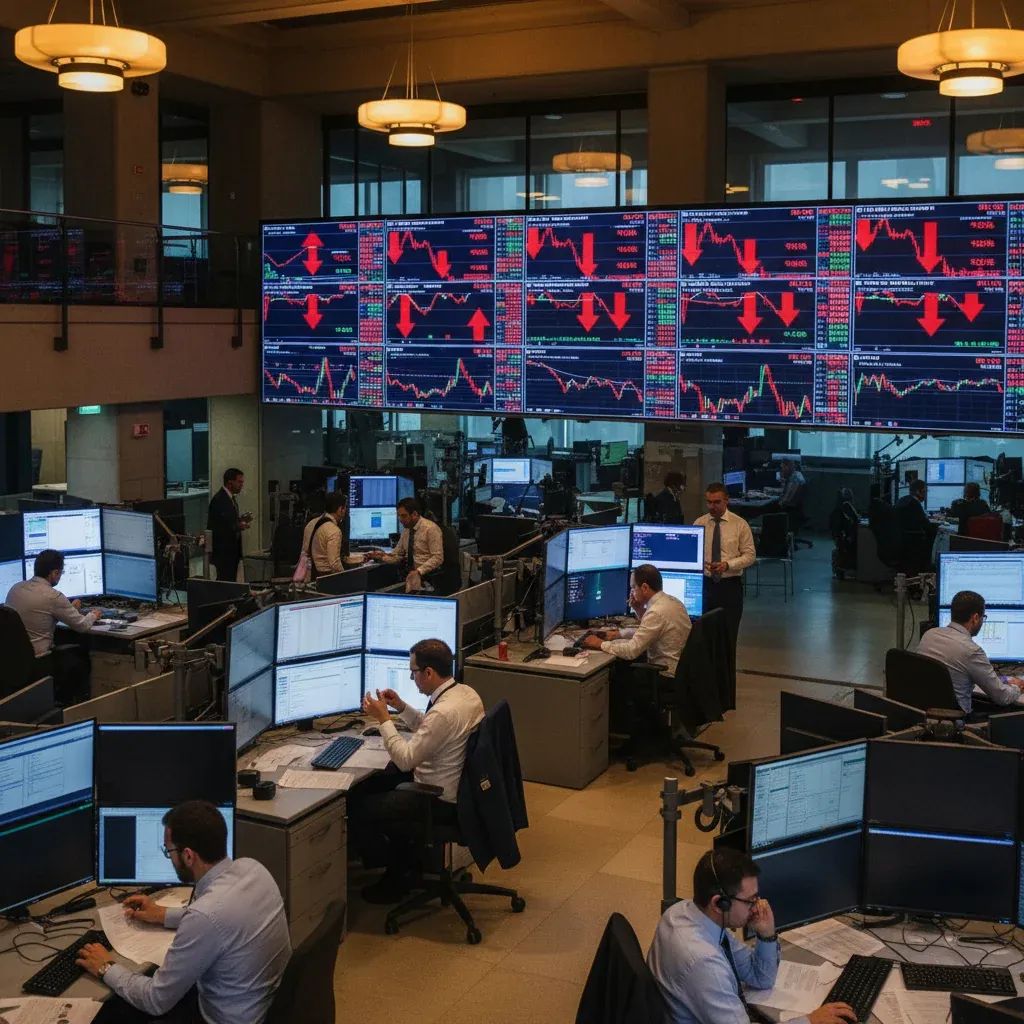
Italy's Piazza Affari plunged more than 2.5% in morning trading as Middle East tensions following a joint US-Israeli military strike on Iran sent shockwaves through European financial markets, pushing energy costs sharply higher and threatening household budgets and business margins across the country.
Why This Matters:
• Energy bills set to surge: Natural gas prices jumped 20% to €38.45 per megawatt-hour, with analysts warning of potential significant spikes if the Strait of Hormuz blockade persists.
• Defense and energy stocks gain: Leonardo climbed 4.6% while Eni rose 3.9%, offering a narrow safe haven for Italian investors.
• Banking and luxury sectors hammered: Major Italian banks lost 4-5%, while automaker Stellantis dropped nearly 6%.
• Gold hits record highs: Safe-haven demand pushed gold to $5,391 per ounce, up 4.1%, as the euro weakened to $1.1737.
The Strait of Hormuz Factor
The crisis centers on Iran's announced closure of the Strait of Hormuz, a narrow waterway through which a substantial share of global oil and liquefied natural gas flows. The blockade has already halted hundreds of tankers and commercial vessels.
For Italy and the broader European Union, this represents a significant challenge. The country relies heavily on energy supplies that transit through Hormuz, and a prolonged shutdown could trigger an energy-driven recession. Shipping companies are already rerouting vessels around Africa, adding days to journey times and imposing significant surcharges. Insurance firms have suspended or sharply limited coverage for the region, with war-risk premiums spiking. The knock-on effects will reach Italian consumers through higher fuel costs, elevated freight charges, and ultimately, broader inflation.
Market Carnage Across Europe
Italy's FTSE Mib index shed 2.5%, dropping below the psychologically important 46,000-point threshold. The decline mirrored losses across European bourses: Madrid fell 2.6%, Frankfurt dropped 1.7%, Paris declined 1.6%, and London lost 0.9%. The pan-European Stoxx 600 was down 1.5% by midday.
Sector performance painted a stark picture of risk aversion. Luxury goods companies, sensitive to discretionary spending and geopolitical uncertainty, collapsed 4%. Richemont lost 6%, Swatch fell 4.9%, Kering dropped 3.7%, and LVMH declined 3.5%. Italian fashion names Moncler and Brunello Cucinelli fell more than 4% each.
Automotive stocks tumbled 3% sector-wide, with Stellantis—one of Italy's largest industrial employers—shedding 5.96%. The dual pressure of rising energy costs and potential supply chain disruptions weighed heavily on manufacturers. Banking shares also suffered, with BPER down 4.5%, Monte dei Paschi off 4.56%, and Mediobanca declining 4.4%. Analysts attribute the selloff to fears of tightening credit conditions and reduced business activity.
Insurance companies lost 1.5%, while utilities dipped only 0.3% despite—or perhaps because of—the gas price surge, which may squeeze margins even as revenues rise.
Winners in the Crisis
A handful of sectors benefited from the geopolitical turmoil. Energy stocks surged 3.4% as Brent crude jumped 8.1% to $78.79 per barrel and West Texas Intermediate (WTI) climbed 7.5% to $72.11. Italy's Eni rose 3.9%, positioning itself as one of the day's few bright spots.
Defense contractors also rallied. Leonardo, Italy's aerospace and defense champion, gained 4.61%, while shipbuilder Fincantieri added 2.2%. Across Europe, BAE Systems surged 6%, Rheinmetall climbed 2.2%, and Saab rose 1.1%. The defense sector stands to benefit from increased military spending and heightened demand for security-related hardware.
What This Means for Residents
The immediate impact for Italians centers on energy affordability. If the Hormuz blockade persists, household heating and electricity bills could rise sharply. Higher energy costs pose a serious threat to household budgets across the country.
Motorists will face higher fuel costs at the pump, with diesel and petrol prices already beginning to reflect the crude oil spike. For businesses, particularly those in manufacturing, logistics, and hospitality, the combination of elevated energy expenses and potential supply chain disruptions poses a serious threat to margins and employment.
Italian government bonds showed resilience, with the BTP-Bund spread widening only slightly to 64 basis points. The 10-year Italian bond yield stood at 3.30%, compared to Germany's 2.66%. This relative stability suggests investors still view Italian debt as manageable despite the external shock.
Aviation and Tourism Under Pressure
Airlines and tourism operators faced sharp losses, down 3.7% and 2.9% respectively. Lufthansa dropped 6%, easyJet fell 3.4%, and Ryanair declined 2.3%. Airspace restrictions in the United Arab Emirates following missile strikes have forced widespread flight cancellations and diversions, creating unprecedented disruptions for travelers.
Italy's tourism sector, a cornerstone of the national economy, is particularly vulnerable. Rising jet fuel costs, longer flight times due to airspace closures, and general traveler anxiety about Middle East instability could impact demand for travel to the region.
Travel insurance premiums are climbing, and tour operators are revising itineraries to avoid the Gulf region entirely. For Italian hospitality businesses dependent on international arrivals, the uncertainty is unwelcome after years of pandemic recovery.
Global Ripple Effects
Asian markets closed sharply lower, with Tokyo down 1.35%, Hong Kong off 2%, Seoul declining 1%, and Mumbai losing 1.8%. Only Shanghai bucked the trend, rising 0.5%. The Japanese yen weakened to 156.80 against the dollar, reflecting reduced appetite for risk assets.
Wall Street futures signaled further pain ahead, with Nasdaq 100 contracts down 2% and S&P 500 futures off 1.6%. The dollar strengthened broadly, with the British pound and Swiss franc both weakening alongside the euro.
Government and Institutional Response
The Italian government has expressed "maximum attention" to the evolving situation and is preparing contingency plans for potential evacuation of citizens and military personnel in the region. The European Union has intensified diplomatic outreach to Middle Eastern partners, seeking to promote stability and protect trade relationships.
The European Commission is reviewing possible adjustments to energy policy to mitigate energy price volatility. In the near term, Brussels is focusing on securing alternative energy supplies and reinforcing strategic reserves.
Italian businesses, particularly in the industrialized northeast, have voiced alarm over the impact on supply chains and export competitiveness. Trade associations are urging the government to consider targeted fiscal relief for sectors most exposed to energy cost spikes.
What Comes Next
Market analysts are cautiously treating the current shock as potentially temporary, contingent on diplomatic progress and the duration of the Hormuz blockade. However, if the crisis deepens or extends beyond several weeks, the economic fallout could shift from a short-term market correction to a structural slowdown affecting growth, inflation, and employment across Europe.
For Italian households and investors, the immediate priority is monitoring energy prices and adjusting budgets accordingly. Those with exposure to banking, automotive, and luxury stocks may face further declines, while defense and energy holdings could provide some downside protection.
The Italian Treasury and Bank of Italy are closely watching bond market dynamics, prepared to intervene if spreads widen significantly. For now, the country's debt position remains stable, but prolonged instability could test investor confidence.
The situation remains fluid, and the coming days will be critical in determining whether this represents a brief shock or the opening chapter of a prolonged economic challenge.


