
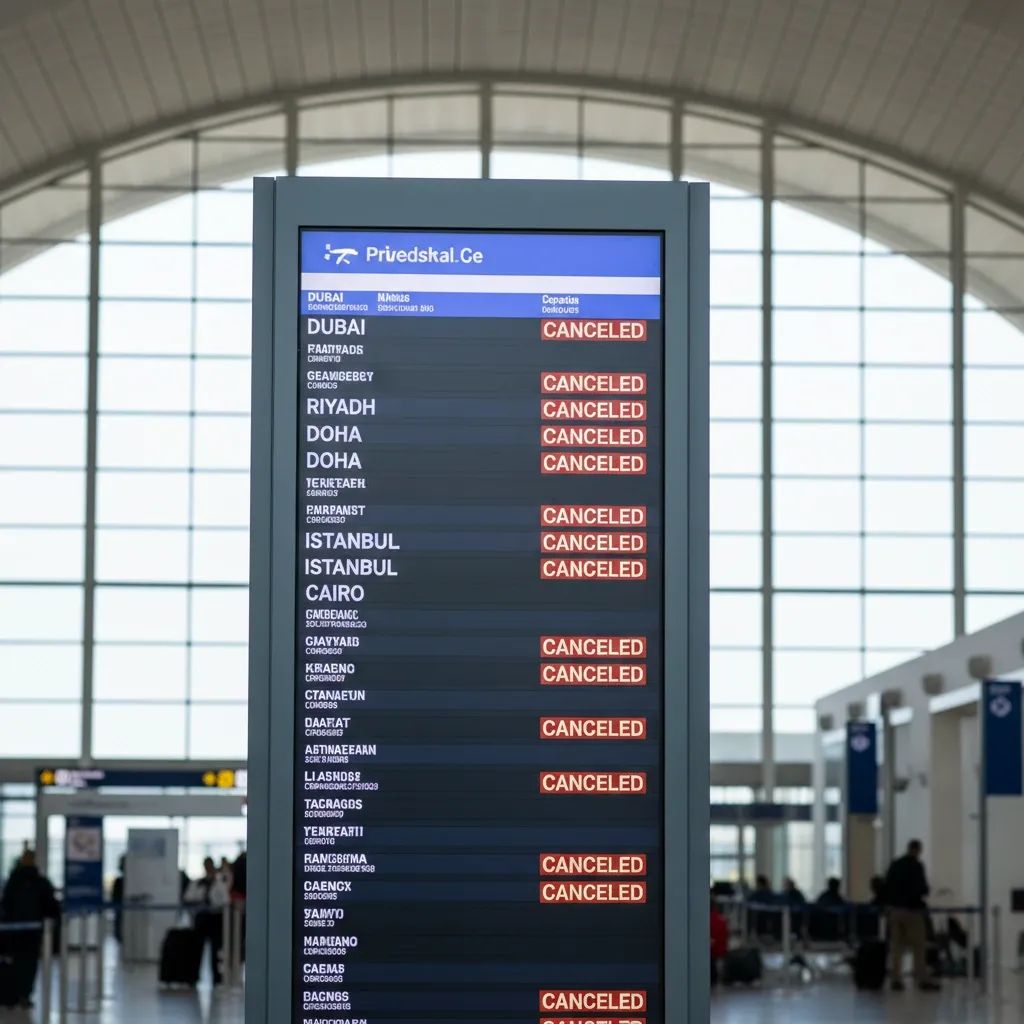
The European Commission confirmed this week that jet fuel supplies across the European Union remain stable, even as officials develop contingency plans to address potential future disruptions stemming from Middle East tensions. While no shortages currently exist, the bloc's oil coordination group will reconvene later this week to assess evolving risks and ensure Europe is prepared for any scenario. A Commission spokesperson emphasized that aviation fuel availability remains secure, though geopolitical developments warrant careful monitoring.
Why the EU is Taking Precautions:
• Europe imports 30% of its jet fuel, much of it from the Gulf region, creating a vulnerability if supply routes are disrupted.
• The International Energy Agency (IEA) has assessed that Europe's jet fuel reserves could last approximately six weeks if supply routes from the Middle East were cut off.
• Approximately one-third of global oil and a significant portion of refined jet fuel pass through the Strait of Hormuz, a narrow waterway currently at the center of rising geopolitical tensions involving the United States, Israel, and Iran.
• Airlines and airport operators have requested the EU develop emergency measures, including shared reserves and temporary adjustments to operational constraints, should they become necessary.
The Strait of Hormuz and Supply Chain Vulnerability
Europe's precautionary approach reflects awareness of structural vulnerabilities in its aviation fuel supply chain. An estimated 75% of the bloc's net jet fuel imports originate in the Middle East. The Strait of Hormuz remains the critical chokepoint: any prolonged restriction or blockade would create serious challenges for European aviation.
Europe produces roughly 70% of its aviation fuel domestically, with refining capacity concentrated in a handful of member states. However, that capacity has been shrinking. Several refineries have closed or pivoted to biofuel production in recent years, and many remaining plants are already running at high levels for jet fuel output. The remaining 30% gap must be filled by imports. These import channels face potential risk in the event of geopolitical disruption, which is why the Commission is developing contingency protocols now.
Regional airports and smaller fuel consortia typically hold only days or weeks of inventory. In a theoretical supply crunch, airlines would prioritize major hubs, potentially leaving secondary airports exposed. The IEA's six-week assessment assumes that at least half of Middle Eastern supplies could be replaced from alternative sources—a scenario that would depend on global market conditions and competitor demand from Asia.
What This Means for Travelers and Businesses in Italy
Currently, Italy's aviation sector continues normal operations. However, should supply disruptions occur, impacts could extend beyond the aviation industry. Corporate travel budgets could face pressure, and companies may be pressed to increase remote work arrangements if the Commission recommends reducing air travel for essential purposes—a measure reportedly under discussion as a contingency.
For leisure travelers planning summer holidays, it's prudent to monitor developments. In a supply disruption scenario, fewer flight options or higher fares could materialize. Train travel could become an attractive alternative, and subsidies for rail tickets are among the options being considered as part of the EU's contingency response toolkit.
Italy's tourism industry, which depends heavily on international air arrivals, could face challenges if fuel supply disruptions occur. A sustained fuel crunch would create risks for hotels, restaurants, and cultural sites during peak summer months. Export-oriented businesses relying on air cargo should monitor the situation, though current operations remain unaffected.
Practical guidance for residents: Continue with normal travel planning, but stay informed about EU policy developments. If Middle East tensions escalate further, adjustments to flight availability and pricing could follow, but no disruptions are anticipated at this time.
Brussels Prepares Contingency Options
The EU's oil coordination group is developing precautionary measures to ensure Europe can respond effectively if disruptions occur. These contingency options include:
• A potential jet fuel-sharing mechanism among member states to pool supplies strategically if needed
• Possible temporary adjustments to the EU's carbon market for aviation to reduce operational constraints during a crisis
• Revised airport slot rules to allow carriers flexibility in reducing frequencies without losing takeoff and landing rights if necessary
• Coordinated fuel distribution protocols and stockpile management across borders
The Commission has mapped Europe's refining capacity and is identifying ways to maximize jet fuel production from existing plants should an emergency require it. The EU's oil coordination group is expected to provide updated assessments on these contingency frameworks in the coming weeks.
Long-Term Strategic Shift: The ReFuelEU Regulation
The current geopolitical focus on aviation fuel has lent urgency to the EU's longer-term aviation strategy, centered on the ReFuelEU Aviation regulation, which came into force in January 2025. This regulation mandates that fuel suppliers at EU airports blend increasing shares of sustainable aviation fuels (SAF) into conventional jet fuel—starting at 2% in 2025, rising to 6% by 2030, and reaching 70% by 2050. Synthetic e-fuels must also be included from 2030 onward.
SAF, derived from waste oils, agricultural residues, and other renewable feedstocks, can cut lifecycle carbon emissions by 65% to 80% compared to fossil kerosene. Importantly, they are "drop-in" fuels, compatible with existing aircraft and infrastructure. Currently, SAF accounts for less than 1% of global jet fuel consumption, constrained by costs that are three to five times higher than conventional fuel and limited production capacity.
To accelerate SAF deployment, the Commission plans a €500M pilot auction for e-SAF in 2026, followed by a broader European mechanism in 2028. The EU's emissions trading system (ETS) is set for review in 2026, with potential funding mechanisms to support e-SAF development.
Switzerland, closely aligned with EU rules, adopted the ReFuelEU framework on January 1, 2026, requiring a 2% SAF blend at Zurich and Geneva airports. Such mandates are intended to create demand signals robust enough to justify large-scale SAF production, though the industry ramp-up will extend over several years.
Future Technologies: Electric and Hydrogen Flight
Beyond SAF, the aviation industry is exploring longer-term alternatives to conventional liquid fuels. Electric aircraft, powered by batteries, promise near-zero emissions on short routes. Prototypes have demonstrated technical feasibility, and EasyJet and partners are targeting commercial electric services on select short-haul routes by 2027. Battery weight and range limitations remain engineering challenges for longer flights.
Hydrogen-powered aviation represents an even more transformative possibility. Using hydrogen in fuel cells or direct combustion, aircraft would emit only water vapor, with substantially reduced nitrogen oxide output. Airbus's ZEROe project aims to bring a commercial hydrogen airliner to market by 2035, and KLM plans to test a hydrogen-powered engine in 2026. However, the technology requires cryogenic infrastructure, new airport investments, and above all, large-scale supplies of green hydrogen—a supply chain that remains nascent.
What Expats and Investors Should Monitor
For expatriates living in Italy, the evolving jet fuel situation warrants attention to policy developments, though immediate changes are not anticipated. Those maintaining ties to countries outside Europe may want to monitor travel cost trends over the coming months. Employers may evaluate travel policies as a precaution, though current reimbursement practices are unlikely to change absent an actual supply disruption.
Investors with exposure to Italy's aviation, tourism, or logistics sectors should track EU policy announcements and geopolitical developments. Airlines operating out of Italian hubs like Rome, Milan, and Venice could experience margin effects from fuel costs should prices rise significantly. Conversely, companies positioned in renewable fuel production, rail transport, or energy infrastructure could benefit from policy shifts and new funding mechanisms.
The bottom line: Europe's aviation sector is being monitored for vulnerabilities in its fuel supply chain. While current supplies are stable and no disruptions are anticipated, the EU is prudently developing contingency plans. For Italy's residents, the immediate advice is to proceed with normal travel planning while staying informed about policy developments and geopolitical events that could affect aviation in the months ahead.


