
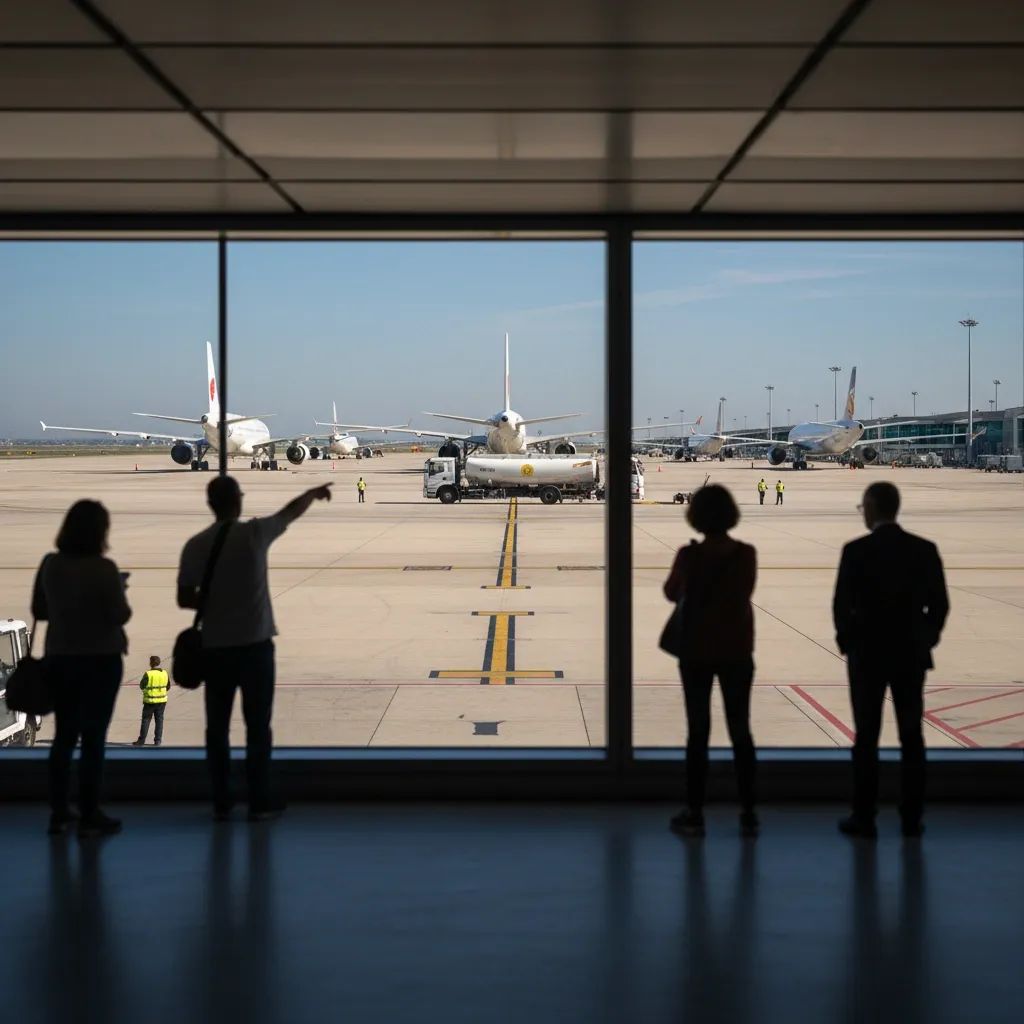
The Italy transport sector faces a critical deadline as European airports warn they may run out of jet fuel within three weeks unless geopolitical tensions ease and supply routes reopen. The crisis, triggered by the near-total blockage of the Strait of Hormuz, threatens to ground flights across the continent just as peak summer travel season approaches—a nightmare scenario for Italy's tourism-dependent economy.
Why This Matters
• Italy's northern airports have already begun rationing fuel, limiting short-haul flights to preserve reserves during the crisis.
• Jet fuel prices have doubled since February, costs that will inevitably reach travelers through higher ticket prices.
• A significant portion of the EU's aviation fuel originates in the Persian Gulf, making Italy and its neighbors acutely vulnerable to supply disruptions in the region.
• The crisis could trigger mass flight cancellations by mid-May, collapsing the infrastructure that brings millions of tourists to Italy each year.
A Ticking Clock for Italy's Aviation Infrastructure
Airports Council International Europe (ACI Europe), representing airport operators across the European Union, sent an urgent letter to EU Transport Commissioner Apostolos Tzitzikostas on April 10, warning of a "systemic shortage" of aviation fuel. The timing is particularly dire: with only weeks before the critical May–August tourism window, Italy's airport operators are watching their reserves drain with no guaranteed resupply pipeline.
The organization emphasized that current stockpiles are dwindling as military activity around the Strait of Hormuz continues to strangle the maritime routes that supply European refineries and airports. While the strait remains technically open, maritime traffic has been significantly reduced, with vessels carefully navigating the passage amid ongoing geopolitical tensions.
Italy's situation mirrors a broader European crisis, but the impact here carries unique weight. The country's economy leans heavily on international tourism, which generated over €50B in 2024 alone. Aviation is the arterial system of that ecosystem, connecting Rome, Milan, Venice, and Florence to millions of visitors from around the globe. A sustained fuel shortage would not only ground planes but could also collapse hotel bookings, restaurant revenues, and retail spending across the peninsula.
Rationing Measures Already Underway in Northern Italy
Several Italy-based airports have moved beyond warnings to active restrictions. Fuel allocations for short-range flights—those under three hours—have been reduced, making operations either uneconomical or technically challenging for some carriers.
These measures are not precautionary—they are reactive. Airlines operating out of these hubs report that fuel suppliers can no longer guarantee deliveries for May onwards, forcing carriers to recalibrate schedules, cancel routes, and in some cases, ground aircraft entirely. Multiple carriers have announced significant reductions to their April schedules, with warnings of deeper cuts if the crisis persists.
For passengers, the immediate consequence is twofold: fewer available seats and steeper fares. Airlines are responding to the doubling of fuel costs by passing expenses downstream through aggressive surcharges. What was an affordable ticket months ago may now cost significantly more—assuming the route remains operational.
Italy's Strategic Reserves and the Timeline for Collapse
Italy maintains jet fuel reserves as part of broader EU energy security measures. However, with rationing already in place and airlines practicing operational adjustments to manage fuel availability, actual reserves are depleting as consumption patterns shift.
Across the European Union, reserve levels vary by member state. The majority of EU countries maintain strategic stockpiles designed for supply disruptions. Even if the Strait of Hormuz reopens immediately, logistical realities impose a four-week minimum for shipments to reach European ports, followed by additional time for refining, distribution, and restocking. ACI Europe estimates that returning to pre-crisis availability levels could take several months, particularly given the ongoing disruptions in the region.
What This Means for Residents, Travelers, and Businesses
For Italians planning domestic or international travel this summer, the jet fuel crisis introduces profound uncertainty. Flight cancellations, schedule disruptions, and fare inflation are no longer hypothetical—they are unfolding in real time. Business travelers relying on Milan's airports for corporate mobility face constraints on short-haul connectivity, potentially forcing rail alternatives or virtual meetings.
The tourism sector confronts an existential threat. If fuel shortages force widespread cancellations during June, July, and August, Italy's coastal resorts, cultural sites, and hospitality industry could see significant revenue losses. Small businesses in tourist-heavy areas—restaurants, boutique hotels, guided tour operators—operate on slim margins and depend on predictable visitor flows. A disrupted summer season could trigger economic consequences for communities across the country.
Investors and executives in Italy's aviation and logistics sectors are watching the EU's response closely. ACI Europe has called on the European Commission to map current and projected fuel availability, identify alternative import sources, assess threats to intra-EU fuel flows, and consider joint procurement of aviation fuel. The organization also urged temporary modifications to import regulations to facilitate alternative supply arrangements.
Brussels Responds with Coordination—But No Silver Bullet
EU Energy Commissioner Dan Jorgensen issued recommendations urging member states to avoid policies that would spike fuel consumption, restrict the free movement of petroleum products, or compromise refinery output. He called for rigorous monitoring, timely information sharing, and coordinated planning through the Oil Coordination Group and the Energy Union Security Task Force.
Brussels also pushed for postponing non-urgent refinery maintenance and accelerating the adoption of sustainable aviation fuels (SAF) to relieve pressure on fossil-based supplies. Under the ReFuelEU Aviation regulation, fuel suppliers must blend at least 2% SAF into conventional jet fuel at EU airports by 2026, rising to 70% by 2050. However, SAF production remains expensive and limited in scale, making it an insufficient short-term solution.
The European Commission has not yet announced emergency purchases or invoked strategic reserve releases, leaving individual member states and airports to manage the crisis with their own resources and ingenuity.
Historical Echoes and the Vulnerability of Air Travel
The current crisis bears striking resemblance to the oil shocks of 1973 and 1979, when geopolitical events triggered major disruptions in global energy supplies and sparked recessions across Western economies. Those earlier disruptions reshaped energy policy, spurring investments in strategic reserves and fuel efficiency standards. Yet aviation remains uniquely vulnerable. Unlike ground transport, which can pivot to rail, electric vehicles, or alternative routes, air travel depends entirely on liquid hydrocarbon fuels—and in Europe, those fuels arrive predominantly by sea from the Persian Gulf.
The Strait of Hormuz is a critical chokepoint through which a substantial portion of global seaborne oil passes. Italy, like the rest of the EU, has no immediate substitute for this supply artery.
Searching for Alternatives Beyond the Gulf
European nations are scrambling to diversify fuel sources. Alternative refining capacity in other regions is emerging as a potential supplier for European markets, offering alternatives to traditional Persian Gulf imports. U.S. and other international refineries are also fielding inquiries, though shipping adds cost and time.
Various countries are reorienting supply strategies while expanding strategic reserves. Asian countries have already implemented fuel management measures. The global aviation fuel market is effectively in crisis mode, with every region competing for limited supply.
For Italy and its European neighbors, the path forward depends on three variables: diplomatic resolution of the Hormuz blockage, accelerated development of alternative supply chains, and disciplined management of existing reserves. None of these factors is fully within the control of airport operators, airlines, or even national governments.
What Comes Next
If the Strait of Hormuz remains operationally blocked through the end of April, Italy and the broader EU will enter May with critically low fuel reserves and no confirmed resupply timeline. Airlines will be forced to ground additional aircraft, cancel routes, and impose fuel surcharges that price out leisure travelers. The summer tourism season—worth tens of billions to the Italian economy—will contract sharply.
Even in a best-case scenario where maritime traffic resumes immediately, the lag time for shipments, refining, and distribution means shortages will persist into June. The Italian government, along with EU counterparts, must decide whether to invoke emergency measures: releasing strategic reserves, subsidizing fuel costs for carriers, or imposing demand-side restrictions.
For now, travelers should monitor airline communications closely, expect higher fares, and prepare for last-minute itinerary changes. Businesses dependent on aviation connectivity should explore contingency plans, including rail alternatives for intra-European travel. And policymakers face a stark reminder: in an interconnected global economy, stability depends on the free flow of energy—and that flow can vanish in a matter of weeks.


