
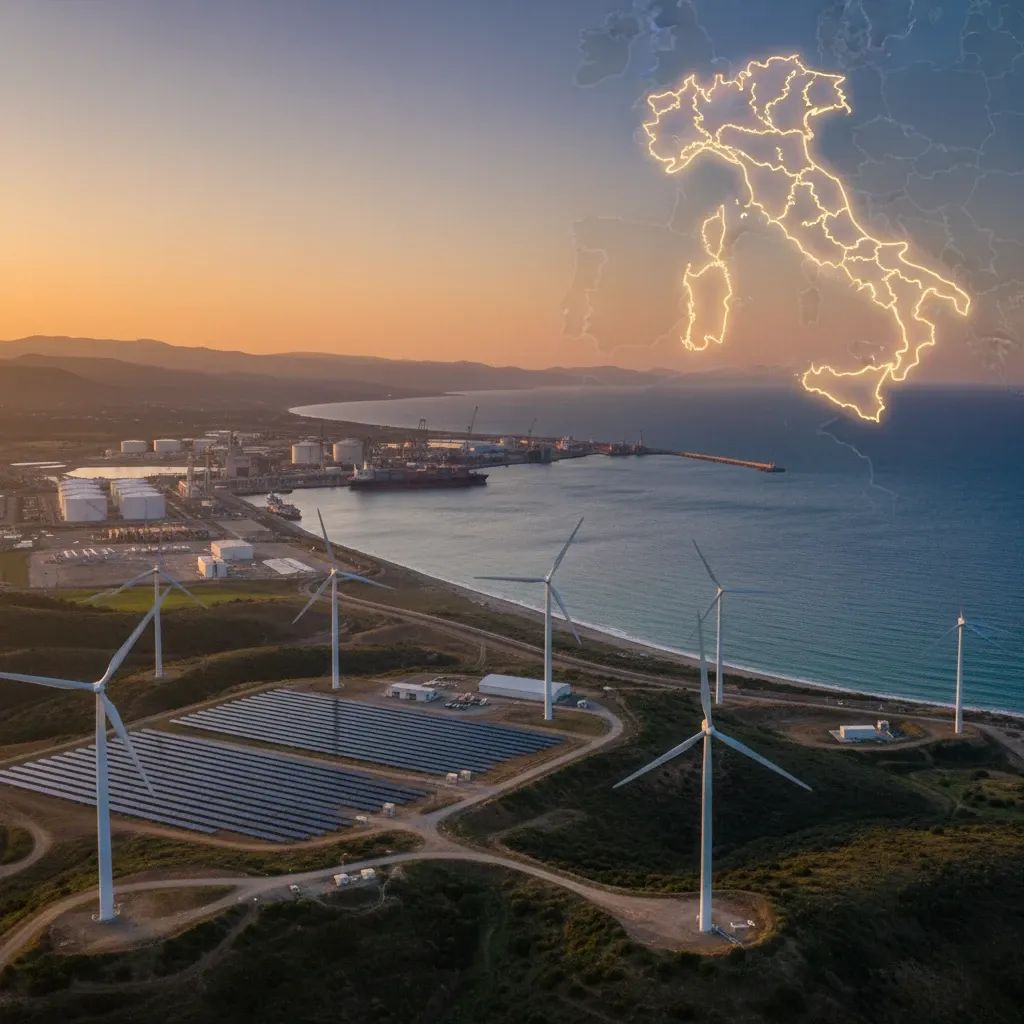
Italy's Friuli Venezia Giulia region is weighing a direct partnership in Slovenia's planned expansion of the Krško nuclear plant, a move that could lock in stable electricity pricing for one of the country's most energy-intensive industrial zones but also reignite dormant debates over nuclear safety and public investment priorities.
Why This Matters
• Energy costs: Friuli Venezia Giulia's manufacturing sector faces electricity prices significantly higher than France, Germany, and Spain, eroding competitiveness in metalworking and heavy industry.
• Timeline reality: Slovenia's second reactor at Krško won't deliver power until the 2040s, meaning no immediate relief for current energy bills.
• Seismic risk: The existing Krško plant sits in a seismically active zone roughly 130 km from Trieste, a factor that has divided local officials.
• Financial scale: The JEK2 expansion carries an estimated price tag between €9.3 billion and €22 billion, depending on reactor capacity and financing model.
The Industrial Push Behind the Proposal
Michelangelo Agrusti, president of Confindustria Alto Adriatico—the regional employers' federation—floated the idea of a trilateral collaboration involving Friuli Venezia Giulia, Slovenia, and Croatia to secure discounted electricity from the expanded Krško facility. Sandra Savino, undersecretary at Italy's Ministry of Economy and Finance and regional secretary for Forza Italia in Friuli Venezia Giulia, publicly endorsed the concept this week, arguing that the region "lives a few kilometers from a nuclear reality" and must approach the question "without slogans or ideological prejudice."
Savino's statement emphasized that Friuli Venezia Giulia hosts one of Italy's most important industrial clusters, where predictable energy pricing and supply continuity are "essential conditions for defending jobs, investments, and competitiveness." She framed potential involvement not as a simple cross-border transaction but as a strategic lever to position the region within continental energy, logistics, and production networks.
Antonio Paoletti, president of the Venezia Giulia Chamber of Commerce, also backed the assessment, viewing partnership in Krško as a pathway toward regional energy self-sufficiency.
What Slovenia Is Actually Building
The JEK2 project envisions a second pressurized water reactor at the existing Krško site, with generating capacity between 1,000 and 2,400 megawatts. In February 2026, the Slovenian Cabinet approved preparation of a National Spatial Plan for JEK2, setting a timeline for final government adoption in autumn 2028 and a binding investment decision by 2029. Technical studies are due by the end of this year.
Westinghouse (with its AP1000 reactor) and France's EDF (offering EPR and EPR1200 designs) began feasibility and site studies in March 2025 and remain the two frontrunners for the contract. Slovenia considers the project self-financeable through sovereign debt, though officials have left the door open to equity participation by neighboring countries, investment funds, and domestic utilities. Croatia, which co-owns the current Krško reactor on a 50-50 basis with Slovenia, has signaled interest in maintaining an equal stake in the expansion.
A national referendum in Slovenia is scheduled for late 2027 or early 2028, pushed back from an initial November 2024 date to allow voters access to more concrete project details. If approved, the reactor would come online sometime in the 2040s, with the existing unit—recently granted a 20-year license extension—operating until at least 2043 and potentially 2063 with proper maintenance.
Political Fault Lines in Friuli Venezia Giulia
Regional president Massimiliano Fedriga called the partnership idea "good but entirely to be verified in practice and on regulatory fronts," signaling cautious openness without commitment. Yet the proposal has exposed sharp divisions within the Friuli Venezia Giulia Regional Council.
Rosaria Capozzi of the Five Star Movement flatly rejected the notion of regional equity in Krško, citing the plant's location in a seismically vulnerable area, the project's long construction horizon, and her conviction that public funds should flow toward energy efficiency and renewables instead. Massimo Moretuzzo and Giulia Massolino of the Patto per l'Autonomia – Civica FVG echoed those objections, labeling nuclear investment a "strategic error" and urging focus on wind, solar, and storage.
Even Fabio Scoccimarro, the region's environment minister, expressed reservations despite not opposing next-generation nuclear technology in principle. Scoccimarro highlighted the "seismic criticality" of the Krško site and warned that heavy upfront investment—potentially spanning seven to ten years of construction—offers no guarantee of lower electricity bills for residents or businesses. He signaled greater interest in small modular reactors (SMRs) and accelerated renewable deployment.
Proponents counter that Gen-Energija, the operator of the existing plant, has commissioned multiple seismic assessments concluding the site presents extremely low or negligible earthquake risk.
Energy Economics and the North East's Competitiveness Gap
Italy imported roughly 5 terawatt-hours of electricity from Slovenia in 2025, equivalent to about 10% of the country's total electricity imports, with a significant share originating from the current Krško reactor. Yet Italian wholesale electricity prices in 2024 remained substantially above those in Germany, Spain, and France, a gap that persisted into early 2025.
The disparity stems from Italy's reliance on natural gas for over 40% of power generation, elevated grid and dispatch charges, and renewable subsidy costs embedded in tariffs. For the metalworking, chemicals, and paper industries concentrated in Friuli Venezia Giulia and the broader Veneto area, those price differentials translate directly into thinner margins and lost export orders.
Italy's national energy strategy targets nearly 40% of total energy from renewables by 2030, with electricity generation reaching 63.4% renewable share. Current installation rates, however, fall short of those benchmarks, and businesses in the North East are increasingly vocal about the need for immediate solutions rather than decade-long timelines.
What This Means for Residents
For anyone living in Friuli Venezia Giulia, the Krško debate boils down to three practical questions: cost, timing, and risk.
Cost: Regional equity participation would require allocating public or utility funds to a multi-billion-euro project with no revenue until the 2040s. That capital could alternatively finance rooftop solar incentives, grid-scale battery storage, or offshore wind in the Adriatic—technologies deployable within three to five years.
Timing: Even if Slovenia's referendum passes and construction begins by 2030, households and factories face at least 15 more years of today's energy market before JEK2 contributes a single kilowatt-hour. Electricity contracts and industrial competitiveness operate on much shorter cycles.
Risk: While Gen-Energija maintains the site is safe, the region's seismic history—including the devastating 1976 Friuli earthquake—makes any nuclear installation a politically and emotionally charged issue. A cross-border incident, however unlikely, would affect air quality, water resources, and property values in bordering Italian provinces with no direct say in plant operations.
The proposal also revives an idea floated 18 years ago by former regional president Renzo Tondo, suggesting that the underlying energy security challenge has remained unresolved for nearly two decades.
European Precedents for Cross-Border Nuclear Collaboration
Friuli Venezia Giulia's deliberations are not without continental parallels. The Visegrád Group—Poland, Slovakia, the Czech Republic, and Hungary—coordinates on reactor design research and infrastructure specifically to reduce reliance on Russian gas imports. The European Atomic Energy Community (EURATOM), established in 1958, facilitates technology transfer and material flows among member states and has brokered agreements with non-EU countries.
More recently, the European Commission's SMR Industrial Alliance unites firms and research centers across borders to accelerate small modular reactor deployment. Italy participates through Ansaldo Nucleare and ENEA, which co-lead the EAGLES Consortium with partners in Romania and Belgium to develop a lead-cooled fast reactor. Italy and France have also pledged to deepen SMR cooperation.
These models demonstrate that regional energy partnerships can distribute financial risk, share technical expertise, and create supply-chain economies of scale—but they also require multilateral governance structures, harmonized safety standards, and long-term political commitment.
The Road Ahead
No formal negotiation between Friuli Venezia Giulia and Slovenia has begun. The current phase remains one of political signaling and feasibility assessment, with industrial lobbies pressing for concrete talks and opposition lawmakers demanding transparency and public consultation.
Slovenia's own referendum will provide the first binding checkpoint. If Slovenian voters reject JEK2, the entire discussion becomes moot. If they approve it, Italy's Ministry of Environment, Energy Security, and Climate would need to authorize any regional financial participation, and the Friuli Venezia Giulia Regional Council would face a politically divisive appropriation vote.
In the meantime, the region's manufacturers continue paying some of Europe's highest electricity rates, and the existing Krško reactor—now cleared to operate until the 2040s—will remain a fixture of the cross-border energy landscape whether or not Friuli Venezia Giulia formally joins the expansion.


