
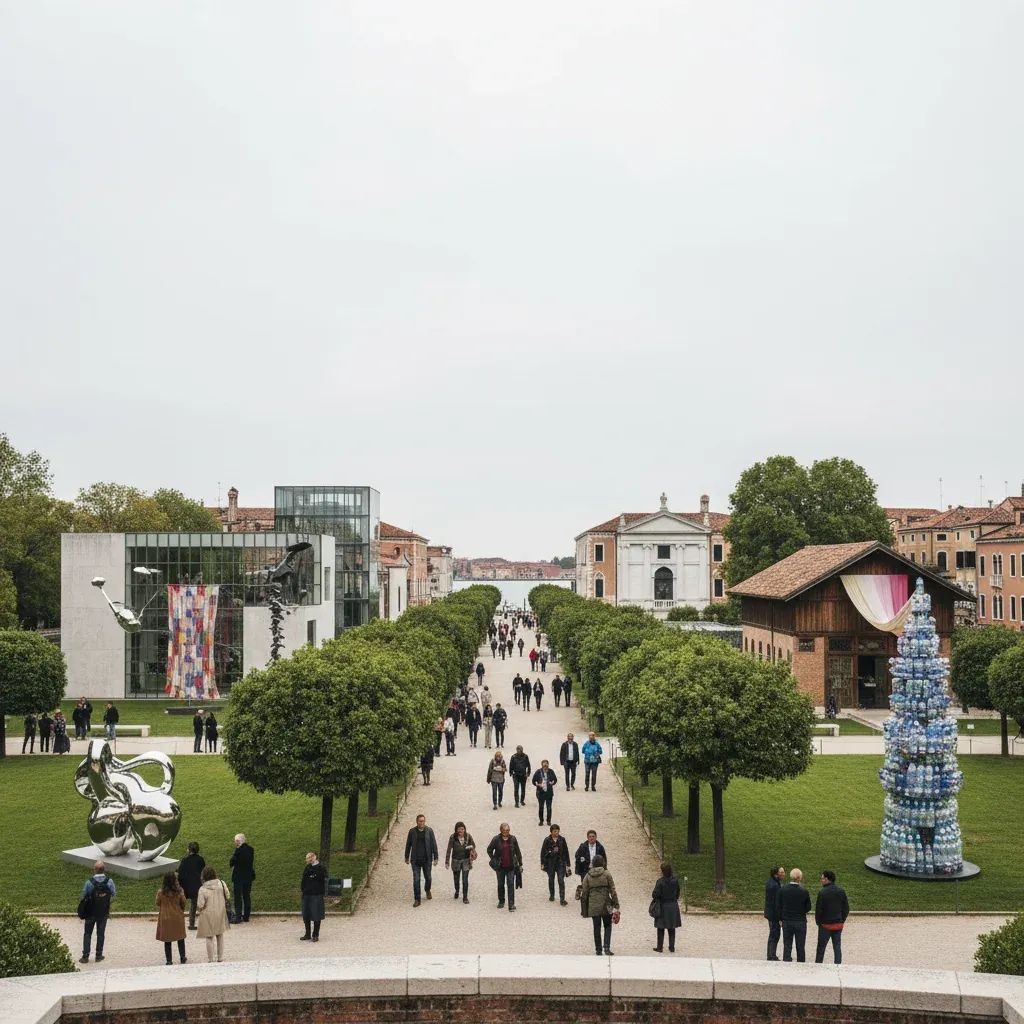
The Biennale di Venezia now faces a critical countdown. The European Commission has set June 4 as the final deadline for the storied arts institution to clarify how its decision to host Russia's pavilion at the 2025 edition complies with EU sanctions—or risk losing €2M in European funding. The standoff marks an unprecedented collision between cultural autonomy and geopolitical enforcement, with ramifications that stretch well beyond Venice's canals.
Why This Matters
• Financial risk: The Biennale stands to forfeit a €2M Creative Europe grant (2025–2028) if Brussels confirms sanctions violations.
• Legal jeopardy: Two specific articles of EU sanctions law are under scrutiny—one banning indirect economic support from Moscow, another prohibiting service provision to Russian state entities.
• Cultural precedent: This is the first time the European Commission has threatened to cut funding from a major European cultural institution over geopolitical compliance.
The Second Letter Raises the Stakes
A European Commission spokesperson confirmed that Brussels has now dispatched two formal letters to the Biennale concerning the Russian pavilion. The first, sent in mid-April, was answered by the foundation. The second, delivered April 30, takes a sharper tone and demands fresh documentation by June 4.
According to Commission sources, the second missive expresses explicit dissatisfaction with earlier responses and outlines suspected breaches of two key sanctions provisions. Article 5t of the EU sanctions regime forbids accepting donations, economic benefits, or financial assistance—directly or indirectly—from the Kremlin. Brussels contends that "any cost borne by Russia for its delegation's participation benefits the Biennale and appears to qualify as indirect provision of economic support."
Article 5n, meanwhile, blocks the supply of certain services to Moscow, including legal counsel, advertising, commercial management, and public relations. The Commission has learned that the Biennale may be furnishing precisely such services to facilitate activities inside the Russian pavilion—services that would require formal sanctions exemptions, which have not been sought or granted.
Russia Returns After Four-Year Absence
The controversy centers on Russia's official return to the Venice art showcase at the 2025 edition, after skipping the 2022 and 2024 editions. In those years, Russian artists withdrew in protest against the full-scale invasion of Ukraine, and the pavilion was loaned to Bolivia in 2024. For 2025, Moscow confirmed participation with a project titled "The Tree is Rooted in the Sky," featuring artists from Russia, Argentina, Brazil, Mali, and Mexico.
To navigate the sanctions minefield, organizers adopted a hybrid format: the Russian pavilion opened only during preview days (May 5–8) for invited guests and press, then closed its doors. From May 9 onward, multimedia documentation of the performances has been displayed on external screens, allowing the public to view the work without physically entering the space.
What This Means for Italian Cultural Institutions
The Biennale case illustrates how EU foreign policy now reaches into the operational decisions of semi-autonomous foundations. While the Biennale operates as a private foundation under Italian law, it receives substantial public funding—both national and European. Brussels is signaling that access to EU grants hinges on strict observance of sanctions policy, even in the cultural sphere.
For other Italian institutions that host international events or collaborate with entities from sanctioned nations, the lesson is clear: financial independence does not guarantee immunity from geopolitical enforcement. Any arrangement that involves cost-sharing, service provision, or indirect economic benefit could trigger scrutiny.
The Italian government, led by Prime Minister Giorgia Meloni and the Ministry of Culture, has publicly disagreed with the Biennale's decision but acknowledged the foundation's autonomy. Behind the scenes, the Culture Ministry is understood to support the Commission's stance. Italy was given one week to respond to the EU's initial inquiry; the Biennale received 30 days for the first letter and is now racing to meet the June 4 cutoff for the second.
Cultural Autonomy Meets Sanctions Enforcement
This confrontation represents the first major test of cultural sanctions since the EU adopted measures targeting Russia's cultural diplomacy apparatus in 2022. Following the invasion of Ukraine, Brussels sanctioned key Russian cultural institutions—including Rossotrudnichestvo, the network of Russian Houses, the Russkiy Mir Foundation, and the Gorchakov Public Diplomacy Fund—labeling them propaganda tools.
The EU also froze assets of Russian oligarchs who are prominent art collectors, restricted trade in cultural goods, and halted inter-museum loans between European and Russian institutions. Yet the Biennale case goes further: it involves a Western cultural organization accused of indirectly aiding Moscow through logistical and service arrangements.
Ukraine has condemned Russia's participation as "incomprehensible" and a potential platform for "whitewashing war crimes." Activist groups including FEMEN and Pussy Riot staged protests outside the pavilion during preview week. In a dramatic gesture, the entire international jury of the Biennale resigned in protest, citing the Russian pavilion controversy among their reasons.
The €2M Question
The grant at stake is part of the Creative Europe program and supports film projects within the Biennale's broader activities. Henna Virkkunen, Vice-President of the European Commission, stated plainly: "If the violation of the grant is confirmed, we will not hesitate to suspend or revoke it. European taxpayers' money should safeguard democratic values and diversity—values not respected in today's Russia."
Should the Commission follow through, the Biennale would lose not only the immediate funding but also credibility with future EU grant evaluators. Other Italian cultural organizations that rely on Creative Europe or Horizon Europe money are watching closely.
Russia's Cultural Diplomacy Gambit
The Russian Ambassador to Italy framed Moscow's presence as proof of a willingness to engage in cultural dialogue despite EU pressure. He characterized attempts to block cultural exchange as an effort to "lower a new Iron Curtain." The framing aligns with Kremlin narratives that cast Western sanctions as ideological overreach rather than legal enforcement tied to war crimes and territorial aggression.
By featuring artists from Argentina, Brazil, Mali, and Mexico alongside Russian participants, the pavilion project also seeks to portray Russia as a champion of Global South voices—a messaging strategy Moscow has deployed across diplomatic and cultural forums since 2022.
What Happens After June 4?
If the Biennale's response fails to satisfy Brussels, the Commission can trigger a formal suspension or termination of the €2M grant. The process typically involves notifying the Italian government, opening a formal breach procedure, and allowing a final right of reply. However, given the public nature of the dispute and the Commission's already-stated position, a suspension appears increasingly likely if the Biennale does not demonstrate full compliance with Articles 5t and 5n.
The Italian government could, in theory, compensate the Biennale for lost EU funds, but doing so would contradict Rome's stated support for sanctions and risk diplomatic friction with Brussels. Alternatively, the Biennale could seek a formal derogation—an official exemption from specific sanctions provisions—but such requests are rarely granted and take months to process.
The case also raises questions about future editions. If the war in Ukraine continues and sanctions remain in place, will the Biennale face the same dilemma in 2027 and beyond? Or will it adopt a formal policy excluding state-sponsored pavilions from nations under EU sanctions?
For now, the clock is ticking. June 4 will reveal whether the Biennale can thread the needle between cultural openness and legal compliance—or whether one of Europe's most prestigious art institutions will pay a steep financial and reputational price for its decision to keep the Russian pavilion open, even behind closed doors.


