
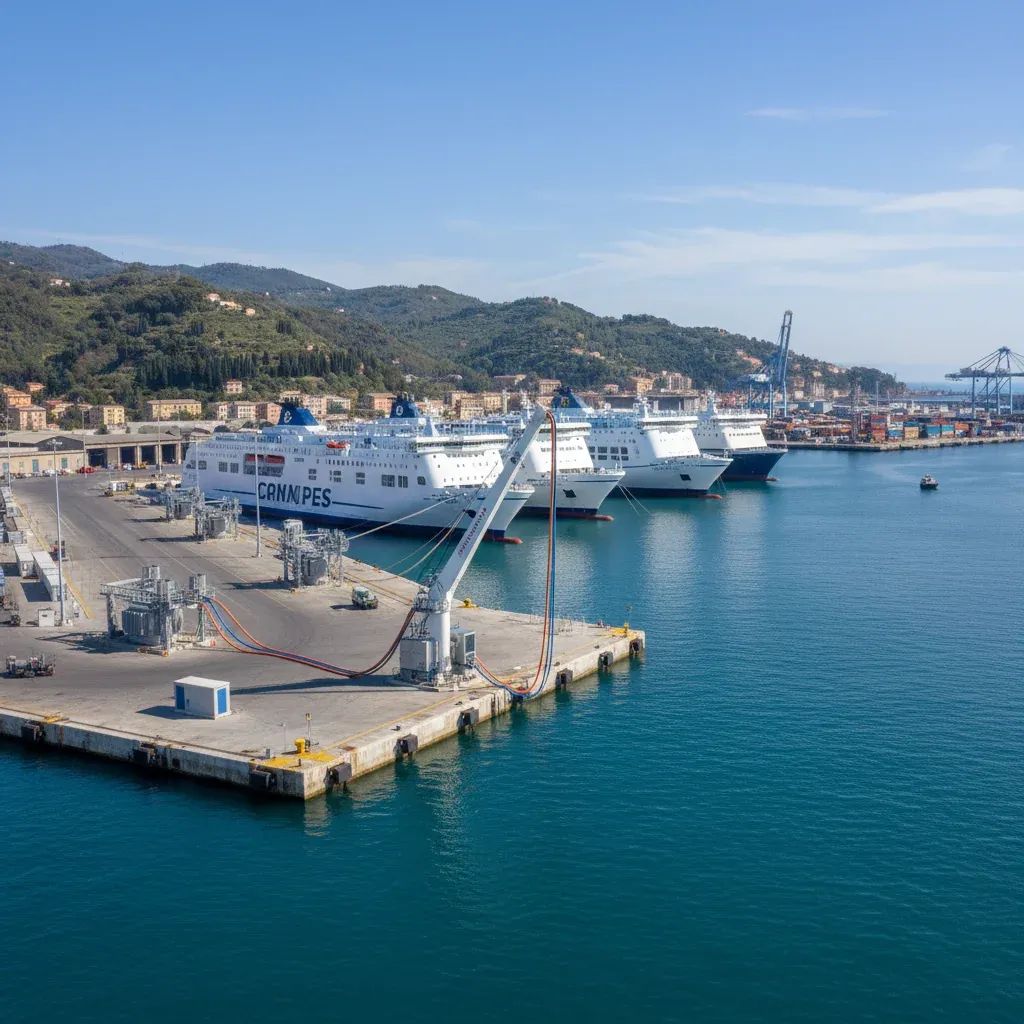
The Italy Eastern Adriatic Sea Port Authority has completed the installation of shore-power infrastructure at Trieste's cruise terminals, a move that will allow vessels to cut emissions dramatically by plugging into the city grid this summer rather than running diesel generators while docked.
Why This Matters:
• First connections expected July 2026 — cruise ships will switch off engines and plug into land-based electricity at the Rive di Trieste downtown berths
• €24M PNRR investment — funded through Italy's National Recovery and Resilience Plan, covering Molo V, Riva Traiana, Molo VII, and Molo Bersaglieri
• Technical certification June 2026 — final inspections scheduled before summer tourist season, pending a Ministry decree on operational protocols
• Air quality gains for residents — eliminates port-side emissions of NOx, SOx, and particulate matter during vessel layovers in the city center
Why Trieste Is Racing the Clock
Marco Consalvo, president of the Eastern Adriatic Sea Port System Authority and Trieste Terminal Passeggeri, confirmed that all construction work has wrapped. "The electrification operation is finished," he said. "We will carry out certification by June, and we are currently waiting for a decree from the Italy Ministry of Infrastructure and Transport to define the procedures—specifically, to identify who will manage this operation."
The Ministry decree is critical: it will clarify which entity operates and bills for the shore-power service, a detail that must be settled before ships can legally draw megawatts from the grid. Without that regulatory framework, completed hardware sits idle.
Trieste's 2026 cruise season is already underway, with multiple vessels berthing simultaneously along the Rive waterfront. The city's ambition is to activate cold-ironing connections before the July peak, when tourist arrivals and air-quality concerns converge.
How Shore Power Works—and Why It Matters for Coastal Cities
Cold ironing, or shore power, allows cruise ships to shut down onboard diesel generators and connect to the terrestrial electricity network through high-voltage cables. This eliminates the combustion of heavy fuel oil or marine gas oil that would otherwise run refrigeration, lighting, air-conditioning, and hotel services for thousands of passengers during port calls.
The environmental arithmetic is compelling. Cruise vessels in port can generate 10 times the air pollution of a busy urban street, emitting nitrogen oxides, sulfur oxides, and ultrafine particulate matter that penetrate deep into lung tissue. Shore power can slash these pollutants by more than 80% at the point of emission.
In Trieste's case, the berths lie along the Rive—a central promenade flanked by cafés, offices, and residential blocks. Shifting energy supply from ship smokestacks to the city grid moves emissions from the waterfront to power plants, which are typically located away from population centers and often supplied by cleaner generation mixes. If the electricity comes from renewable sources—hydro, wind, or solar—the net carbon footprint drops even further.
What This Means for Residents
For Trieste residents and businesses near the port, shore power delivers three direct benefits:
Cleaner air: Elimination of diesel exhaust during vessel stays, cutting exposure to carcinogens and respiratory irritants.
Noise reduction: Shutting down shipboard generators eliminates the low-frequency hum and vibration that carry through the waterfront district.
Climate accountability: The infrastructure aligns with EU Green Deal mandates and the Alternative Fuels Infrastructure Regulation (AFIR), which require shore power at major passenger and container ports by 2030.
The Trieste electrification covers four key zones: Molo V, Riva Traiana, Molo VII, and Molo Bersaglieri (the main passenger terminal). Together, these berths handle the bulk of cruise traffic in Italy's northeastern Adriatic gateway.
Italy's €700M Shore-Power Push—and the Laggards
Trieste is part of a national wave. Italy has allocated roughly €700M for cold-ironing projects across approximately 40 ports, drawing primarily on PNRR funds. The deadline for many installations is June 2026, though not all projects will meet that target.
Among Italy's frontrunners:
• Genova completed the INES project at the Prà container terminal, cutting CO₂ and NOx emissions while also electrifying shipyard repair basins.
• Gioia Tauro has two tranches underway—€18.3M already finished, a second lot worth potentially €76M in progress—with a June 2026 PNRR milestone.
• Ancona awarded a €4.3M integrated contract in February 2024 for six ferry berths, aiming for 9 MW capacity by mid-2026.
• Ravenna is channeling €42M into the Porto Corsini cruise terminal.
• Piombino and Portoferraio expect to go live by early summer, backed by €26M in PNRR funding.
Across Europe, however, adoption is uneven. A DNV study for Transport & Environment found that by mid-2025 only 20% of required cold-ironing infrastructure had been installed or commissioned in major EU ports. Göteborg, Oslo, Antwerp, and Zeebrugge lead, each exceeding 50% compliance. Barcelona is investing €130M in the Nexigen project to deliver 100% certified renewable electricity to vessels by 2025. Rotterdam targets full coverage for container and cruise terminals by 2028.
Germany is set to complete shore power at all major commercial and passenger terminals by 2026, a year ahead of Trieste's timeline. Hamburg activated cruise-berth cold ironing in 2024, supplying 11 kV to visiting ships.
The Cost and the Complications
Electrifying a single berth is expensive. Frequency converters—needed because most ships run on 60 Hz while European grids supply 50 Hz—cost between €300,000 and €500,000 each. Grid connection upgrades add millions more; in Sardinia, linking port installations to the national network alone carried an estimated €40M price tag.
Trieste's total outlay has climbed since the original €24M allocation. Cost overruns tied to raw-material inflation have been covered by a special State fund. Breakdown by zone:
• Molo V and Riva Traiana: €4.3M (design and construction)
• Molo VII (container terminal): €8.3M
• Molo Bersaglieri (cruise station): €10.1M (works only; design handled in-house by the Port Authority)
• Scalo Legnami: €6.8M (PNRR allocation: €8.2M)
• Piattaforma Logistica: €4.1M (PNRR)
Trieste also secured EU Connecting Europe Facility (CEF) co-financing through the EALING project (European flagship Action for coLd ironING), which contributed roughly €800,000 of a €7.3M total budget for design work at Molo V, Piattaforma Logistica, and neighboring Monfalcone. A second EU initiative, PRESPORT (Interreg Italy-Croatia), funded design and installation.
On top of shore power, the Port Authority, Trieste municipality, and utility AcegasApsAmga are advancing a €18M Smart Grid project under the PNRR to reinforce the local electricity network ahead of the surge in demand once ships start drawing power.
What Happens Next
Assuming the Ministry of Infrastructure and Transport issues its decree on schedule, technical certification will proceed in June. If approved, the first cruise ships could plug in as early as July 2026, marking a visible turning point for air quality in Trieste's historic center.
Success hinges on three factors: regulatory clarity, grid stability, and vessel readiness. Not all cruise lines have retrofitted their fleets with the necessary onboard switchgear, and tariff structures must be attractive enough to encourage captains to connect rather than run generators.
Italy's broader cold-ironing rollout faces similar hurdles. A Ministry decree approved in late 2025 set the framework for managing and supplying shore power nationwide, and procurement tenders for service contracts are now expected. Electricity tariffs will include reductions on general system charges, which must be passed through to shipping operators to make plugging in economically rational.
For Trieste, the stakes extend beyond compliance. The city is betting that cleaner, quieter cruising will enhance its appeal as a premium Adriatic destination—and that the infrastructure investment will anchor its role in the post-carbon maritime economy taking shape across the Mediterranean.


