
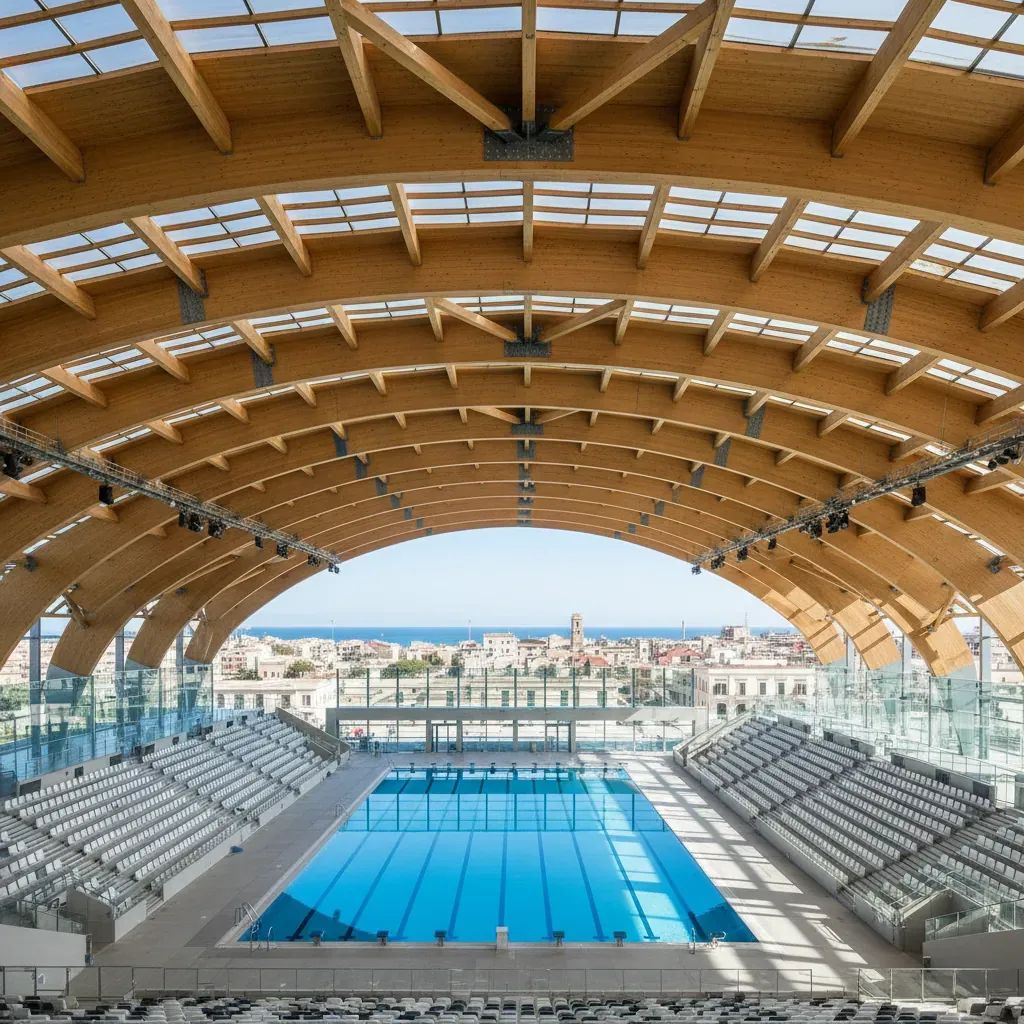
Italy's Mediterranean Games aquatics facility reaches a major construction milestone, bringing Taranto closer to hosting the region's premier sporting event ahead of August's opening.
Ferraro S.p.A., the Italian construction firm managing the project, completed the installation of the laminated timber roof structure for Taranto's new swimming stadium on April 22, 2026. The 3,800-square-meter canopy—comprising 860 cubic meters of laminated wood, 342 cubic meters of X-Lam panels, and 11,500 kg of structural steel—marks the completion of one of the most technically demanding phases for the venue, which is scheduled to host aquatics competitions at the XX Mediterranean Games in August.
Why This Matters
• Timeline pressure: With the Games opening on August 21, the facility must be fully operational in approximately 17 weeks.
• Olympic-grade infrastructure: Taranto is building two 50-meter pools (one indoor, one outdoor) designed to meet international standards for world championships and Olympic qualifiers.
• Post-Games legacy: The €65M investment in Taranto's sports infrastructure aims to leave the city with modern facilities usable by the community long after the closing ceremony.
• Sustainability benchmark: All construction adheres to Italy's mandatory Criteri Ambientali Minimi (CAM) environmental standards, part of the national green procurement framework.
Weather and Logistics Slowed—But Didn't Stop—Progress
Construction crews began erecting the roof framework on January 29, battling persistent challenges over the intervening three months. High winds and heavy rainfall repeatedly disrupted work schedules in a coastal city exposed to Adriatic weather patterns. Logistical complexity compounded the delays: the site required simultaneous installation of oversized structural components, bulk material storage in constrained spaces, and coordination of multiple teams working in overlapping zones.
Despite those obstacles, Ferraro's project managers and subcontractors delivered the roof structure on schedule. The final weatherproofing layer—a multi-component membrane system—is now in its closing stages, setting the stage for interior fit-out work to begin in earnest.
What Comes Next: Pools, Seating, and Finishing Touches
With the roof sealed, attention shifts to the venue's core function: competitive swimming. Fluidra Commerciale Italia S.p.A., a specialist supplier, is scheduled to install both 50-meter Olympic-specification basins in the coming months. The indoor pool will be flanked by a 986-seat grandstand, while the outdoor basin will have a 1,000-capacity stand, giving the complex a total spectator capacity of approximately 2,000.
Beyond the pools, contractors will complete:
• Mechanical systems: High-efficiency heat pumps, photovoltaic arrays, and solar thermal collectors designed to meet the nearly Zero Energy Building (nZEB) standard and achieve Energy Class A4 certification.
• Water management infrastructure: Rainwater harvesting tanks and low-flow fixtures to minimize municipal water demand.
• Carbon-neutral HVAC: "Carbon-free" heating and cooling solutions that eliminate fossil-fuel dependence.
• Bioclimatic design elements: Overhanging shading devices, green roof sections, and natural ventilation pathways to reduce passive energy loads.
• Interior finishes and furnishings: Spectator seating, locker rooms, technical areas, and competition timing equipment—all sourced in compliance with CAM specifications that mandate recycled content, low-VOC materials, and third-party sustainability certifications.
Angelo Ferraro, managing director of Ferraro S.p.A., emphasized the importance of this phase in transforming the structure into a venue that serves Taranto's residents beyond the two-week sporting festival. "The building is meant to be used every day by the community," he noted, underscoring the project's emphasis on long-term utility rather than event-only spectacle.
CAM Compliance and Agenda 2030 Alignment
Italian public procurement law requires all contracting authorities to apply Criteri Ambientali Minimi across design, construction, and operational phases of government-funded projects. For the swimming stadium, that translates into enforceable benchmarks covering energy consumption, material sourcing, waste diversion, and greenhouse-gas reduction.
The Taranto aquatics center's design incorporates several CAM-driven features:
• Renewable energy primacy: Solar photovoltaic and thermal systems supply the majority of the building's power and hot-water needs.
• Circular economy principles: Construction waste is sorted on-site for reuse or recycling; demolition materials from site preparation were processed locally rather than landfilled.
• Heat-island mitigation: Light-colored cladding and roof finishes reflect solar radiation, reducing urban warming effects in a city already contending with industrial pollution concerns.
• Low-carbon structural materials: Laminated timber and X-Lam panels store atmospheric carbon rather than emitting it, contrasting with conventional steel or concrete framing.
These measures align the facility with United Nations Sustainable Development Goals outlined in Agenda 2030, particularly targets related to clean energy (Goal 7), sustainable cities (Goal 11), and climate action (Goal 13).
Taranto's €350M Infrastructure Sprint
The swimming stadium is one node in a broader network of venues being delivered for the Mediterranean Games under the oversight of a special commissioner appointed by the Italian Cabinet. The government has allocated €350M for the event, with €275M earmarked for sports infrastructure across all municipalities and the remainder covering operational costs. Taranto's facilities, including the aquatics center, are among the priority venues receiving significant investment.
Other major construction milestones recorded in recent weeks include:
• PalaRicciardi: The steel superstructure for this 6,250-square-meter indoor athletics hall is complete. The venue will accommodate approximately 1,500 spectators and is set to become the southernmost indoor track-and-field facility in Italy. The surrounding Salinella district is being upgraded with new green spaces, sidewalks, and utilities.
• Stadio Erasmo Iacovone: Renovations to the football stadium—including improved turf, lighting, audio systems, and giant LED screens—are expected to finish by late June, possibly stretching into mid-July for final touches. The 20,050-seat venue will host the opening and closing ceremonies and carries a UEFA Category 1 classification (natural constraints prevent Category 4 status). Private investors have already expressed interest in post-Games management.
• Centro Nautico (Torpediniere): The last of the waterfront facilities to break ground, this rowing, canoe, and sailing center remains on track for summer delivery.
Most commissioner-managed works are scheduled for handover between late June and mid-July, leaving a narrow window for operational testing before athletes arrive. In total, the Games will utilize 45 facilities across 21 municipalities in Puglia, including 14 cities beyond Taranto, making it a regionally distributed event rather than a single-city affair.
Economic Impact and Post-Games Concerns
Supporters project significant tourism and hospitality revenue during the August 21–September 3 competition window, when thousands of athletes, officials, and spectators will descend on a city better known for its steel mills and naval shipyard than for international sports. Local businesses anticipate a short-term windfall, and regional officials hope the global media exposure will reposition Taranto as a Mediterranean destination.
Yet skeptics have raised red flags about long-term operational costs. Public sports facilities in Italy frequently struggle with maintenance funding once initial construction grants dry up. Critics are pressing the municipality to clarify who will pay for staffing, utilities, and upkeep once the event concludes—and whether private operators can be secured to manage flagship venues like the Iacovone stadium and the new aquatics complex without further subsidies.
The administration has indicated it is actively soliciting private-sector proposals for several facilities, attempting to lock in multi-year management agreements before the opening ceremony. Success on that front will determine whether the Games leave Taranto with a genuine community asset or a financial liability.
A City Betting on Reinvention
Taranto won the hosting rights in August 2019 at a Mediterranean Games assembly in Patras, Greece. The bid was anchored in "Taranto Futuro Prossimo" (Taranto Near Future), a strategic plan focused on environmental sustainability, economic diversification, and social cohesion for a city grappling with industrial decline and pollution legacies.
For Taranto, the Mediterranean Games represent more than a sporting event—they are a symbolic pivot toward a post-industrial identity. The expectation is that modern, eco-certified sports infrastructure will catalyze broader urban regeneration, attract new investment, and give younger residents reasons to stay rather than migrate north for opportunity.
Whether that vision materializes depends not only on finishing construction on time but on ensuring the facilities remain accessible, affordable, and actively used by the community for years to come. The swimming stadium's roof may be complete, but the real test of success lies in what happens after the final medal ceremony.


