
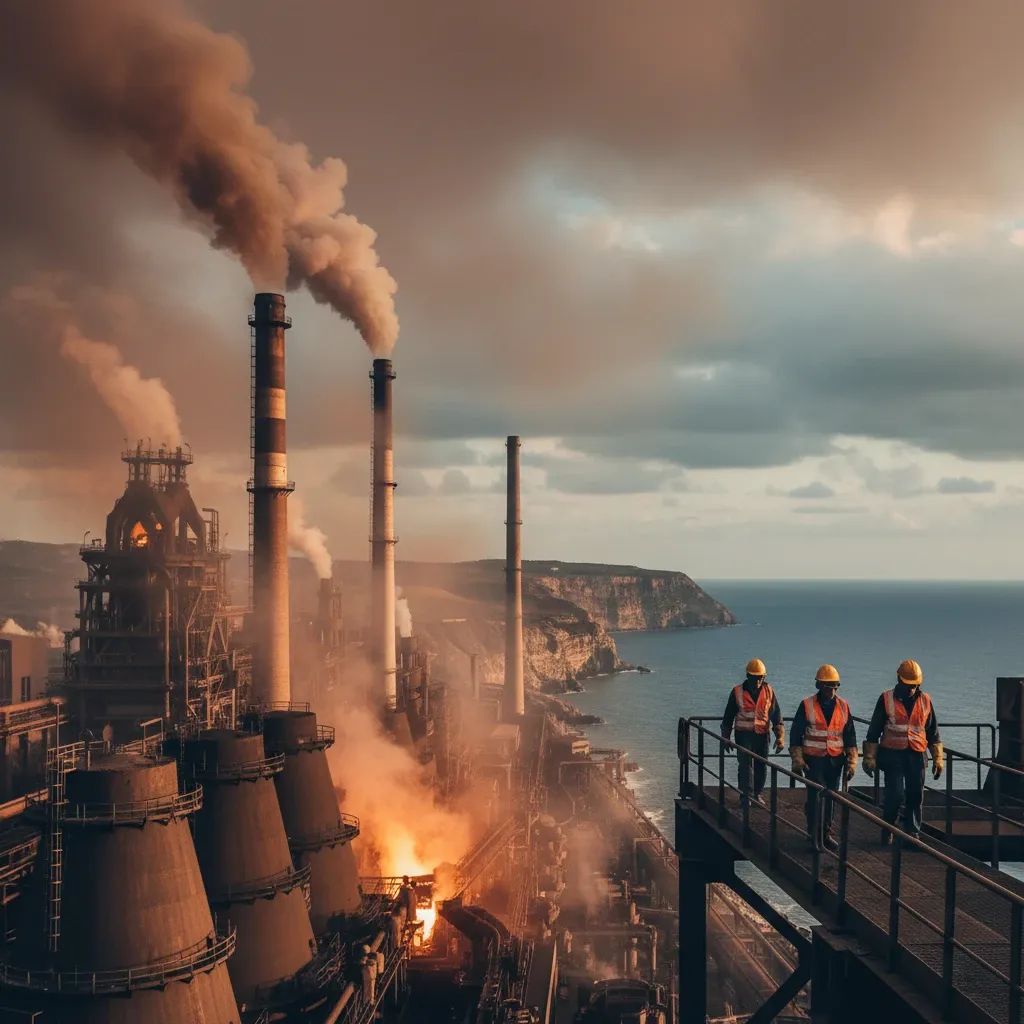
The Italy Ministry of Enterprise and Made in Italy is scrambling to assemble a domestic consortium of investors for Taranto's massive steel plant, a last-ditch attempt to prevent economic collapse in a city already reeling from a court-ordered shutdown of its core production unit. Minister Adolfo Urso's push for an "Italian solution" comes as workers block highways and thousands of jobs hang in the balance.
Why This Matters:
• Deadline pressure: Milan's Court of Appeal has given the plant 90 days—until October 28, 2026—to shut down the "hot area" due to environmental and health violations, threatening up to 20,000 jobs across direct employment and supply chains.
• Alternative plan from India: Jindal Steel proposes importing two million tons of low-carbon steel slabs from Oman by December 2027 to keep downstream plants running, bypassing the blast furnaces entirely.
• State intervention on the table: The government is considering taking a minority equity stake to facilitate a sale and stabilize the crisis-hit facility.
• Week of crucial talks: Technical meetings between August 4-6 will determine whether the plant can survive in any recognizable form.
Highway Blockades Signal Worker Desperation
An 8-hour strike declared by the metal unions Fim, Fiom, and Uilm last week spilled onto the streets, with demonstrators shutting down State Road 100 between Bari and Taranto for roughly an hour. The protest reflects mounting frustration among steelworkers who have watched the plant lurch from crisis to crisis for over a decade. Union leaders are demanding not vague assurances but concrete commitments: "It's time to make a decision," they said during the walkout, warning that strikes will continue indefinitely if the government fails to produce a viable rescue plan by month's end.
The stoppage is just the opening salvo. Unions have declared permanent mobilization, with further action planned if Rome's series of technical roundtables yields nothing substantive. The mood in Taranto is grim. Workers at contractor firms like Semat and Anmar have already been sent home as activities wind down, and many fear they will not qualify for Italy's extraordinary layoff schemes, leaving them with no income and no safety net.
The Court Ruling That Changed Everything
The Milan Court of Appeal's order to halt the hot area within 90 days stems from years of litigation over pollution—specifically fine particulate matter and asbestos exposure linked to cancer clusters and respiratory disease in Taranto's surrounding neighborhoods. Updated epidemiological data from ASL Taranto paint a stark picture: statistically significant excesses in mortality, hospitalization, and lung cancer incidence, alongside infant mortality rates above the national average. The court deemed continued operation incompatible with public health protections.
For the steelworks, the ruling is an industrial death sentence unless an alternative production model emerges. The hot area—where iron ore is smelted in blast furnaces to produce raw steel—feeds every downstream facility: rolling mills in Taranto, plants in Genoa, Novi Ligure, and Racconigi. Shut it down, and the entire production chain grinds to a halt.
Jindal's Gambit: Import Slabs, Skip the Furnaces
The Indian conglomerate Jindal Steel International, which has been in exclusive talks to acquire the former Ilva complex, believes it has found a workaround. According to Minister Urso, Jindal "considers it can address the closure of the hot area by importing slabs produced by its new blast furnace in India," thereby maintaining continuity for the cold-rolling and finishing plants that transform semi-finished steel into marketable products.
Jindal's broader pitch hinges on decarbonization. The group has committed to replacing blast furnaces with electric arc furnaces and integrating supply chains across its Oman facilities, where it is building green hydrogen-ready Direct Reduced Iron (DRI) plants. The company aims for net-zero emissions by 2047, with an aspirational target of 2035, and a 30% reduction in CO2 intensity by 2030 relative to 2005 baselines. Jindal intends to supply up to two million tons of low-carbon slabs from Oman by late 2027, positioning the Taranto site as a downstream finishing hub rather than an integrated steel mill.
But the proposal raises immediate questions. Can the Italian logistics network handle continuous slab imports at that scale? What happens to the workforce employed in the blast furnace operation? And does the economic model still make sense if you strip out primary steelmaking? The extraordinary commissioners overseeing the bankrupt plant are tasked with evaluating Jindal's technical and financial viability, and Minister Urso has indicated an assessment could arrive within the week.
Urso's Call for a Domestic Consortium
Not content to rely solely on Jindal, Minister Urso has revived his campaign for a "cordata italiana"—a consortium of Italian steel and industrial firms that could either compete with or complement the Indian offer. The appeal targets major domestic players in the sector, including steelmaker Arvedi, which in the past has shown interest in the cold-rolling assets and northern plants, sometimes in partnership with state energy giant Eni.
Urso's strategy is clear: use the threat of foreign control and job losses to galvanize Italian capital, leveraging national pride and strategic concerns. The Ministry has scheduled a packed agenda for early August, with separate sessions for unions, local government officials, Confindustria (Italy's employers' federation), Federacciai (the steel association), and Federmeccanica (the engineering employers' group). The aim is to present a credible Italian alternative—or at least secure commitments that can be woven into a broader rescue package.
To sweeten the deal, Rome is weighing a minority equity injection from the state, which would provide financial backing and political cover for private investors wary of the plant's toxic legacy. Italy has a long history of state intervention in steel: the postwar boom saw massive public investment through the Istituto per la Ricostruzione Industriale (IRI) and its subsidiary Finsider, which built Taranto into Europe's largest integrated steelworks, employing over 20,000 workers directly in the 1970s.
But that era also ended in tears. By the 1980s, bloated payrolls and foreign competition drove Finsider to the brink. The restructuring of the state steel sector slashed employment from 120,000 to 44,000 by the early 1990s, with plants like Bagnoli shuttered entirely. Privatization followed, but chronic underinvestment and environmental scandals dogged the Taranto site for decades. The question now is whether another round of state involvement can avoid repeating past mistakes.
What This Means for Residents and Workers
For Taranto residents, the stakes are existential. The city's economy has revolved around the steel plant since its construction in the 1960s as part of the Cassa per il Mezzogiorno development program aimed at industrializing Italy's impoverished South. Decades of pollution have left a toxic legacy—elevated cancer rates, compromised respiratory health, contaminated soil—but the plant remains the region's largest employer and economic engine.
If the hot area closes without a credible alternative, up to 20,000 jobs could vanish across direct employment and the supply chain, triggering a social and economic catastrophe in a region already struggling with high unemployment. Contractor workers, many of whom lack access to Italy's Cassa Integrazione wage support schemes, face immediate destitution. Local businesses dependent on steelworker spending would collapse in quick succession.
For investors and industrial firms, the picture is murkier. Jindal's model offers a high-tech, low-carbon future, but it also implies a radically smaller workforce concentrated in downstream processing. An Italian consortium, if it materializes, might preserve more jobs in the short term but would still need to navigate the court-imposed environmental constraints and sink billions into modernization.
For policymakers, the Taranto crisis is a microcosm of Europe's broader steel dilemma: how to maintain industrial capacity and employment in the face of strict environmental regulations, high energy costs, and cheap imports. The European steel sector has shed over 100,000 jobs since 2008, with a further 18,000 lost in 2024 alone. Union federations across the continent are demanding protective tariffs, retraining funds, and state aid to prevent entire regions from deindustrializing.
August's High-Stakes Negotiations
The coming weeks will test whether Italy's government can broker a deal that satisfies courts, unions, investors, and voters. The technical tables beginning August 4 represent the last realistic chance to craft a plan before the October 28 deadline makes large-scale layoffs unavoidable. Minister Urso's dual-track approach—encouraging both Jindal and a domestic bid—buys time but also risks producing paralysis if neither option proves workable.
Sindacati have made clear they will not accept cosmetic reassurances. They want binding commitments on employment levels, investment timelines, and environmental cleanup. They also want transparency: previous rescue attempts, including the 2014 intervention via Cassa Depositi e Prestiti and the troubled partnership with ArcelorMittal, collapsed amid broken promises and legal wrangling.
The broader lesson from Italy's steel history—and Europe's—is sobering. State intervention can delay closures and cushion the blow, but it rarely reverses long-term decline without genuine industrial transformation. Taranto's survival depends on whether the parties can agree not just on who owns the plant, but on what kind of plant it will be: a relic of 20th-century heavy industry clinging to life, or a leaner, greener operation capable of competing in a decarbonizing global market.
The clock is ticking, and the workers blocking highways know it.


