
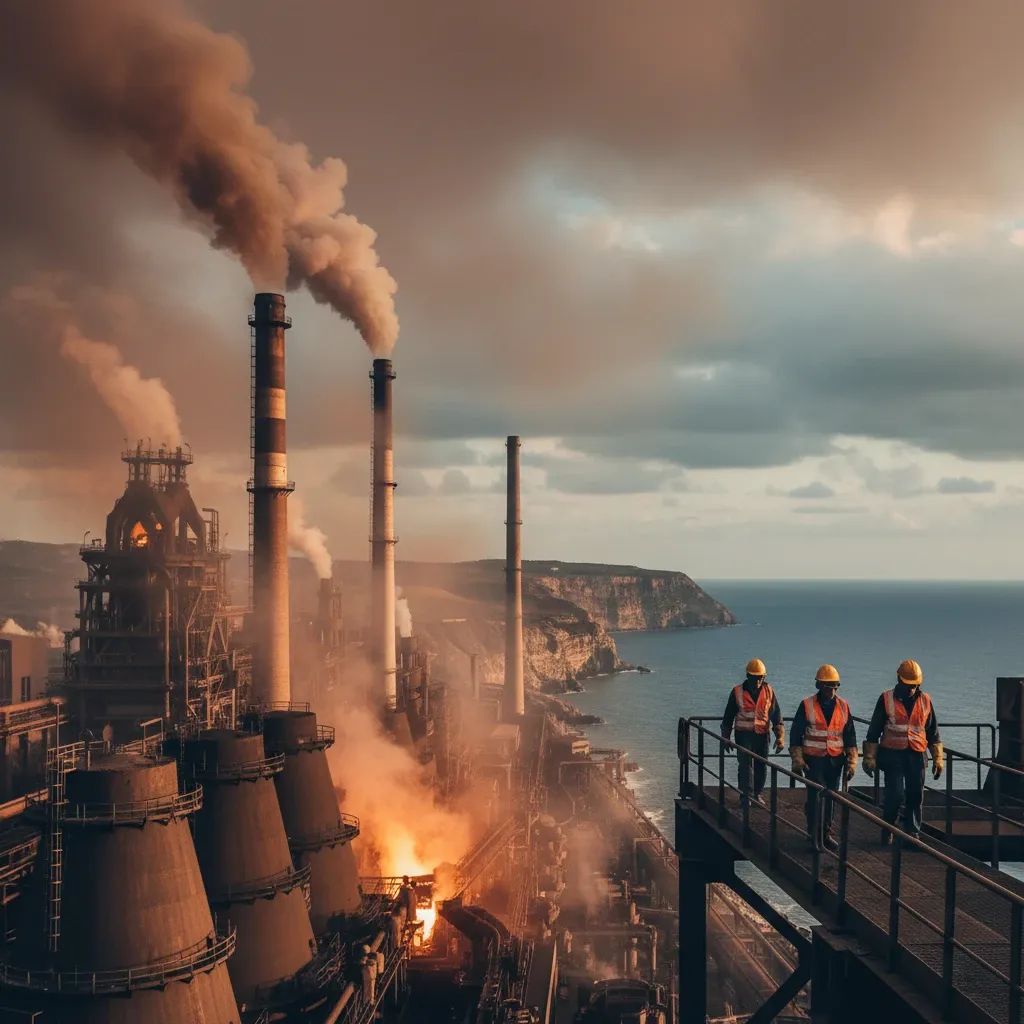
Italy's Ministry of Business and Made in Italy is sounding alarms over a Milan court decision that threatens to shut down the country's largest steel production facility. The ruling could eliminate 25,000 jobs and force the government to reconsider a €390M emergency loan package. Issued February 26, 2026, the decision orders the Taranto plant's blast furnaces closed by August 24 unless environmental safeguards are drastically strengthened—a deadline that could collapse ongoing sale negotiations and reshape Italy's industrial landscape.
Why This Matters
• Job crisis looming: Up to 25,000 direct and indirect positions at risk if the August shutdown proceeds, with 4,450 workers already in limbo over suspended layoff protections.
• Sale in jeopardy: Potential buyers may abandon acquisition bids due to the sudden regulatory overhaul, leaving the state-owned facility without a private buyer.
• Steel supply threat: A production halt would disrupt Italy's manufacturing sectors that depend on domestically produced steel, from automotive to construction.
• Taxpayer exposure: The European Commission's bridge loan—conditioned on finding a buyer—could evaporate, forcing Rome to choose between additional bailouts or industrial collapse.
Court Overhauls Environmental Permit
Milan's specialized Civil Court Section XV ruled that the 2025 Integrated Environmental Authorization (AIA) for the former Ilva plant contains insufficient protections for residents of Taranto, Statte, and surrounding neighborhoods. The judges partially invalidated key AIA provisions, citing vague timelines for interventions meant to reduce health hazards.
Specific deficiencies flagged include inadequate monitoring of PM10 and PM2.5 particulates, unclear protocols for "wind days" when emissions spike, missing deadlines for installing hazardous substance tanks, substandard minimum combustion temperatures in steel refining flares, and incomplete capture systems for diffuse coke transfer emissions.
The decision applies a June 2024 Court of Justice of the European Union judgment that prioritized public health over industrial continuity. Residents filed the lawsuit after decades of documented health impacts, including elevated cancer and respiratory disease rates in neighborhoods downwind of the vast coastal complex.
Acciaierie d'Italia in Extraordinary Administration—the entity currently managing the facility—along with its holding company and Ilva SpA, have until August 24, 2026 to secure a revised AIA that establishes "certain and reasonably short deadlines" for environmental upgrades. If they fail, the court-ordered suspension becomes enforceable, halting molten iron and crude steel production.
Government Warns of Domino Effects
Speaking on the sidelines of an artificial intelligence and labor conference, Italy Business Minister Adolfo Urso described the ruling as a "complete game changer" that "rewrites the rules" governing the decade-long Ilva saga. He expressed being "very concerned" that the revised environmental obligations could make the facility financially unviable for prospective buyers.
Urso emphasized that the judgment directly impacts "production continuity and employment," two pillars of the government's strategy to salvage Italy's steel sector. More critically, he warned that if the ruling derails the sale process, "the conditions would no longer exist" for disbursing the bridge loan authorized by Brussels—a lifeline intended to keep furnaces operational while ownership transfers.
The Minister's comments reflect broader anxiety within Rome's economic policymaking circles. Italy has already invested billions in the Taranto site since it entered extraordinary administration in 2015. Without a credible buyer or a viable environmental compliance path, the facility risks becoming a permanent drain on public finances.
What This Means for Residents
Economic Fallout
Taranto's economy revolves around the steel complex. Direct employment at the plant stands at roughly 8,000 workers, but the multiplier effect through suppliers, logistics firms, and service providers brings the total to between 20,000 and 25,000 jobs. A shutdown would trigger mass unemployment in a region already struggling with below-national-average GDP per capita and limited alternative industries.
The court decision immediately suspended negotiations at Italy's Ministry of Labor regarding an extension of extraordinary layoff benefits—CIGS (Cassa Integrazione Guadagni Straordinaria), Italy's extraordinary wage guarantee fund for workers in crisis situations—for 4,450 employees, 3,800 of them based in Taranto, set to expire March 1. Administrators requested time to assess the ruling's implications, a move unions labeled "purely instrumental" and a stalling tactic that leaves families in financial limbo.
For workers, the threat is twofold: either the plant closes outright, eliminating positions, or a buyer demands steep job cuts as a condition for acquisition.
Health vs. Jobs Trade-Off
The Milan ruling represents a legal recognition of what Taranto residents have argued for years: that the plant's operations pose "current risks of harm to health." Elevated rates of lung cancer, cardiovascular disease, and childhood respiratory illnesses in districts adjacent to the steelworks have been documented in epidemiological studies. Environmental groups and local activists welcomed the court's decision as overdue accountability.
Yet the timing creates a painful dilemma. Residents near the plant understandably prioritize clean air and lower disease burdens. At the same time, many of those same households depend on paychecks tied to steel production. The court's August deadline compresses years of needed environmental investment into six months, a timeline most engineering assessments deem unrealistic, effectively forcing an all-or-nothing outcome.
National Steel Supply
Italy's manufacturing backbone—automotive plants in the north, appliance makers, construction firms—relies on domestically produced steel to avoid supply chain bottlenecks and currency exposure. The Taranto facility, despite operating at reduced capacity, still provides a strategic buffer. A prolonged shutdown would increase import dependence, particularly from non-EU sources, raising costs and complicating compliance with European carbon border adjustment mechanisms.
Sale Talks Collapse Risk
Before the court ruling, potential buyers were negotiating to acquire the facility from Italy's extraordinary administration commissioners. Acquisition proposals hinged on Rome underwriting environmental remediation costs, providing state guarantees for future compliance, and accepting reduced production targets aligned with a gradual shift toward electric arc furnace technology.
The Milan judgment fundamentally alters that calculus. Stricter AIA requirements translate to higher upfront capital expenditures, longer compliance timelines, and greater regulatory risk. Prospective buyers may demand additional state subsidies, lower purchase prices, or withdraw entirely, viewing the Italian regulatory environment as too volatile for a multi-billion-euro industrial bet.
Moreover, the European Commission's €390M bridge loan—approved in late 2025—was explicitly conditioned on identifying a credible private-sector buyer by mid-2026. If no viable buyer emerges, Brussels could revoke authorization for the loan, leaving Italy's Treasury to either fund operations unilaterally or permit insolvency proceedings.
Minister Urso's blunt assessment—"there would be no conditions" for the loan if the sale falters—signals that Rome's options are narrowing.
ArcelorMittal Legal Battle Adds Complexity
The saga is further entangled by a bitter legal fight between Italy and ArcelorMittal, the multinational that held a 62% stake in Acciaierie d'Italia before the facility entered administration in February 2024.
Extraordinary administrators have filed a €7B damage claim against ArcelorMittal in Milan court, alleging systematic asset stripping, deliberate plant degradation, and fraudulent manipulation of CO₂ emission data to secure free EU carbon allowances. ArcelorMittal denies all allegations and has launched international arbitration seeking €1.8B in compensation from the Italian state, arguing that Rome and its investment agency Invitalia engaged in discriminatory conduct and illegally expropriated its investment.
The company contends that government interference—including repeated changes to legal immunity provisions for environmental upgrades—made it impossible to fulfill contractual obligations. This parallel litigation clouds any resolution. Potential buyers must weigh not only environmental and financial risks but also the possibility of inheriting unresolved disputes or becoming entangled in state-investor arbitration. The uncertainty deters serious bidders and complicates due diligence.
Decarbonization Path Still Unclear
Italy's long-term vision for Taranto centers on "green steel" production using electric arc furnaces powered by renewable energy and eventually hydrogen-based direct reduced iron. The government has committed substantial funding to finance the transition, aiming for an annual output aligned with EU climate targets.
However, the Milan court's immediate compliance demand disrupts that gradual timeline. Converting blast furnaces to electric arc technology requires dismantling existing infrastructure, building new facilities, securing renewable electricity contracts, and retraining the workforce. Engineering estimates suggest a realistic transition period of five to seven years, not six months.
Environmental advocates argue that prolonged reliance on coal-fired blast furnaces—even with incremental upgrades—perpetuates harm and violates EU law. The court sided with this view, effectively forcing an accelerated shutdown unless the company can demonstrate a credible fast-track remediation plan.
Union Response and Political Pressure
Italy's major trade unions—FIOM-CGIL, FIM-CISL, and UILM-UIL—have called an emergency self-convened meeting at Palazzo Chigi (the Prime Minister's office) for March 9, demanding clarity on the government's strategy. Union leaders accuse Rome of lacking a coherent industrial policy and warn that repeated stopgap measures—temporary loans, revolving administrators, piecemeal environmental fixes—have only deepened the crisis.
Unions insist on three non-negotiables: guaranteed employment levels, full public financing of environmental compliance, and union participation in governance decisions. They oppose private equity ownership models that prioritize short-term returns over long-term industrial development and social stability.
Political opposition parties have seized on the crisis to criticize the current administration's handling of state-owned enterprises, arguing that insufficient oversight of ArcelorMittal's tenure and delayed environmental enforcement created the current impasse.
Historical Context: Italy's Steel Sector Struggles
Taranto's steelworks, built in the 1960s during Italy's post-war industrial boom, became Europe's largest integrated steel plant by the 1970s. Managed under state control through IRI and Finsider, the facility symbolized Italy's manufacturing ambitions. However, the 1973 oil crisis and subsequent European overcapacity forced restructuring. Italy closed historic plants like Bagnoli in Naples and Cornigliano in Genoa while doubling down on Taranto.
Privatization in the 1990s and 2000s shifted ownership to private hands, culminating in ArcelorMittal's 2018 acquisition. But the company's tenure was marked by operational disputes, environmental violations, and eventual withdrawal, leaving the state to pick up the pieces through extraordinary administration—a legal framework allowing court-appointed managers to operate insolvent firms of strategic national importance.
The current crisis mirrors broader challenges facing Europe's heavy industry: aging infrastructure, stringent environmental standards, high energy costs, and competition from lower-cost producers in Asia. Italy's steel output has declined steadily over two decades, and Taranto's uncertain future exemplifies the painful trade-offs between industrial heritage, economic necessity, and ecological responsibility.
What Happens Next
The August 24 deadline is now the focal point. Acciaierie d'Italia's extraordinary administrators must negotiate with Italy's Ministry of Environment and Energy Security to draft a revised AIA that satisfies the Milan court's demands while remaining technically and financially feasible. This involves:
• Concrete timelines for installing advanced particulate filtration systems.
• Binding commitments on wind-day production curtailments to prevent emission spikes.
• Capital expenditure schedules for hazardous material storage and flare temperature upgrades.
• Independent verification protocols to ensure compliance.
Simultaneously, the government must decide whether to pursue a private sale, seek alternative buyers, or pivot to full state ownership and a publicly financed green transition. Each path carries political and fiscal risks, and the clock is ticking.
For Taranto's residents, the next six months will determine whether the facility that has defined their city for six decades will transform into a cleaner industrial model or disappear entirely, taking tens of thousands of livelihoods with it.


