
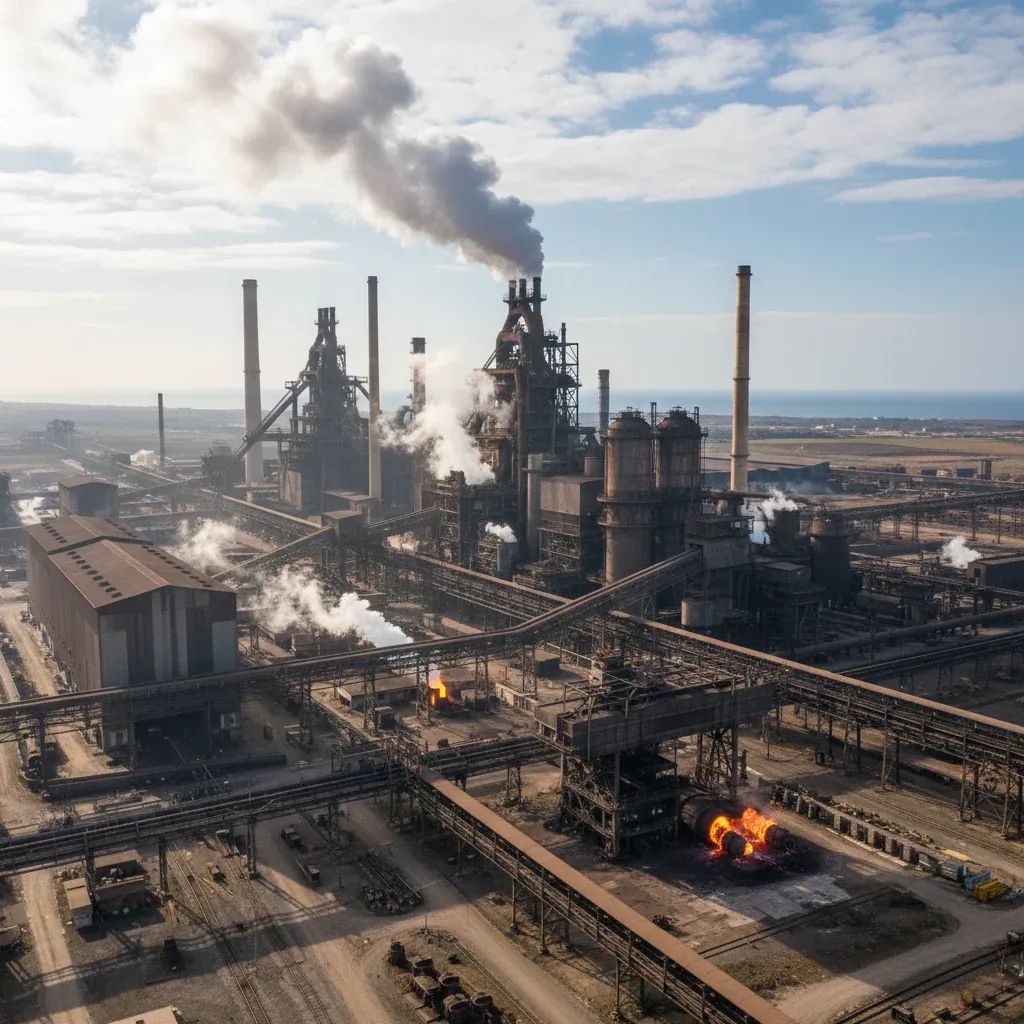
Acciaierie d'Italia in Amministrazione Straordinaria has restarted its Blast Furnace 2 at the Taranto plant, a move that will restore a key production unit to an industrial site whose future remains deeply uncertain. The furnace had been idle for an extended period, leaving the once-mighty steelworks operating at a fraction of its historic capacity.
Why This Matters
• Production target: The restart aims to push capacity back to 4 million tonnes of steel per year by the end of the planned timeline.
• Job security at stake: Over 4,450 workers face an extension of extraordinary wage-guarantee funds (CIGS), with discussions ongoing regarding the terms and duration of this support.
• Sale negotiations underway: Talks with Flacks Group, the preferred U.S. bidder, are progressing with potential conclusions anticipated in coming months.
• North-South split looms: Confindustria federations in Genoa and Alessandria are pushing to detach the Cornigliano and Novi Ligure facilities from Taranto—an idea that has ignited fierce opposition from national metalworkers' unions and Confindustria Taranto.
The Taranto Reality: Multiple Blast Furnaces at Different Stages
The Taranto steelworks has operated with varying furnace capacity as operational conditions change. Blast Furnace 1 has faced significant operational challenges, including fire damage from equipment failure. Blast Furnace 3 has been demolished entirely. The commissarial management has invested substantially in maintenance and industrial upgrades to stabilize operations and prevent further deterioration.
Preparation to restart Furnace 2 has been completed, and operations have now resumed—a critical step in the effort to stabilize output. The operational strategy calls for coordinated use of available furnaces to achieve the production target of 4 million tonnes of annual steel production.
What This Means for Workers and the Local Economy
Taranto's dependence on steel has long made the plant's troubles a matter of existential concern. The current workforce stands at approximately 9,700 employees, with restructuring discussions underway as part of new ownership negotiations.
The Italy Ministry of Labour has scheduled consultations to assess support requests for workers affected by operational changes. Union leaders from Fim, Fiom, and Uilm have demanded comprehensive government engagement and have insisted on clarity regarding the state's role in any new ownership structure.
The Flacks Group Bid and the Role of the Italian State
Flacks Group has emerged as the preferred bidder for the facility, with negotiations focused on modernization commitments and operational improvements. The broader strategy envisions significant investment in facility upgrades and production optimization.
The government's strategy includes a transition toward improved production efficiency and environmental compliance, with plans for facility modernization alongside enhanced environmental monitoring and remediation efforts. This is intended to bring Taranto into compliance with stringent environmental authorization standards.
The North-South Fracture: Cornigliano and Novi Ligure in Play
A proposal gaining traction among industrialists in the northwest has become one of the most divisive flashpoints. Confindustria Genova and Confindustria Alessandria have called for a separate negotiation track to free the Cornigliano and Novi Ligure plants from the Taranto orbit, arguing that the northern sites have distinct production histories and should not be tied to the southern complex's operational uncertainties.
The two federations want independent development opportunities for these sites. Novi Ligure, which specializes in high-grade steel for the automotive sector, is seen as strategically important.
National metalworkers' unions have denounced the idea as "industrial scavenging" that threatens the integrity of the group and the livelihoods of approximately 20,000 workers nationwide. Crucially, Confindustria Taranto has now aligned with the unions, publicly expressing skepticism about any split. President Salvatore Toma stressed the need for unity and warned against fragmentation of a nationally strategic asset.
Environmental and Public-Health Accountability
Environmental remediation remains a state priority. The company is required to meet rigorous environmental authorization standards that include ongoing emissions controls and environmental monitoring. The legal framework ensures that environmental remediation obligations are central to the extraordinary administration procedure.
What Happens Next
Negotiations with Flacks Group continue, with discussions expected regarding timelines and operational plans. The company is focusing on operational coordination to maintain and grow output.
For Taranto, the stakes are unambiguous: the city's economic future, the fate of nearly 10,000 direct jobs, and the credibility of Italy's commitment to both industrial continuity and environmental responsibility all hinge on the decisions made in coming weeks and months.


