
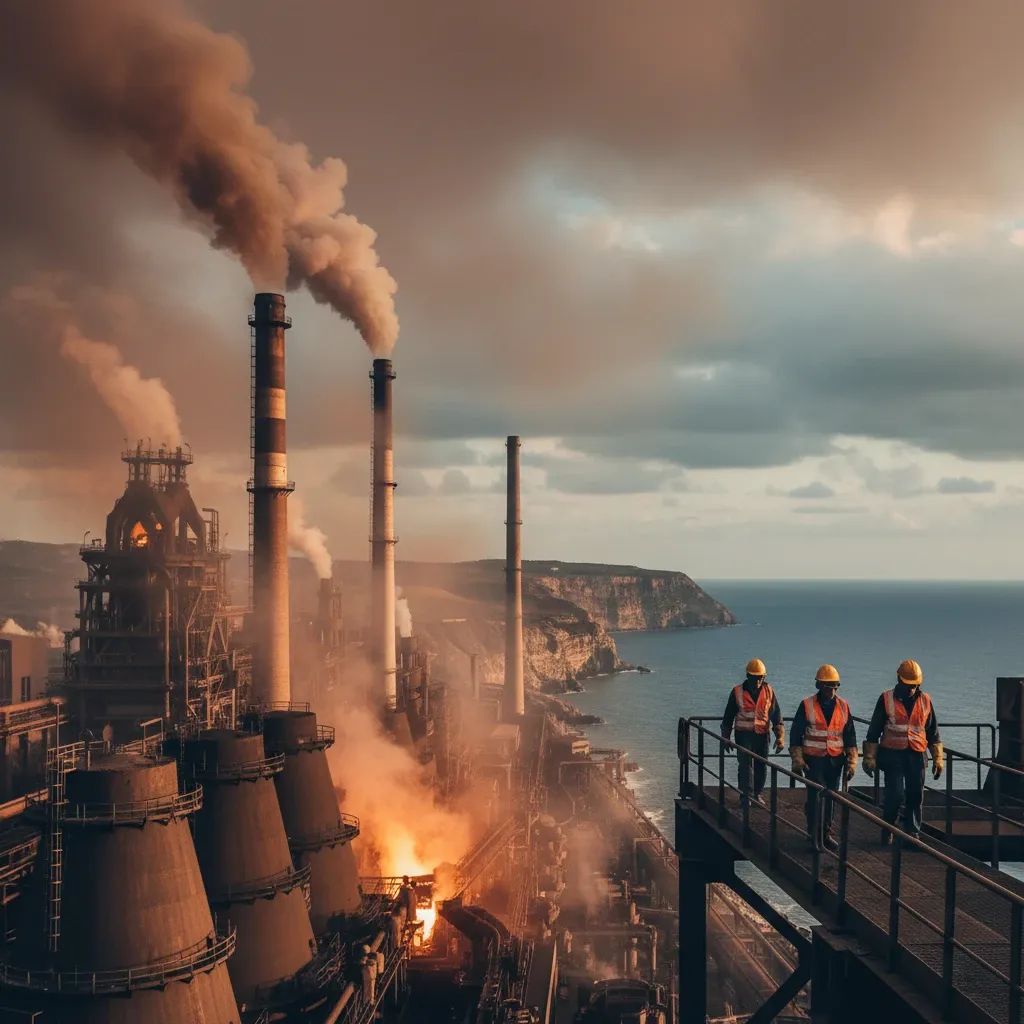
The Italy Ministry of Business and Made in Italy is racing to salvage the country's most troubled steel plant, a facility that has accumulated €7 billion in damages under previous management and now faces critical decisions that threaten production at the core of Europe's steel industry. Industry Minister Adolfo Urso will meet with labor unions on Monday to outline rescue options for Acciaierie d'Italia (formerly Ilva) in Taranto—a plant that employs thousands and supplies a critical share of Italy's steel demand.
Why This Matters:
• €7 billion liability: Court-appointed administrators have documented significant defects in plant infrastructure, the result of alleged mismanagement by ArcelorMittal between 2018 and 2024.
• Green steel pivot: The government's long-term strategy hinges on converting Taranto into a modern steel complex, powered by electric arc furnaces and advanced technologies.
• International bidding process: The government is evaluating proposals from potential industrial investors to find a new owner for the plant.
• Union demands: Workers and their representatives are pressing for clarity on financial resources, job security, and modernization timelines.
The €7 Billion Damage Claim Against ArcelorMittal
Court-appointed commissioners have filed a lawsuit seeking reimbursement for what they describe as mismanagement executed by ArcelorMittal, the multinational that controlled the plant from 2018 until it returned to state administration. The commissioners' assessment identified significant operational and structural challenges across the Taranto site, including deferred maintenance and inadequate capital investment.
Urso confirmed the figure in recent remarks, stating that the €7 billion represents "the inheritance we received" and forms the basis of the commissioners' legal action. The lawsuit alleges that ArcelorMittal prioritized short-term cash extraction over capital investment, leaving major equipment in a state of deterioration. Environmental and worker safety concerns at the site have been documented in official reports.
Monday's Union Meeting: Demands for Transparency and Job Security
Union federations will convene with Ministry officials on Monday, following weeks of requests for an urgent briefing. Workers and their representatives are pressing for clarity on several fronts:
• Financial resources: With cash reserves challenged, maintenance budgets have been scrutinized, raising concerns about workforce investment.
• Employment security: The government must provide assurances about job retention and workforce planning during the modernization transition.
• Investment plans: Unions seek details on the timeline and scale of capital investment needed to modernize the facility.
• Modernization strategy: Unions seek clarity on how decarbonization plans will affect production volumes and employment levels.
Urso pledged to explain the current state of affairs and the pathways available for a "structural solution in productive continuity" that meets Italy's industrial and environmental objectives. His comments suggest the government is weighing options that balance environmental targets, employment levels, and industrial output.
Government Vision: A Modern, Sustainable Steel Plant
Gilberto Pichetto Fratin, Minister of Environment and Energy Security, has stated that the administration's objective is to transform Ilva into a modern, competitive facility aligned with Europe's decarbonization goals. He emphasized that Italy already operates significant electric arc furnace capacity that melt scrap rather than relying solely on coal-fired blast furnaces.
Pichetto Fratin noted that any rescue package must involve an industrial investor with genuine production capabilities, and must reconcile local environmental and regional interests with national strategic objectives. The Ministry of Business and Made in Italy is currently evaluating multiple proposals from interested industrial operators.
The minister also highlighted the geopolitical dimension: ensuring Italy maintains domestic steel production capacity affects sectors ranging from automotive to construction. A prolonged collapse at Taranto would force manufacturers to source material from abroad, often at higher cost and with longer lead times.
Italy's Steel Sector Showing Resilience
Despite the challenges at Taranto, Italian steel production has risen in the first months of 2026, demonstrating sector resilience. Urso cited this uptick as evidence that the sector can remain competitive, provided structural issues are resolved. He pointed to Piombino as a success story: the Tuscan port town is preparing to restart steelmaking with a modern facility backed by private investors and €285 million in public support. The new facility will rely on electric arc furnaces and advanced technologies, positioning it as a benchmark for modern steel production in southern Europe.
Urso expressed hope that Taranto can follow a similar modernization path, though he acknowledged that success hinges on "full awareness and participation by all stakeholders"—a reference to local government, environmental regulators, labor unions, and potential private investors.
What This Means for Residents and the Broader Economy
For people living in Taranto and surrounding communities, the fate of Acciaierie d'Italia directly affects household incomes, municipal revenues, and the viability of businesses dependent on the steel industry. The plant directly employs several thousand workers and supports tens of thousands of indirect jobs in logistics, maintenance, and supply chains. Prolonged uncertainty threatens economic stability in the region.
Environmental concerns remain significant. The facility's historical operations have raised health questions in surrounding neighborhoods. International monitoring indicates that any modernization plan must include credible environmental remediation and compliance with European standards.
For investors and companies in sectors such as automotive, appliances, and construction, the availability of domestically produced steel at stable prices is strategically important. Reliable domestic production protects against supply-chain disruptions and price volatility.
Decarbonization and the European Context
Italy's significant electric arc furnace capacity gives it advantages in producing modern, lower-carbon steel. Across the European Union, investments in advanced steelmaking technologies are accelerating. These include direct-reduced iron (DRI) plants and hydrogen-based production methods that reduce reliance on coal-fired processes.
The transition to modern steelmaking requires substantial capital investment. Green production technologies remain more expensive than traditional methods, and European Union regulations increasingly impose requirements on carbon intensity. Italian industry groups emphasize the importance of adequate support mechanisms to ensure competitiveness during this transition.
The Path Forward
Commissioners and government officials are evaluating proposals from potential industrial investors to determine the best path for Taranto's modernization. The process involves assessing multiple factors: capital commitment, environmental compliance, employment guarantees, and alignment with Italy's industrial strategy.
Unions insist that any new ownership structure must guarantee job retention, safety investment, and environmental compliance. They have also called for mechanisms ensuring state involvement in decisions affecting employment and production levels.
Monday's meeting will be critical in establishing a timeline for decisions and clarifying the government's role in supporting the plant's modernization. Transparent communication with all stakeholders—unions, environmental regulators, local government, and residents—will be essential for rebuilding confidence in the facility's future.
The Bigger Picture: Italy's Industrial Sovereignty
The commitment to revitalizing Acciaierie d'Italia reflects a broader conviction that steel production is strategically important for Italy's economy and industrial independence. Italy cannot afford to become wholly dependent on imports from regions with varying labor standards, environmental regulations, or geopolitical considerations. Maintaining domestic productive capacity in critical sectors protects against supply-chain disruptions and supports manufacturing competitiveness.
At the same time, the environmental legacy of older steelmaking—air pollution, soil contamination, and health impacts—has understandably eroded public acceptance. The government's approach is that modernizing the facility with credible decarbonization commitments, backed by transparent reporting and enforceable standards, can address environmental concerns while maintaining productive capacity.
Whether this strategy succeeds will become clearer in the coming weeks and months. Monday's union meeting is the first step in what will be a complex negotiation involving government officials, investors, regulators, labor representatives, and the local community—all with the goal of securing a viable, sustainable future for steelmaking in Taranto.


