
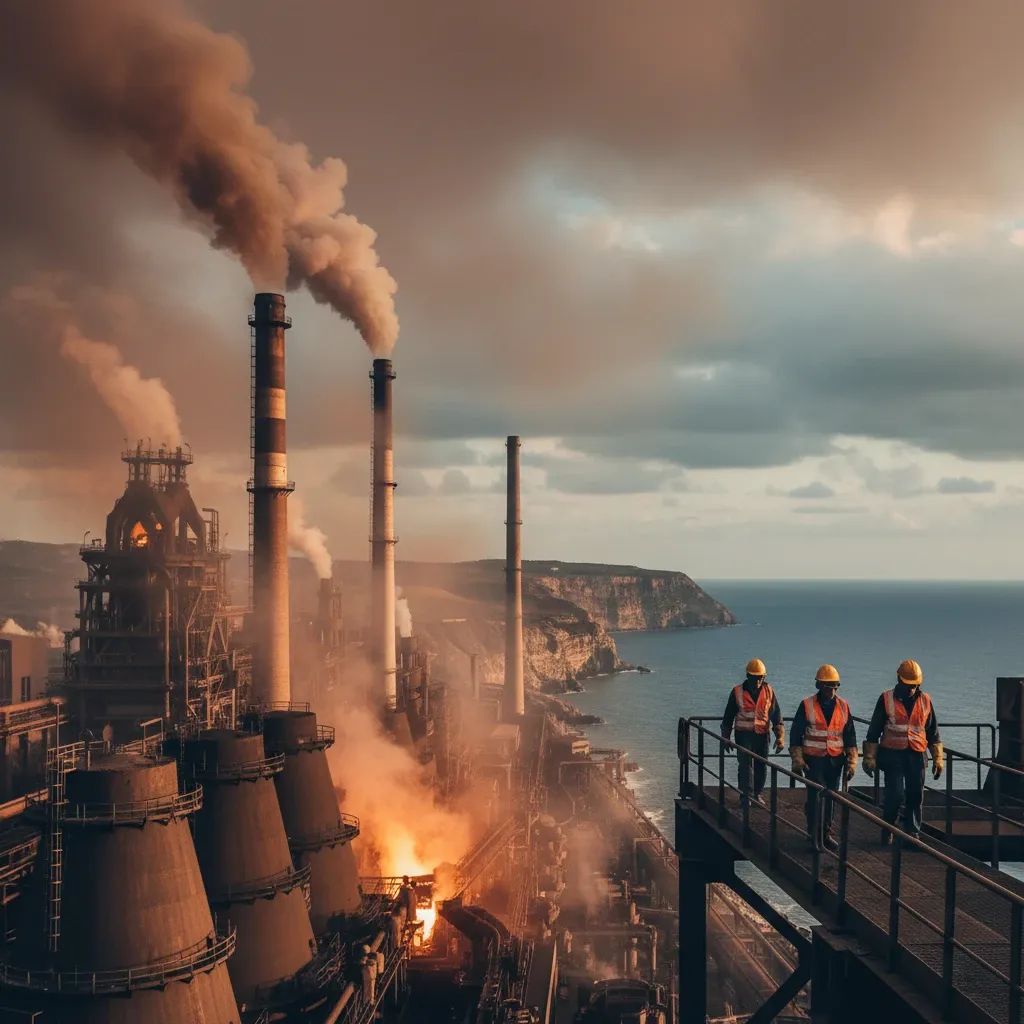
Jindal Steel has submitted a revised bid for the entire ex-Ilva Taranto industrial complex, positioning itself to navigate the fallout from a Milan court ruling that mandates closure of the plant's hot steelmaking operations within 90 days. This development marks a pivotal moment in the long-running saga of Italy's largest but most environmentally troubled steel facility, as the Italian Ministry of Enterprises and Made in Italy scrambles to prevent the collapse of a sector that supports roughly 20,000 jobs across direct employment and supply chains. The crisis is unfolding in August 2026, with critical decisions expected in the coming weeks.
Why This Matters
• Indian steel giant adjusts strategy: Jindal's updated proposal accounts for the court-ordered shutdown and includes plans to import semi-finished steel slabs while evaluating a carbon-free furnace.
• Italian consortium emerging: The Confindustria business federation now sees conditions for assembling an all-Italian investor group, spearheaded by Minister Adolfo Urso.
• Tight deadline: Current financing via an EU-approved bridge loan will run dry in the coming months, leaving no room for delays in selecting a buyer.
• Union anger mounts: Metal workers' federations have rejected the government's August meetings as "listening exercises only," demanding immediate intervention at Palazzo Chigi.
The Court Order That Changed Everything
The Milan Court of Appeals ruled on July 27, 2026 that the Taranto plant's hot area—where raw materials are transformed into molten steel—must cease operations within 90 days unless environmental violations are remedied. The judgment cited the presence of over 2,000 kg of asbestos in blast-furnace cowpers without any removal plan in the 2025 Environmental Authorization, and the absence of binding limits for PM10 and PM2.5 particulate emissions despite five successive authorizations since 2011.
The decision followed an appeal by the "Genitori Tarantini" parents' association and was bolstered by epidemiological data from the Taranto Local Health Authority, which documented statistically significant excess mortality, hospitalization, and lung cancer incidence among residents. Infant mortality rates in Taranto exceed the national average, reinforcing decades of public outcry over the plant's impact on the surrounding population.
Minister Urso confirmed during an August 5 meeting that the closure order has been uploaded to the "data room" accessible to all bidding parties, fundamentally altering the contours of the ongoing sale process. Under the terms of Italy's insolvency proceedings for Acciaierie d'Italia, the entity now operating the former Ilva assets, any prospective buyer must factor the shutdown into its financial and operational planning.
Jindal's Revised Approach
Jindal Group, the Indian steel conglomerate that has pursued the Taranto facility for months, responded by presenting a restructured offer covering the full industrial perimeter—both hot and cold rolling operations. According to statements relayed by the ministry, Jindal's plan includes accepting the risk of restarting the hot area at its own expense and in compliance with court directives, alongside near-term continuity for downstream production through imports of semi-finished slabs from its Indian mills and, eventually, from Oman.
The proposal also contemplates installation of an electric arc furnace, signaling alignment with broader decarbonization mandates. Jindal's willingness to move forward despite the court ruling has provided a degree of relief to officials concerned about a total industrial collapse, though critics note that reliance on imported feedstock would reduce domestic value-added activity and potentially weaken employment at the upstream end of the production chain.
The Push for an Italian Consortium
Confindustria President Emanuele Orsini described an August 5 meeting with industrialists at the ministry as "serious and productive," stating that "given the new conditions around the ex-Ilva plant, the prerequisites now exist to evaluate an Italian consortium that has the country's base industry at heart." He emphasized that beyond the workforce, crucial product supply chains depend on the survival of integrated steelmaking capacity.
The ministry has been convening a series of working tables with Federacciai (the national steel association) and major Italian producers, including Marcegaglia, Arvedi, Acciaierie Venete, Danieli, and Feralpi, to gauge interest in forming a domestic buyer group. The logic is twofold: preserve strategic control over a sector deemed vital for defense, infrastructure, and automotive manufacturing, and avoid handing the facility to a foreign player that might prioritize offshore sourcing.
Minister Urso has floated the possibility of revising the tender to exclude the hot area altogether or even breaking up the asset portfolio into separate lots, which could make participation more palatable for smaller Italian firms. Such a restructuring would, however, require publication of a new public notice and extend timelines—an unattractive prospect given that the EU-approved bridge loan keeping Acciaierie d'Italia afloat is projected to be exhausted within months, with no authorization for further disbursements.
Union Demands and Frustration
Metal workers' unions—Fim-Cisl, Fiom-Cgil, Uilm, and USB—held an eight-hour strike and blocked the SS100 highway connecting Bari and Taranto in the days leading up to the August meetings. Their platform centers on four pillars: production continuity, environmental remediation, decarbonization via electric furnaces, and employment protection for both direct hires and subcontractor personnel.
Ferdinando Uliano, general secretary of Fim-Cisl, told reporters after the August 4 technical session that "we had great expectations regarding the government's capacity to formulate proposals; we received only a hearing with no answers." He insisted that the administration must convene a high-level summit at Palazzo Chigi—the prime minister's office—"with a concrete political proposal."
Michele De Palma, head of Fiom-Cgil, was equally blunt: "Eight hours of strike were evidently not enough for the government to understand there is an Ilva emergency. Today's meeting was, from our perspective, negative." He called for direct state participation to "strategically secure the ex-Ilva situation," adding that "the countdown has already begun." Unions have requested wage-continuity guarantees through a dedicated social buffer, early-retirement programs, and recognition of pension credits for workers exposed to asbestos or performing physically demanding tasks.
The labor organizations criticized the defunding of DRI Italia, the state-owned vehicle tasked with developing direct-reduced-iron plants necessary for the transition away from blast furnaces. Without that infrastructure, they argue, decarbonization pledges remain hollow.
What This Means for Residents and Workers
For the roughly 20,000 people whose livelihoods are tied to the Taranto steel complex—spanning plant employees, contractors, and downstream manufacturers—the next 90 days represent existential uncertainty. The court-imposed deadline expires at the end of October 2026, and barring a negotiated compliance pathway or appeal, the hot area will go dark, halting primary steel production.
If Jindal or an Italian consortium secures the asset and successfully navigates permitting hurdles, employment could stabilize under a leaner, electrified production model. Conversely, failure to attract investment risks triggering mass layoffs and the unraveling of regional supply chains that feed automotive, white-goods, and construction sectors across southern Italy.
Taranto residents face a different calculus. Decades of living downwind from blast furnaces have left a legacy of elevated cancer and respiratory disease rates. Many view the court ruling as long-overdue accountability, even as they worry about economic fallout. A "Decreto Salva Taranto"—a special legislative package to safeguard both the plant and public health—has been floated but not yet drafted.
Financial and Timing Pressures
Acciaierie d'Italia, operating under extraordinary administration since the previous owner withdrew, has been sustained by a bridge loan authorized by the European Commission. Ministry statements confirm that these funds are projected to run out "in the coming months," with no provision for additional tranches. This financial cliff compresses the window for selecting a buyer and closing the transaction.
Any modification to the tender scope or conditions would necessitate republishing the sale notice, potentially adding several months to a timeline that is already colliding with the court's October 2026 cutoff and the loan-exhaustion date. Commissioners overseeing the insolvency are therefore under immense pressure to evaluate existing bids—principally Jindal's—or to pivot rapidly toward an Italian alternative.
Government's Next Steps
The Ministry of Enterprises and Made in Italy has indicated that technical departments will spend the coming weeks assessing the feasibility of union proposals and the viability of submitted bids. A synthesis of these findings is expected to feed into a high-level policy meeting at Palazzo Chigi in early September 2026, where political leadership will need to choose among competing scenarios: accept Jindal's offer, back an Italian consortium, restructure the tender, or pursue a hybrid solution involving partial state ownership.
Officials have clarified that companies interested in acquiring the full industrial perimeter—including both hot and cold areas—may already submit new bids or improve existing ones under the current framework. That provision gives Jindal and any emergent Italian group a path forward without formal tender amendments, though the legal and environmental uncertainties surrounding the hot area remain daunting.
The intensity of union mobilization, combined with Confindustria's renewed advocacy for national ownership, suggests that the political calculus has shifted in favor of exploring a domestic solution more seriously than at any point since the 2018 collapse of the ArcelorMittal joint venture. Whether Italian industrialists can muster the financial firepower and risk appetite to compete with a global player like Jindal, however, remains an open question that will define the Taranto plant's fate in the months ahead.


