
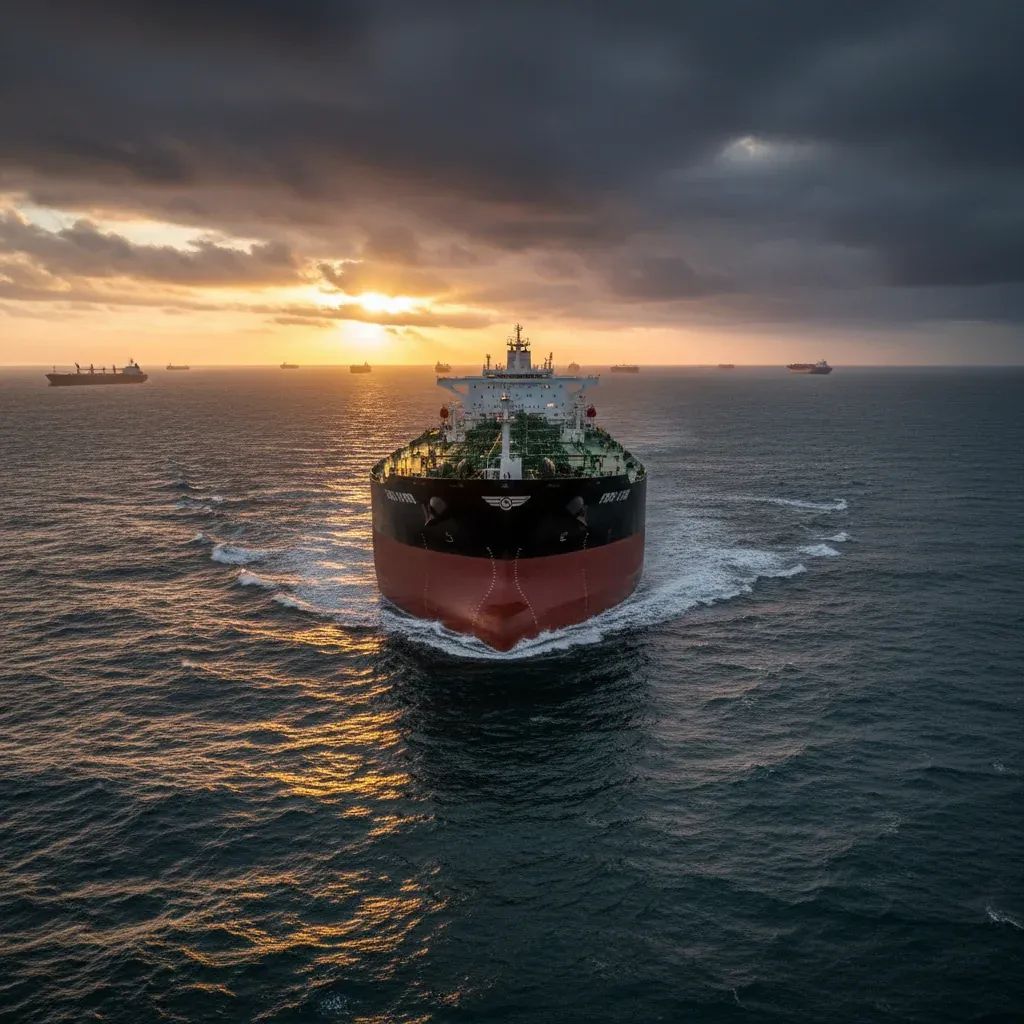
The United States and Iran have inked a preliminary accord that could finally unlock the Strait of Hormuz, the maritime chokepoint that handles roughly 21% of global oil traffic, but the journey back to normalcy for shipping and energy markets will be anything but swift. The memorandum of understanding signed in June 2026 promises a 60-day toll-free window and a cessation of hostilities that began in late February, yet industry experts, maritime insurers, and Italian shipping officials all caution that full recovery may stretch beyond a year.
Italy's Prime Minister Giorgia Meloni welcomed the memorandum during a pre-G7 meeting with her Japanese counterpart, Prime Minister Sanae Takaichi, emphasizing the agreement as a shared priority for both Rome and Tokyo. "We expressed satisfaction for the memorandum and underscored the importance of reopening the Strait of Hormuz for free and secure navigation," Meloni stated, framing the accord as a cornerstone for global trade stability ahead of the G7 summit in Evian-les-Bains.
Why This Matters for Italy
Italy's economy, deeply reliant on imported energy and maritime logistics, stands to benefit substantially from the reopening, but only if transit costs and security risks are genuinely neutralized. Here's what residents and businesses need to know:
• Energy Price Relief Delayed: Expect petroleum and LNG costs to remain elevated for at least several more months, as mine clearance and logistical congestion prevent immediate supply normalization.
• Shipping Industry on Alert: Confitarma, Italy's shipowners' association, has declared any toll system "unacceptable" under international maritime law, warning it would set a "dangerous precedent" for global navigation.
• Italian Naval Contribution: Italy has pledged political and operational support to a France- and UK-led multinational mission aimed at mine clearance and escort duties, potentially deploying within days.
• Trade Route Uncertainty: Even after the Strait reopens, Italian exporters and importers may see persistent delays and rerouting costs, as shipping companies hedge against future instability.
The 60-Day Toll-Free Window and What Comes Next
President Donald Trump announced the Strait would be "completely open" by Friday, June 19, and emphasized it would remain "permanently toll-free." Yet Iranian sources have told the Fars news agency a different story: the 60-day exemption is exactly that—temporary. After two months, Tehran reserves the right to impose fees for "security, navigation, environmental, and insurance services," according to officials close to the negotiations.
Luca Sisto, director general of Confitarma, told ANSA that any tariff regime would breach United Nations Convention on the Law of the Sea provisions guaranteeing free transit through international straits. "This is out of the question and would create a catastrophic precedent," he said, noting that 20,000 mariners remain trapped or delayed in the Gulf region.
French President Emmanuel Macron echoed Italy's stance, declaring from Evian that "the reopening of the Strait of Hormuz with the imposition of tolls would be contrary to international law." France, alongside the United Kingdom, Netherlands, Germany, Japan, and Italy, is preparing a rapid-deployment mission to support mine clearance and secure passage, with vessels potentially in position within 48 to 72 hours.
Mine Clearance: A 3-to-6-Month Bottleneck
The accord obliges Iran to clear naval mines within the first 30 days, but Pentagon internal estimates and independent maritime analysts suggest a realistic timeline of 40 to 50 days minimum, with full confidence restoration taking up to six months. Professor Gian Enzo Duci of the University of Genoa, an expert in maritime economics, explained that while two corridors near Oman and Iranian waters remain mine-free, allowing limited transit, the bulk of the Strait requires systematic sweeping.
"We can't expect 40 million barrels of oil to flow out on day one," Duci said. "The logistical congestion alone—hundreds of vessels waiting on both sides—will take weeks to untangle even after routes are declared safe."
Bloomberg reported that approximately 300 laden ships are queued to exit, with an equal number of empty vessels waiting in the Gulf of Oman to enter and load cargo. Many have disabled their transponders, complicating precise headcounts and coordination.
Shipping Companies Remain Cautious
Major international carriers, including Japan's Mitsui OSK Lines and Nippon Yusen, have signaled they will wait for concrete operational details before resuming full Strait transit. Angad Banga, CEO of Hong Kong-based Caravel Group, told Bloomberg, "We've seen positive signals before. What truly matters is whether this deal holds over time."
The Baltic and International Maritime Council (BIMCO) stressed that coordinated departure schedules are essential to avoid collisions and ensure safe passage through newly cleared corridors. Crew rotations, vessel inspections, and insurance recalibrations will all add days or weeks before ships can depart.
Italy's Confitarma also highlighted a structural risk: even if Hormuz becomes navigable again, the global shipping industry has already adapted. "Logistics has natural flexibility," Sisto explained. "When a historically consolidated flow is blocked, the industry repositions itself. It's not guaranteed that everything that once transited Hormuz will return to the same routes."
Alternative Routes and Their Costs
During the closure, Italy-bound energy shipments rerouted around the Cape of Good Hope, adding roughly 3,500 nautical miles and 10 to 14 days to voyages from the Gulf. This detour inflated fuel costs, emissions, and insurance premiums, contributing to the energy price spikes felt across European markets, including Italy.
Saudi Arabia's East-West Pipeline (Petroline) and the UAE's Abu Dhabi Crude Oil Pipeline (ADCOP) to Fujairah have absorbed some of the slack, bypassing Hormuz entirely. These strategic assets are likely to retain heightened importance even after the Strait reopens, as exporters seek supply chain diversification.
Multimodal land bridges through Saudi Arabia and Oman, as well as the China-Europe Railway Express, gained traction during the crisis and may continue to serve niche markets despite higher costs, particularly for time-sensitive cargo.
Italy's Role in the Multinational Mission
Italy has formally joined a six-nation political and operational initiative alongside France, the UK, Germany, the Netherlands, and Japan. Italy's Defense Ministry clarified the mission is primarily political rather than combat-oriented, aimed at ensuring compliance with international maritime law and supporting mine-clearance operations.
The Quinta Flotta degli Stati Uniti, headquartered in Bahrain, retains operational command of coalition naval forces in the region and has tripled demining efforts since April. France and the UK are coordinating with Italy's Navy to deploy dragamine vessels and surveillance assets, with the first ships potentially arriving within days of the formal accord signing on June 19.
What Businesses and Consumers Should Expect
For Italian businesses reliant on Gulf energy or Asian trade, the reopening is a promising first step but not an immediate fix. Energy import costs will likely remain above pre-crisis levels through the end of 2026, as the market waits for verified mine-free corridors and consistent transit volumes.
Logistics managers should budget for continued uncertainty. Even optimistic scenarios suggest a 3-to-6-month adjustment period before shipping schedules stabilize. Companies with exposure to LNG contracts or petroleum derivatives may see gradual relief starting in Q4 2026 or early 2027.
Investors in Italian shipping, energy, and logistics sectors should monitor the formal signing ceremony on June 19 and subsequent BIMCO and International Maritime Organization bulletins for route certifications. Any backsliding by Iran on toll commitments or delays in mine clearance could trigger renewed volatility.
Geopolitical Fragility and Long-Term Questions
The accord leaves critical issues unresolved, including Iran's nuclear enrichment program and the future of Israeli military presence in Lebanon. The 60-day truce window is intended as a confidence-building phase, but both Washington and Tehran have incentives to renegotiate or reinterpret terms.
Emmanuel Macron and Giorgia Meloni both underscored the need for multilateral oversight and adherence to international maritime conventions. Trump, for his part, assured Macron that the U.S. does not need "much help" to reopen Hormuz but welcomed European participation in the multinational mission.
For Italy, a country that imports the vast majority of its energy and relies heavily on maritime trade for exports, the Strait's fate is not just a Middle Eastern issue—it's a question of economic resilience. The memorandum offers hope, but the real test lies in execution, transparency, and whether the fragile truce can withstand the next wave of regional tensions.


