
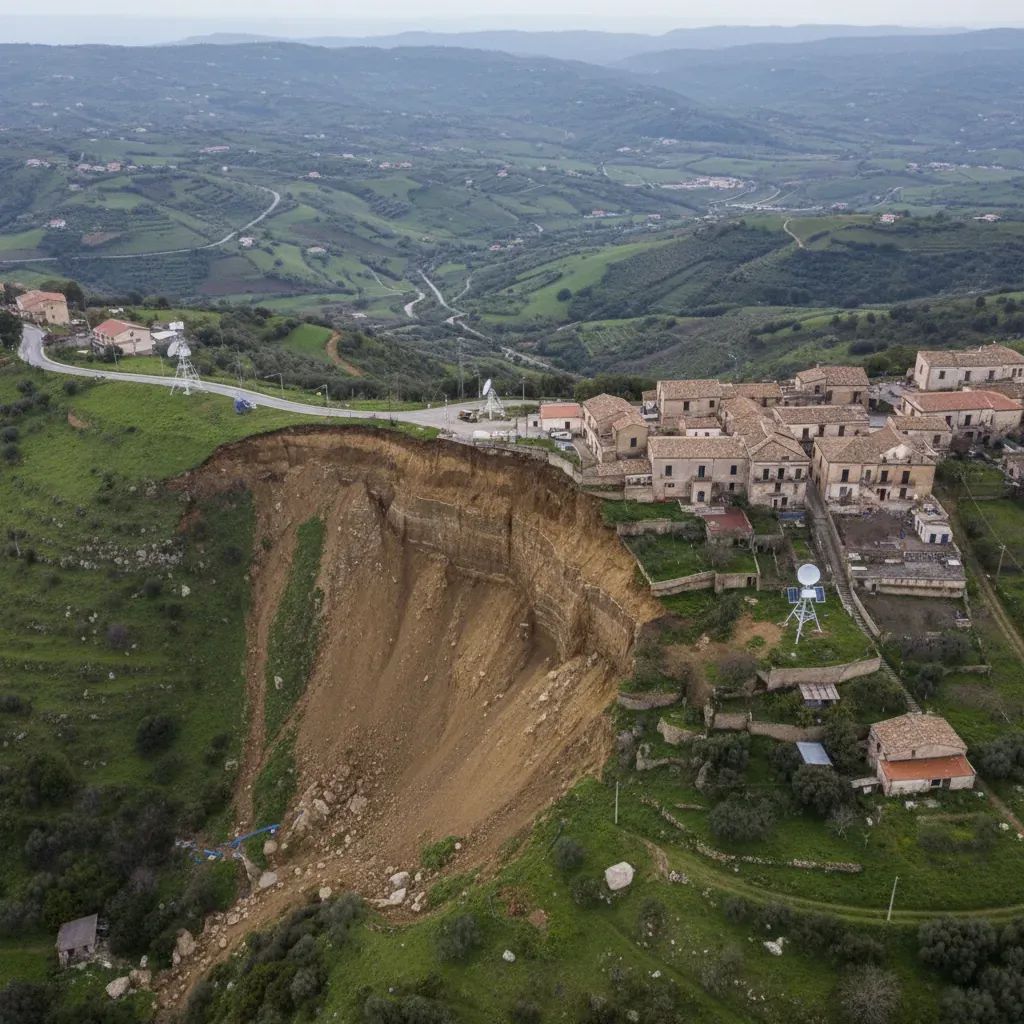
The Italian government is fast-tracking relief for Niscemi, the Sicilian town devastated by a January landslide. Prime Minister Giorgia Meloni confirmed on Thursday that the Cabinet will approve €150M in funding across two distinct tracks: €75M for terrain stabilization and infrastructure repair, and an equal sum for compensating displaced homeowners. The decision follows months of bureaucratic stalling and marks the first concrete disbursement schedule for residents awaiting both safety interventions and financial restitution.
Why This Matters
• Cabinet vote scheduled Friday: Two executive orders worth €75M each will finalize spending originally authorized under a February emergency decree converted into law in April.
• Demolition zone expanded: All structures within a 50-meter safety perimeter (the "red zone") face mandatory demolition; an estimated 500 residents must permanently relocate.
• Compensation excludes illegally constructed homes: Only properties with proper cadastral registration qualify for buyout assistance; owners of unlicensed buildings receive nothing.
• Ongoing criminal investigation: Prosecutors are examining 13 government and technical officials, including the current and two former Sicilian governors, for permitting high-risk construction in known hazard zones.
Niscemi's Geological Trap
The town sits atop a geological nightmare: sandy, water-absorbent soil stacked above impermeable clay. When Mediterranean cyclone Harry unleashed torrential rains across Sicily in January, this moisture imbalance triggered a cascading hillside collapse. Homes and vehicles tumbled into the ravine; dozens of buildings now hang precariously over cliff edges. About 1,500 people were forced to evacuate neighborhoods bearing names that now evoke disaster—Sante Croci, Pirillo, Canalicchio.
Fabio Ciciliano, Civil Protection Chief and now emergency commissioner, has warned that the hill continues shifting toward the adjacent plain where the city of Gela sits. This isn't a one-time rupture; it's a slow-motion process. On May 16, a two-story apartment building in the "black zone" simply collapsed, crushed by continuing soil settlement. Geotechnical monitoring remains active because the landslide is unpredictable—engineers cannot yet predict where the next failure point will emerge.
A Government Playing Catch-Up
Meloni emphasized a rupture from history during her visit to the municipal council. "We're doing things differently compared to 1997," she told reporters, referencing the last major landslide in Niscemi that displaced 400 people and destroyed 48 homes, including an 18th-century church. Back then, emergency response was chaotic and fragmented. Reconstruction dragged on for years, with families receiving piecemeal rent allowances rather than coordinated relocation programs. Worse, the state continued paying residual compensation well into the 2000s.
The 1997 disaster should have triggered systematic prevention. Instead, three decades of inaction followed. Drainage systems were never modernized. Water management infrastructure remained minimal. Urban expansion continued unchecked on slopes already classified as very high risk (P4) in the national hydrogeological registry updated in 2022. The territory was essentially left to repeat its tragedy.
When the May 9 conference titled "The Niscemi Landslide: From Emergency to Reconstruction" convened at the town's civic museum, urban planners and engineers confronted an uncomfortable reality: the very conditions that caused 1997 were never remedied. Funds allocated over decades for prevention sat unutilized. Political will evaporated once media attention faded. The paradox haunted the 2026 response—€150M now feels necessary only because €50M in preventive measures went unspent between 1997 and 2026.
What Displaced Residents Face
The compensation structure is bifurcated and harsh. Homeowners with legally registered properties and valid construction permits will receive assistance purchasing replacement housing or developable land in safer zones. Those holding "abusive" permits or properties never recorded in the municipal cadastre receive no state support—a policy that effectively punishes informal construction while potentially stranding poor families in legal limbo.
On May 14, angry residents gathered to protest the reimbursement terms, demanding full compensation at 100% replacement value. A demonstration was scheduled for May 15 in Piazza Vittorio Emanuele III. The government's May 21 announcement represents the first concrete timeline, yet residents remain skeptical. As of mid-April, only 25 social housing apartments had been assigned to the 1,500 displaced, and temporary housing subsidies—the Autonomous Accommodation Contribution (CAS)—were disbursed only through a second monthly installment.
The €75M compensation package breaks down into three streams: €22M for technical demolition costs and debris removal, €53M for relocation assistance (acquisition of replacement properties or construction of new housing in designated zones), and an unspecified reserve for administrative overhead. The exact boundaries of the red zone remain subject to continuous revision as monitoring reveals fresh fractures and settlement patterns.
The Money Split and Infrastructure Priorities
The parallel €75M infrastructure allocation targets road systems severed by the collapse. The SP82 and SP35 provincial highways, vital arteries connecting Niscemi to neighboring municipalities, require reconstruction. Equally critical is the regia trazzera, the ancient cattle path linking Niscemi to San Michele di Ganzaria, which serves as a secondary transit route and cultural heritage landmark. Work on these corridors is nearing completion, but final stabilization of embankments remains contingent on resolving the underlying soil instability.
An additional €2M has been ring-fenced for schools and educational services, acknowledging that the evacuation shattered the town's basic infrastructure for learning. Administrative offices, health clinics, and municipal services are also fragmented across temporary locations, compounding the dysfunction that displaced families endure.
The spending strategy reflects a tacit admission: full structural stabilization of the sliding hillside through engineering alone is not feasible. Instead, the approach combines continuous geotechnical monitoring, deep drainage installations, and sophisticated water management aimed at slowing—not halting—the landslide's progression. This philosophy marks a shift in Italian disaster policy away from the historical assumption that engineering can restore normalcy.
The Criminal Dimension and Political Accountability
The Gela Prosecutor's Office has opened a formal investigation for culpable disaster and property damage, naming 13 individuals. The suspects include Sicily's current governor Renato Schifani, his predecessor Nello Musumeci (now serving as national Civil Protection Minister), and two additional former regional governors. Technical officials and municipal administrators are also implicated.
Investigators are examining whether construction permits were granted illegally for projects in high-risk zones already flagged in hazard maps. The inquiry also scrutinizes why mandatory prevention measures mandated after 1997 were never executed—a failure spanning nearly three decades and multiple administrations. Opposition lawmakers have demanded a parliamentary commission to investigate the broader pattern of inaction and the paradox of unspent prevention budgets.
This criminal exposure has intensified political pressure. Neither national nor regional leadership can now claim ignorance about Niscemi's vulnerability. The town's history was documented. The science was settled. The money, in theory, existed. Yet nothing meaningful happened until catastrophe forced intervention.
A Pattern Italy Cannot Ignore
Niscemi is not unique. Dozens of Italian municipalities perch on unstable ground where aging infrastructure, unplanned urbanization, and deferred maintenance collide with increasingly intense climate events. The €150M commitment signals that Italy recognizes the problem. Whether it represents genuine systemic reform or simply another cycle of post-disaster spending remains uncertain.
Prime Minister Meloni's third visit to the town since January's collapse adds political weight to Friday's Cabinet decision. Her government faces scrutiny on whether the money translates into tangible prevention or merely finances another round of compensation and demolition—a repetition of the 1997 playbook with a larger budget.
For now, Niscemi's 1,500 displaced residents remain suspended between emergency assistance and permanent resettlement, awaiting both formal Cabinet approval and the final delineation of the red zone. The town's slow, grinding collapse serves as a cautionary tale for Italian policymakers: geological hazards respect no political timeline, and yesterday's ignored warnings become today's catastrophes.


