
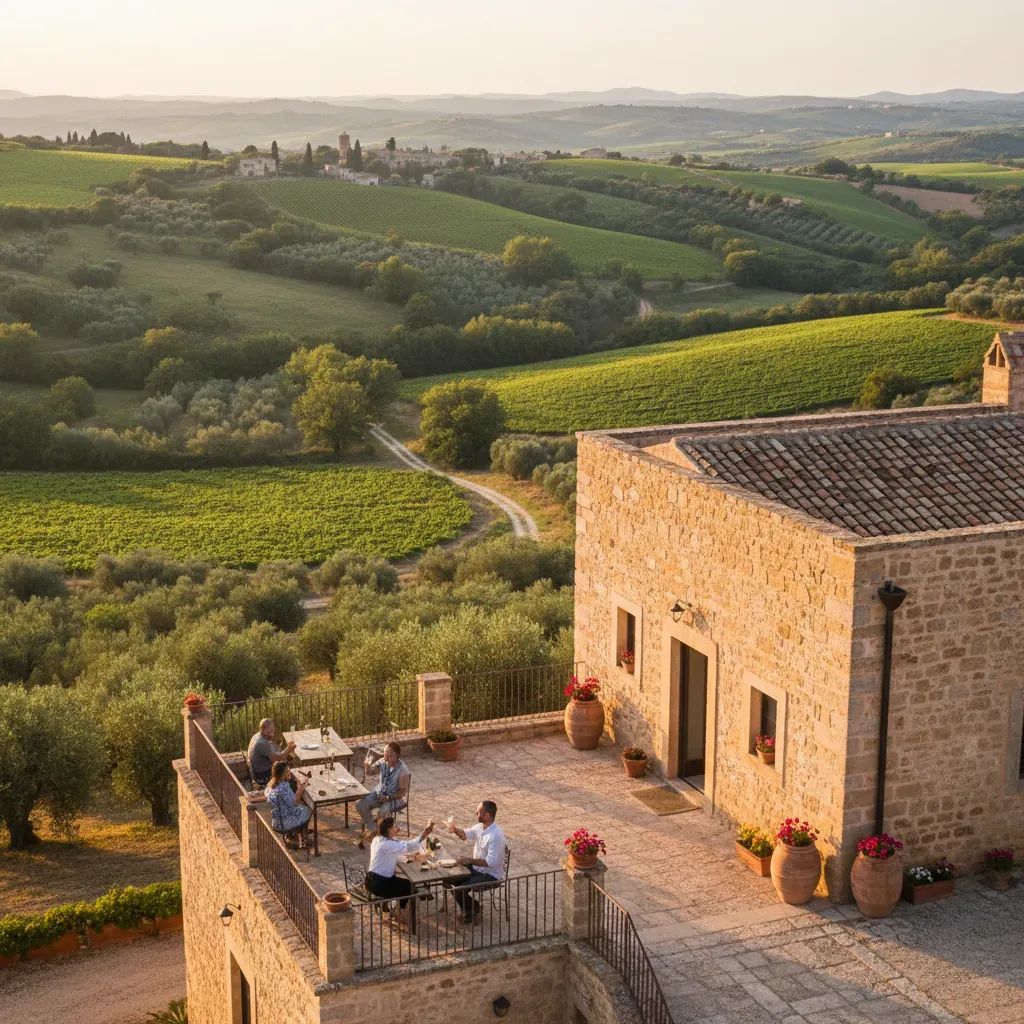
Italy's agritourism sector has expanded its economic footprint by an average of 5.3% annually over the past decade, positioning the country as Europe's largest agritourism sector in rural hospitality. The sector's total economic value now stands at just over €1.93 billion, according to fresh data released by the Italy National Institute of Statistics (Istat), though the pace of growth has moderated sharply—2024's 3.3% increase marks the slowest annual expansion since the pandemic disrupted global travel patterns.
For anyone living in Italy—whether running a business, investing in rural property, or simply planning a countryside getaway—this trajectory signals both maturity and opportunity. The sector has reached 26,360 active operations nationwide, up 231 units from the previous year, with the most dramatic growth occurring not in traditional strongholds like Tuscany, but in the southern regions and islands, where new authorizations surged by double digits.
Why This Matters
• Economic shift southward: Sicily's agritourism operations jumped 118% in new activations in 2024 (from 55 to 120 licenses), while Puglia saw new authorizations spike by 68%—signaling fresh investment momentum in Italy's Mezzogiorno.
• Average revenue climbs: The typical agritourism business now generates €73,300 annually, up from €71,600 the year prior, though regional disparities remain steep.
• Market stabilization: Birth and closure rates for agriturismi converged at 4.1% and 3.2% respectively, indicating the sector is entering a consolidation phase after years of rapid expansion.
• Foreign tourists dominate: International visitors accounted for 54.8% of overnight stays in 2024, with Germany, France, the Netherlands, and the United States leading the inbound flow.
What This Means for Residents
If you live in Italy, these shifts carry tangible implications. For rural landowners, the data suggests that agritourism remains a viable diversification strategy, particularly in the South and Islands where competition is lighter and growth rates are higher.
Aspiring agritourism operators must navigate region-specific licensing requirements—ranging from minimum land size to building codes. The Ministry of Agriculture maintains regional contact information, and most regions now offer digital application portals, though processing times vary from 60 to 180 days depending on location. Additionally, property owners may access support through the Common Agricultural Policy (CAP) 2023–2027 framework, which has allocated significant funding for rural tourism infrastructure. Interested operators should contact their regional Agricultural Development Agency for details on subsidy eligibility and application procedures.
However, the average revenue per operation reveals stark regional inequality: businesses in the North-East pull in over €103,000 annually, compared to €57,600 in the South and a meager €23,500 in the Islands. Profitability hinges not just on location, but on the ability to offer multifunctional services—nearly half of all agriturismi now provide activities like horseback riding, wine tastings, cooking classes, or trekking excursions.
For workers and job seekers, the sector's resilience is noteworthy. Tourism broadly contributes 13% of Italy's employment, and agritourism's upward trajectory—especially in regions like Sicily, Puglia, and Basilicata—translates into seasonal and permanent jobs in hospitality, food service, and land management. The sector's emphasis on local supply chains and farm-to-table produce also supports adjacent industries, from organic farms to artisan food producers.
For travelers within Italy, the proliferation of agritourism options means greater variety and competitive pricing, though the data hints at a potential saturation point in mature markets. The North-West's stagnation and the slowdown in Tuscany suggest that established regions may struggle to maintain growth without innovating their offerings or targeting niche demographics.
Northern Dominance, Southern Momentum
Italy's agritourism geography remains lopsided. Northern regions control 43.6% of all operations and command 51.3% of the sector's total economic value. Central Italy, home to iconic wine country and hilltop villages, accounts for 36.5% of businesses and an identical share of revenue. The Mezzogiorno—comprising the South and Islands—holds just 19.8% of operations yet contributes a mere 12.2% to national turnover.
But raw numbers obscure a more dynamic story. The North-West saw new authorizations contract by 3.3% in 2024, while the North-East experienced severe fragmentation: Veneto, Friuli-Venezia Giulia, and Emilia-Romagna each recorded declines near 20%, even as the Autonomous Province of Bolzano/Bozen surged 18.6%. Tuscany still leads in absolute terms with 219 new licenses issued last year, yet that figure represents a decline from prior periods. Lazio, by contrast, posted a robust 23.7% jump in fresh authorizations.
The Mezzogiorno's 13.5% rise in new licenses outpaced every other macro-region. The Islands alone grew 31.1%, driven overwhelmingly by Sicily, where activations leapt from 55 to 120—a 118% surge. Puglia's 68% increase in new permits underscores the region's rapid pivot toward experiential tourism, leveraging olive groves, traditional farmhouses, and coastal charm to attract both domestic and international guests.
When new openings are weighed against closures, the North-West essentially broke even, while the South netted 20 additional operations and the Islands 108—the highest regional surplus in the country.
Regional Revenue Disparities
Average annual revenue per agritourism business stands at €73,300, but that figure masks profound disparities. The North-East's €103,000 average reflects a concentration of high-end wine estates and alpine retreats in Trentino-Alto Adige, where the Autonomous Province of Bolzano/Bozen alone accounts for 13% of Italy's agritourism operations. Central Italy follows at €73,200, buoyed by Tuscany and Umbria's brand cachet.
The North-West lags at €53,600, hampered by limited rural tourism infrastructure in industrial Lombardy and Piedmont. The South's €57,600 average is depressed by smaller operations and shorter guest stays, while the Islands' €23,500 figure reflects both nascent market development and operational challenges—though Sicily's rapid expansion suggests this gap may narrow.
Market Maturation and the Slowdown
The sector's 3.3% growth in 2024 represents a marked deceleration from the 15.4% surge recorded in 2023, when pent-up pandemic demand flooded rural Italy. The 10-year compound annual growth rate of 5.3% obscures recent volatility: the industry contracted sharply in 2020, rebounded aggressively through 2023, and is now entering what Istat describes as a "progressive slowdown" phase.
Birth and closure rates have converged at historically tight margins—4.1% and 3.2% respectively—signaling that the easy growth phase has ended. From 2015 through 2024, openings consistently outpaced closures, but the gap has narrowed each year since 2021. The sector is stabilizing, with fewer speculative entrants and more emphasis on operational efficiency.
Why the South Is Booming
Several structural factors explain the Mezzogiorno's outperformance. First, international demand for authentic, experiential travel has surged, with foreign tourists now representing the majority of overnight stays. Southern regions offer unspoiled landscapes, archaeological heritage, and lower price points than Tuscany or the Dolomites, making them attractive to budget-conscious visitors from Germany, France, and increasingly the United States.
Second, policy support under the Common Agricultural Policy (CAP) 2023–2027 has channeled significant investment into rural tourism infrastructure, with a particular focus on underdeveloped regions.
Third, the rise of food-focused travel as a primary travel motivator plays to the South's strengths. Puglia's olive oil estates, Sicily's wine cooperatives, and Basilicata's artisan cheese producers have leveraged direct supply chains and organic certifications to attract visitors seeking culinary experiences. These businesses often combine accommodation, dining, and hands-on workshops, generating higher margins than traditional farmstays.
Finally, digitalization has leveled the playing field. Southern operators have embraced online booking platforms, social media marketing, and customer reviews, compensating for historically weaker brand recognition.
Challenges Ahead
Despite the positive headline numbers, the sector faces headwinds. Overtourism in popular destinations—Cinque Terre, Amalfi Coast, Tuscan hilltowns—has prompted local authorities to impose visitor caps and seasonal restrictions, limiting growth potential in these markets.
Shorter stays and last-minute bookings are pressuring revenue models. The traditional week-long family vacation is giving way to quick weekend trips, compressing turnover and complicating labor planning. Operators must adapt by offering premium add-ons—private tours, chef's tables, wellness treatments—to offset declining occupancy duration.
Regulatory complexity remains a persistent irritant, particularly for new entrants. Each of Italy's 20 regions maintains its own licensing regime, creating a patchwork of requirements that discourages investment and complicates expansion. Industry advocates continue to push for harmonized national standards, though political will for such reform remains elusive.
Looking Forward
The agritourism sector's long-term fundamentals remain strong. Italy hosts over 28% of the EU's agritourism operations—the largest share in Europe—reflecting deep cultural assets that competitors cannot easily replicate.
For the sector to sustain momentum, however, it must diversify offerings, streamline regulations, and invest in off-season programming. The South's recent surge demonstrates that growth is still achievable, but mature markets in the North and Center will require reinvention. The data suggests Italy's agritourism story is evolving: the rapid expansion phase has stabilized, and future success will depend on operational efficiency, innovation in service offerings, and strategic regional development.


