
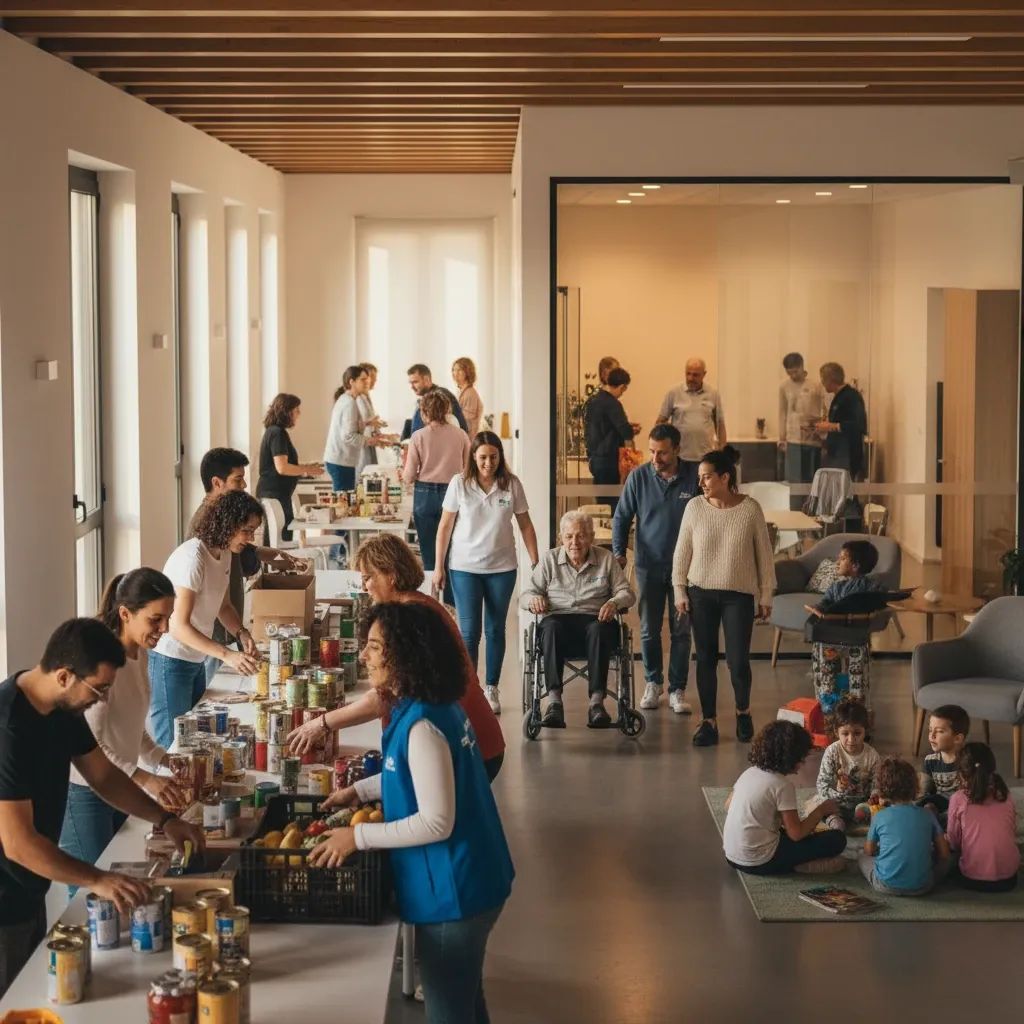
The Italy Third Sector now accounts for more than €100 billion in economic output, marking a decisive shift in how the country delivers social welfare, employment, and community services. This milestone—reached in 2025—positions the non-profit economy at roughly 4.5% to 5% of national GDP, and signals that the sector has evolved from a supplementary layer of civil society into a core pillar of Italy's productive infrastructure.
Why This Matters
• Economic scale: The Third Sector's value has surged 42% since 2015, when it stood at €70.4 billion, according to Italy's national statistics institute Istat.
• Employment impact: The sector now provides jobs to 1 million people, anchoring livelihoods across every region and bridging gaps left by traditional public services.
• Organizational growth: Nearly 400,000 entities were active in 2025, up 19% in recent years, spanning sports clubs, cultural associations, social assistance agencies, and emergency response units.
• Funding reality: While the Italy Ministry of Labor and Social Policies allocated €44.2 million for 2025 through a dedicated fund, the sector still faces sustainability challenges, especially among smaller organizations.
A Sector Outpacing Traditional GDP Growth
Data from Confederazione Aepi—an employers' union representing 40 organizations and 160,000 businesses across the Third Sector—underscores the velocity of this expansion. The confederation's analysis reveals that non-profit institutions have grown nearly twice as fast as Italy's overall economy over the past decade, driven by three converging forces: tax reform, digitalization, and rising public allocations.
The 2025 fiscal year proved pivotal. A new tax regime, confirmed by a "comfort letter" from the European Union, took effect on January 1, 2026, simplifying compliance for volunteer organizations, social promotion associations, and social enterprises. This regulatory clarity, long awaited, has unlocked capital and operational bandwidth that many entities had reserved for legal contingencies.
Simultaneously, the acceleration of digital transformation has enabled even modestly sized organizations to streamline volunteer management, broaden donor outreach, and track social impact with greater precision. Roughly 20.5% of non-profits remain undigitized, however, a gap that experts identify as a critical vulnerability for resource-constrained groups.
Who Does What: The Sector's Internal Architecture
The Third Sector is far from monolithic. While one in three organizations operates in sports—reflecting Italy's deep civic tradition of athletic clubs—the employment density tells a different story.
Social assistance and civil protection account for nearly half of all salaried positions, despite representing only 10% of registered entities. These are the frontline agencies managing emergency response, elder care, disability support, and poverty relief. The disparity reflects labor intensity: a neighborhood sports association may rely entirely on volunteers, while a residential care facility requires round-the-clock staffing.
Cultural and artistic activities claim 15% of organizations but employ far fewer people per entity, as do recreational and socialization initiatives, which make up 17% of the total. Education and research absorb 14.5% of the workforce, followed by economic development and social cohesion (11%) and healthcare (10%).
This structure reveals a sector that is simultaneously horizontally dispersed across recreational and cultural life and vertically concentrated in labor-intensive welfare services—often substituting for state provision in domains like home care, mental health outreach, and reintegration programs for the unemployed.
Regional Imbalances and the North-South Divide
Lazio and Lombardy lead in economic output, but territorial disparities remain pronounced. Northern regions benefit from denser networks of foundations, higher per-capita donations, and closer integration with corporate social responsibility programs. Southern provinces, by contrast, face structural disadvantages: lower household incomes, weaker municipal budgets, and less developed philanthropic ecosystems.
This geographic split mirrors broader patterns in Italy's economy, yet the Third Sector's decentralized nature offers a unique mechanism for localized resilience. In municipalities where public services are strained, non-profit entities often serve as the primary interface between vulnerable populations and institutional support—delivering meals, legal aid, childcare, and job training that would otherwise be unavailable.
What This Means for Residents
For anyone living in Italy, the Third Sector's expansion translates into more accessible services, but also greater variability in quality and coverage. If you are navigating unemployment, seeking elder care, or enrolling a child in an after-school program, the likelihood that a non-profit entity will be involved has increased substantially.
However, the sector's reliance on volunteer labor and limited budgets means that service continuity can be fragile. Organizations are under mounting pressure to professionalize, adopt transparent accounting, and demonstrate measurable social impact—all of which require expertise that many small associations lack.
The new fiscal regime offers some relief, but also introduces compliance burdens. Entities that fail to align their statutes with declared activities, or that exceed spending caps tied to the 2021–2023 baseline, risk removal from the National Register of the Third Sector (RUNTS), a database that confers tax benefits and legal recognition.
For donors, the sector's growth presents both opportunity and due diligence challenges. While high-impact projects can generate social returns exceeding €3.30 for every euro invested—as documented in a 2025 study by Intesa Sanpaolo and Prometeia—navigating the crowded landscape requires scrutiny. Not all entities report impact metrics, and transparency standards vary widely.
The Poverty Question: Impact and Limitations
Italy's poverty rate remains stubbornly high. In 2023, 5.7 million people lived in absolute poverty—9.8% of the population—the worst figure since 2014. Preliminary 2024 data suggest the rate climbed to 10.9% of households, with large families, single-parent households, and solo individuals disproportionately affected.
The Third Sector plays a vital but insufficient role in addressing this crisis. Caritas Italy, one of the largest networks, supported 277,775 families in 2024, equivalent to roughly 12% of all households in absolute poverty. The organization distributed 365,000 meals, facilitated 14,000 job placements, and provided professional training to 40,000 individuals.
Yet these interventions, while significant, cannot reverse systemic drivers of poverty: stagnant wages (down 7.5% in real terms between 2021 and 2025), precarious employment, and rising housing costs. The Third Sector functions as a buffer, not a solution—absorbing shocks that the state and market fail to address, but unable to replace structural reforms.
Experts warn of "normalized poverty," a condition in which even employed individuals struggle to meet basic needs. In this context, the Third Sector's role has shifted from emergency relief to long-term accompaniment, providing not just food or shelter but also skills training, psychological support, and social reintegration pathways.
Challenges Ahead: Sustainability, Professionalization, and Generational Turnover
Despite its growth, the sector faces existential pressures. Financial sustainability tops the list. The 2025 national budget imposed spending caps on entities receiving state support, tying allowable expenditures to the average of the previous three years—a move critics argue penalizes organizations that expanded services during the pandemic.
Cuts to funds for educational poverty and disability services (partially restored after backlash) have left many entities in limbo. The absence of an increase in the 5 per mille tax allocation—a voluntary mechanism allowing taxpayers to designate 0.5% of income tax to non-profits—means income growth lags behind mission expansion.
Volunteer recruitment is another flashpoint. Youth participation remains low, with under-35s representing just 22.8% of volunteers, and turnover has accelerated. Experts describe a shift toward "liquid volunteering"—episodic, project-based engagement rather than sustained institutional commitment. This complicates planning and erodes the informal knowledge that once anchored many organizations.
Professionalization is advancing but uneven. The sector needs managers fluent in impact measurement, digital tools, and public procurement, yet training infrastructure remains underdeveloped outside major cities. Universities are expanding curricula in social enterprise management, but demand far exceeds supply.
Looking Forward: From Fragility to Antifragility
Policymakers and sector leaders increasingly frame the Third Sector's future around the concept of "antifragility"—the ability not merely to withstand shocks but to grow stronger through them. The pandemic, despite its devastation, demonstrated the sector's capacity for rapid mobilization, from volunteer-led food distribution to remote mental health support.
The Italy Cabinet has proposed recognizing the Third Sector as a "social enterprise" and a pillar of the national economy, a symbolic but potentially consequential designation that could unlock procurement preferences, dedicated financing instruments, and seats at policy tables.
Shared administration—collaboration among public agencies, non-profits, and private firms to co-design and deliver services—is gaining traction as a governance model. This approach aims to pool resources, reduce duplication, and align incentives, though implementation remains patchy.
The €141 million fund for 2025–2027 prioritizes national-level projects (€14.3 million, including €3.5 million for artificial intelligence applications), local initiatives (€19.7 million distributed by regions), and equipment purchases such as ambulances (€7.4 million). While modest relative to the sector's scale, these allocations reflect growing recognition that the Third Sector is not charity but infrastructure.
Whether this recognition translates into sustained investment, regulatory coherence, and true parity with public and private actors will determine whether Italy's Third Sector becomes a model of inclusive growth—or a stopgap for state failure.


