
The Third Night Became Italy's Most Concentrated Television Moment in Over 35 Years
The Rai Network captured 9.5 million Italians in a single moment on Thursday evening, February 13, 2025, representing 60.6% of all televisions actively in use across the country. By percentage share, this third-night audience concentration marks the most intense national synchronization around Sanremo since 1990, when the festival operated on a different structural format. More significantly, it surpasses every comparable third-night result in the modern five-evening era, breaking through the 60.52% barrier that stood from 1995 (the Pippo Baudo edition co-hosted with Anna Falchi and Claudia Koll).
Understanding Sanremo: Why This Matters to Italy
For context, the Sanremo Festival stands as Italy's most prestigious annual music competition and cultural institution, dating back to 1951. Comparable to Eurovision in international scope but distinctly Italian in cultural significance, Sanremo determines which artists dominate national radio airplay, launches or revives music careers across the Italian and European markets, and commands the nation's undivided attention as a shared annual tradition. When Italians gather around Sanremo, they participate in a ritual that connects generations and defines the contemporary moment within Italian popular culture.
Why Thursday's Concentration Matters
• Premium advertising slots during peak moments commanded premium rates — positioning Sanremo alongside championship football broadcasts in commercial television value
• The Liguria region experienced substantial festival-related economic activity, with accommodation, dining, and retail generating measurable transaction volume throughout the week
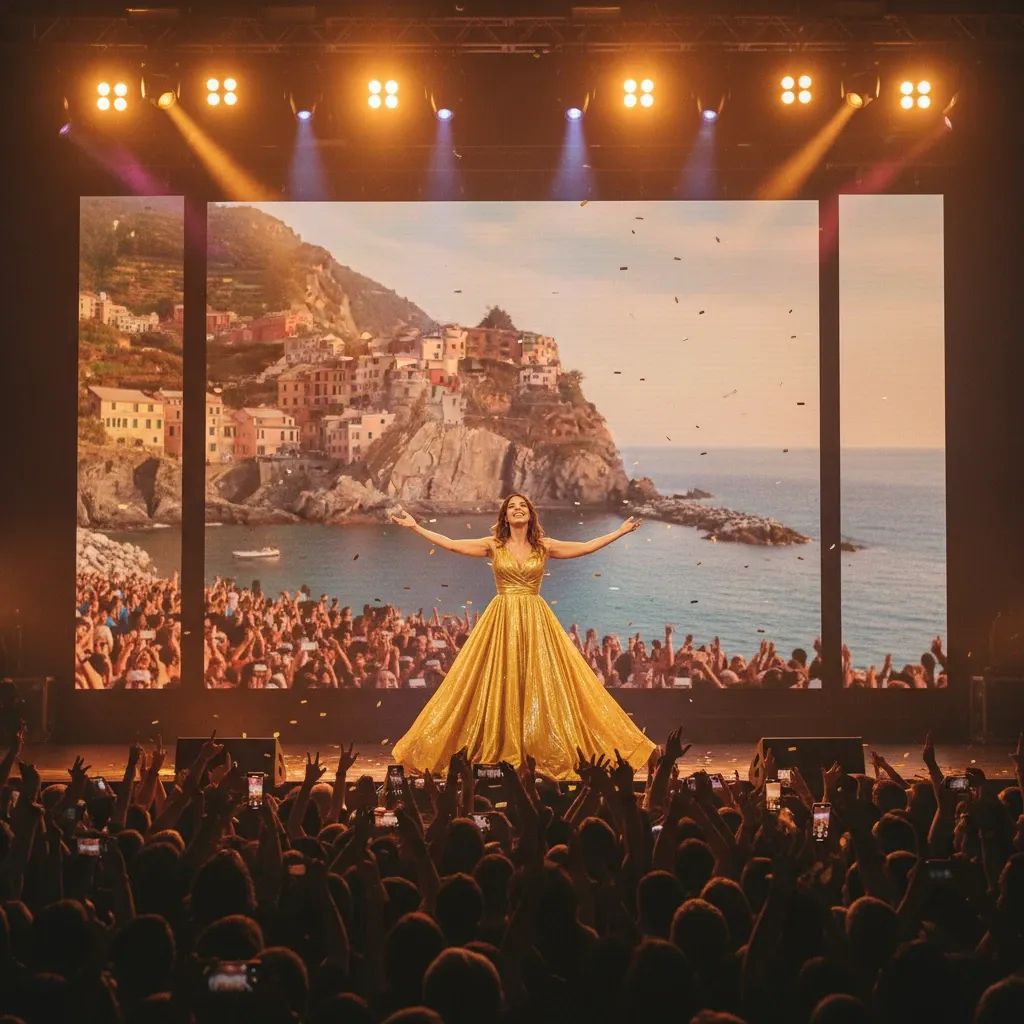
• Peak convergence hit 14.2M simultaneous viewers when Laura Pausini took the stage in yellow; the 65.8% share ceiling arrived moments later during the Alicia Keys-Eros Ramazzotti duet — moments that instantly seeded viral clips across TikTok, Instagram, and YouTube
The Composition of a Record Share
The evening split into two distinct viewing windows. From 9:45 PM through 11:33 PM, the Rai1 broadcast pulled 12.6M viewers who sustained a 60.4% share — numbers that would typically qualify as blockbuster television on most nights. The second half, stretching past 1:00 AM into Friday morning, retained 5.9M viewers but paradoxically climbed to 61.3% in share percentage. This late-night behavioral anomaly suggests committed audiences remained locked to their screens rather than abandoning the broadcast for sleep, a pattern that contradicts typical viewership decay curves for entertainment programming.
To contextualize this against prior performance: last year's third evening drew 10.7M absolute viewers — approximately 1.2 million more individual people than Thursday's broadcast — yet only captured 59.8% of the audience share. The mathematical inverse reveals a crucial fact about contemporary media consumption. Television audiences have shrunk overall as people disperse across streaming platforms, gaming, and social feeds. Yet when Italians do congregate around a live event, their concentration intensifies precisely because fewer competing entertainment options fragment attention simultaneously.
The Moments That Spiked the Needle
At 10:11 PM, the studio doors opened for Laura Pausini. The co-host, draped in a bold yellow gown that dominated visual framing, triggered an immediate audience surge to 14.2M simultaneous viewers — the evening's absolute ceiling. The audience share itself crested slightly later at 11:04 PM, reaching 65.8% as Alicia Keys and Eros Ramazzotti performed their duet on L'Aurora, whereupon Keys transitioned to a piano rendition of Empire State of Mind executed entirely in Italian, a tribute to her Sicilian family roots.
The strategic clustering of these segments — a striking visual entrance followed immediately by international celebrity alignment with Italian music tradition — functioned as a masterclass in television pacing. Within seconds of Keys completing her performance, the Rai Play streaming app logged traffic spikes that strained server capacity. By morning, dedicated YouTube compilations titled variations of "Best Moments" had accumulated seven-figure view counts, and TikTok algorithm systems auto-promoted short clips to users who hadn't watched live. This secondary media wave extended the festival's cultural reach far beyond linear television viewership.
Ramazzotti's earlier segment revisiting Adesso Tu — the ballad that catapulted his career exactly 40 years prior, in 1986 — carried distinct emotional resonance for generational audiences. The performance began with archival footage of Pippo Baudo, the deceased television personality who hosted Sanremo more frequently than any other individual across its 76-edition history (13 separate hosting engagements). The tribute functioned simultaneously as cultural monument and reminder that television events accumulate meaning through accumulated generational memory.
Supporting Performances and Thematic Architecture
Mogol, now age 89 and approaching his 90th birthday in August, received a lifetime career achievement recognition celebrating his lyrical work alongside Lucio Battisti, who remains Italy's most spiritually revered songwriter. The award functioned as timely elder-statesman acknowledgment in a broadcast ecosystem that occasionally honors legacy preemptively.
Laura Pausini (herself co-hosting the festival for the evening) interpreted Michael Jackson's Heal the World flanked by a children's choir, pivoting the broadcast toward cross-demographic emotional resonance while maintaining political neutrality — an increasingly delicate balance as entertainment increasingly carries loaded cultural meaning. The segment's tonal shift toward vulnerable content contrasted sharply with spectacle-driven moments.
Paolo Sarullo, a 25-year-old from the Liguria coastal town of Albenga, delivered a raw anti-bullying statement from his wheelchair following a gang assault that left him tetraplegic. The moment registered as deliberately discordant from entertainment framing — broadcasting human consequence and social messaging to millions as a grounding force against pure spectacle.
Irina Shayk, the Russian supermodel deputized as co-presenter, embodied an alternative dimension of international representation. Her limited Italian vocabulary and constrained speaking segments reduced her practical function to visual and transitional presence, a reminder that not every guest appearance prioritizes dialogue intensity over aesthetic contribution and celebrity silhouette.
The Financial Significance
For Italy's state broadcasting corporation, Sanremo functions as an economic engine during periods when traditional advertising revenue faces structural pressure. The festival generates substantial revenue through advertising, sponsorship partnerships, and branded content integration across linear broadcast, streaming infrastructure, and digital platforms. Agencies now execute coordinated "Total Audience" packages — transactions designed to reach audiences simultaneously through linear Rai1 broadcast, RaiPlay streaming, YouTube campaigns, and influencer social distribution.
For individual luxury and consumer brands, acquiring adjacency to high-rating moments like the Pausini yellow-gown segment means guaranteed access to audiences simultaneously composed of traditional linear television viewers (typically older demographic), streaming and social media followers (typically younger), and disproportionately female consumption — demographic targeting precision that offers distinct marketing advantages.
Economic Activity in the Liguria Region
The third evening's audience concentration corresponds with measurable economic activity throughout Sanremo and neighboring municipalities. The hospitality and accommodation sector experienced elevated bookings during the festival week, with restaurants operating within Sanremo's historic center districts reporting advance reservation calendars extending beyond the festival conclusion, indicating sustained culinary demand. Luxury storefronts noted elevated transaction volumes from visiting celebrities, professional entourages, and event attendees whose presence generated measurable spending across multiple service sectors. Regional economic activity encompassed catering operations, security services, technical audio-visual providers, transportation logistics, and contingent workforce employment across hospitality, dining, retail, and ancillary service sectors.
The Competition and Emerging Category Winners
Nicolò Filippucci, a 19-year-old artist originating from Perugia, secured the New Proposals category with his submission Laguna, perpetuating the longstanding pattern whereby Sanremo functions as a professional incubator for emerging musicians whose subsequent careers achieve traction across Italian and European markets. The category's competitive structure systematizes discovery, distinguishing debut artists from established acts competing within the main festival framework.
Regarding the primary competition divisions, Thursday's programming ranked five performers in notable positions according to aggregated metrics combining live audience phone voting and professional radio industry jury assessments: Arisa, Sayf, Luchè, Serena Brancale, and Sal Da Vinci. The eventual cumulative leaderboard across all five competitive nights reaches final crystallization only following Saturday evening's conclusion, when the Golden Lion — Italy's highest-prestige musical award — is formally bestowed.
Carlo Conti, administering the festival for his second sequential year and fifth total tenure spanning his career, orchestrated a performer roster deliberately balancing nostalgic acts, contemporary relevance markers, and generational breadth considerations. Patty Pravo made her eleventh Sanremo appearance — a durability testament reflecting either remarkable professional longevity or the festival's demonstrated preference for recurring artists carrying substantial cultural weight. The performer slate incorporated returning acts including Malika Ayane, Ermal Meta, and Levante (consolidating their positions as festival fixtures), layered alongside emerging voices from rap, trap, and urban music categories like Chiello, Tredici Pietro, and Samurai Jay — intentionally positioning the festival as an intersection space where established Italian pop traditions meet digital-era musical movements and internet-native artists.
Conti's articulated programming philosophy centered on presenting "entertainment calibrated for the family unit spanning multiple generational cohorts, from grandparents through grandchildren," a deliberate strategic attempt to re-anchor the festival toward multigenerational viewership patterns that commercial television networks had partially surrendered to streaming platform fragmentation. The formula's operational effectiveness appears substantiated by Thursday evening's audience concentration data.
Laura Pausini assumed co-hosting responsibility — a narrative symmetry completing a circular arc, as her own breakthrough performance occurred through a 1993 Sanremo victory achieved at age 18. Her presence now as seasoned performer and broadcast personality simultaneously acknowledges her professional stature and strategically appeals to audiences who developed their entertainment preferences during her initial emergence.
Why a Unified Television Moment Still Crystallizes When Everything Else Fragments
The Italian media ecosystem has fractured substantially throughout the preceding decade. Younger demographic cohorts predominantly consume entertainment via short-form video platforms (Instagram Reels, TikTok), subscription-access streaming services (Netflix, Disney+, Sky), and algorithmic content feeds customizing selections according to individual preference profiles. Sanremo paradoxically persists as one of the final remaining "appointment television" cultural phenomena — events wherein national simultaneity and collective participation retain gravitational force.
Several reinforcing mechanisms explain this anomalous persistence. First, cultural ritualization patterns: Sanremo has operated across 76 consecutive annual editions, rendering it organizationally older than television broadcasting itself within Italy. Families treat the festival as intergenerational tradition, gathering annually to participate in synchronized national conversation. Breaking that participation pattern carries social friction and familial expectation — deliberately skipping Sanremo evening implies voluntary stepping outside a cultural rhythm that connects individuals to broader community experience and annual calendrical meaning-making.
Second, format pluralism: Unlike sports competitions (attracting primarily enthusiast demographics) or news broadcasts (consumed individually for isolated information acquisition), Sanremo functions as hybrid spectacle containing music performance, comedic segments, fashion commentary, celebrity visibility, social debate, and pure visual spectacle. No singular demographic profile requires self-identification as the festival's "natural" audience — all demographic categories discover entry points into the experience.
Third, social media velocity acceleration: Contemporary Sanremo operates functionally as a content production factory generating real-time engagement fodder. Individual moments don't require live viewing to accumulate cultural significance; viral short clips, internet memes, reaction thread chains, and influencer-generated commentary produce secondary and tertiary waves of audience engagement extending far beyond linear television viewership itself. A user from Gen Z demographic who watches YouTube compilation videos titled "Sanremo's Most Awkward Moments" the subsequent morning has still meaningfully participated in the cultural phenomenon, creating algorithmic distribution incentives and commercial partnership opportunities targeting that secondary audience tier.
Fourth, competitive broadcast absence: Thursday evening offered no marquee competing broadcasts — specifically no UEFA Champions League fixture or comparable flagship sports transmission that typically fragments available audience attention across multiple television platforms. Sanremo's 60.6% share benefited materially from this scheduling advantage, although the festival demonstrates resilient performance even during commercially contested weeks when competing events vie for viewer attention.
The Path to Saturday's Closing Night
The festival culminates Saturday evening with remaining competitive rounds, cumulative rankings aggregated across all five nights, and final Golden Lion award conferral — the nationally recognized highest music industry honor. Current performance momentum suggests the closing broadcast could challenge or potentially exceed last year's final-night performance of 12M+ viewers, a psychologically significant threshold influencing both Rai's annual corporate performance narratives and the broader sociological question of whether traditional television still commands unprecedented attention concentration within an increasingly digital media environment.
For analysts monitoring Italian media sociology, this third evening represents a crucial data point suggesting that while audiences have demonstrably fragmented across multiple platforms and viewing windows, certain cultural institutions still command profound national attention concentration — even as absolute viewer totals decline, the intensity of per-viewer engagement measurably increases. That paradox defines contemporary media power dynamics: fewer total eyeballs maintaining focus, yet eyes remaining demonstrably locked onto shared moments with unprecedented concentration levels.


