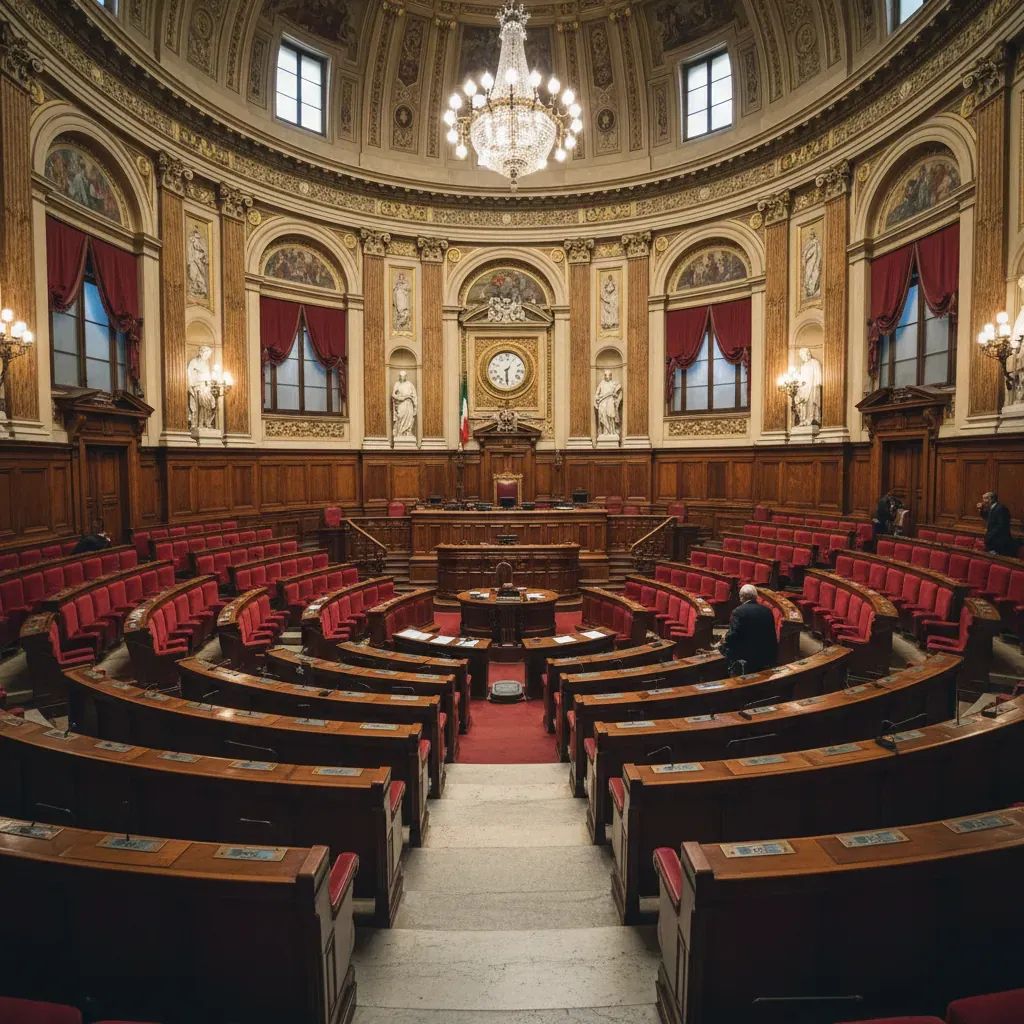
The Italian Chamber of Deputies is set to receive a contentious amendment to the country's electoral law that exposes fresh fissures within the ruling coalition. Fratelli d'Italia (FdI), together with its minor allies Noi Moderati and Unione di Centro (UDC), has submitted a proposal—this is not yet law, but a contested amendment under debate. The proposal would introduce blocked top candidates alongside voter preference votes, a hybrid model that conspicuously lacks the support of Forza Italia and Lega, the coalition's two other major pillars.
The Proposal: What FdI Is Pushing
The amendment, submitted ahead of today's deadline, proposes that each party list feature a locked-in lead candidate chosen by the party apparatus, followed by six additional names arranged in alternating gender order. Voters would be allowed to mark up to three personal preferences from those six candidates, with at least one preference required to be for a candidate of a different gender. Failure to respect the gender rule would void the second and third choices.
Why This Matters Now
• Coalition fracture exposed: Two of Italy's three governing parties have declined to co-sign the amendment, signaling internal disagreement on voter empowerment versus party control.
• Tight timeline for negotiation: The Chamber is scheduled to resume debate on the electoral reform with votes expected within days, leaving limited time for coalition partners to align positions.
• Borrowing from opposition playbooks: The proposal draws the locked-list leader from the defunct Italicum law championed by the center-left and the preference vote mechanism from Tuscany's regional election statute—both frameworks previously favored by opposition parties.
• Overseas voting changes included: The amendment also collapses the four foreign constituencies down to just two for the Chamber (Europe and extra-EU) and one for the Senate.
The Broader "Stabilicum" Framework Under Discussion
The electoral overhaul being debated—informally dubbed the "Stabilicum" for its stability-boosting ambitions—aims to end Italy's chronic governmental fragility. Under the base text, Italy would retain a proportional representation system but award a majority bonus of up to 55% of seats to any coalition clearing 42% of the national vote. Individual parties face a 3% threshold, while coalitions must surpass 10%. Crucially, coalitions would be required to name their candidate for Prime Minister before the election, mimicking the German model.
Until now, the draft contained no provision for voter preferences, leaving candidate selection entirely in party hands. That omission triggered sharp criticism from voter-rights advocates and smaller coalition partners, who argued the system would entrench party bosses and sideline grassroots input. The FdI-led amendment attempts to split the difference by preserving party control over the top slot while restoring limited voter choice for the remainder of the list.
Why Forza Italia and Lega Haven't Signed On
Sources close to the government confirm that while the amendment was circulated for consultation among all coalition partners, neither Forza Italia nor Lega has formally endorsed it. Both parties are conducting internal caucus meetings to finalize their positions. In the interim, the bill's rapporteur in the Chamber is expected to issue a provisional opinion deferring debate, effectively buying time for last-minute negotiations.
The reluctance of Forza Italia and Lega to sign on reflects deeper tensions over the balance of power within the coalition. Forza Italia has historically favored open lists with full preference votes, viewing them as a bulwark against oligarchic party structures. Lega, conversely, has oscillated between championing voter empowerment and defending the prerogatives of regional party chiefs, who benefit from controlled candidate placement.
FdI's strategic calculus appears twofold: avoid a public split in the Chamber by presenting the amendment as a product of intra-coalition dialogue, and claim credit for incorporating ideas long championed by the opposition. Government sources emphasized that the locked lead candidate was a centerpiece of the Italicum, the electoral law passed in 2015 under then-Prime Minister Matteo Renzi's center-left government and later struck down by the Constitutional Court. Similarly, preference voting with gender parity rules has been the law in Tuscany's regional elections for years—a system backed by the Democratic Party and smaller left-wing formations.
What This Would Mean for Residents If Adopted
Should this amendment pass, Italian voters would gain more direct influence over parliamentary composition than under the initial draft, but far less than under fully open-list systems. In practical terms:
• Party leaders remain untouchable: The capolista would be guaranteed election if the list wins seats, insulating high-profile incumbents and coalition negotiators from voter rejection.
• Mid-tier candidate competition would intensify: Candidates ranked second through seventh on each list would need to campaign actively and cultivate personal followings to secure preference votes.
• Gender quotas embedded in ballot design: The alternating gender order and preference rules aim to ensure balanced representation, though enforcement would hinge on voter compliance and clarity of ballot instructions.
• Potential for localized candidate power: In regions where personal networks and clientelism remain strong—particularly in the South—preference votes could shift the balance toward candidates with deep territorial roots, even if party leadership preferred others.
Parliamentary Timeline and Next Steps
If the coalition partners fail to reconcile their positions, the amendment could come to a floor vote without Forza Italia and Lega backing—an outcome FdI is keen to avoid, given the optics of disunity on a flagship reform.
Opposition parties, led by the Democratic Party (PD) and Movimento 5 Stelle (M5S), have yet to formally respond to the FdI amendment. However, PD lawmakers have previously criticized the majority bonus as anti-democratic and warned that any system privileging party elites over voters would face legal challenge in the Constitutional Court. M5S, which has historically championed direct democracy mechanisms, is expected to demand even broader preference rights and may propose counter-amendments restoring fully open lists.
Legal experts note that the locked lead candidate, while controversial, is not inherently unconstitutional—the Court's 2017 ruling against the Italicum focused on the majority bonus and runoff mechanisms, not the list structure. The real test will be whether the overall system, including thresholds and seat allocation formulas, ensures proportional representation and equal suffrage as required under Articles 48 and 67 of the Italian Constitution.
A Pattern of Electoral Instability
Italy has cycled through four electoral laws since 1993, each reform promising stability and each eventually abandoned or overturned. The Stabilicum, if enacted, would become the country's fifth system in 33 years—a record of volatility unmatched in Western Europe. This legislative churn reflects deep disagreement over fundamental questions: Should elections prioritize governability or representation? Should voters choose parties or individuals? Should coalition-building happen before or after the vote?
The FdI amendment, for all its technical detail, does not resolve those tensions. Instead, it layers a preference mechanism atop a locked-leader structure, a proportional base beneath a majority bonus, and a gender-parity rule alongside party discretion. The result is a system that attempts to balance competing interests, reflecting the compromises—and disagreements—within the ruling coalition itself.
For residents watching Italy's electoral debate unfold, the key point is that this amendment remains contested and uncertain. Coalition divisions suggest negotiations will continue before any final vote. Should this proposal ultimately become law, ballot design and voting procedures would change. But for now, this remains a proposal under debate, not a confirmed reform.