European equity markets face a risk-off opening as Middle East tensions surrounding the Strait of Hormuz send shockwaves through global trading floors, with oil prices surging past $79 per barrel and Asian indices closing sharply lower.
Why This Matters
• Oil shock incoming: Crude prices are climbing toward $80/barrel after conflicting reports emerged about Hormuz access, with Iran claiming closure of the strait, threatening roughly 20% of global oil and LNG supplies.
• Portfolio volatility: Italian investors face potential losses as European futures signal a negative open, mirroring sharp drops in Seoul (-9%) and Shanghai (-1.67%).
• Inflation risk resurfaces: Higher energy costs could derail the European Central Bank's inflation trajectory, which currently stands at 2.8% for June 2026.
• Key data cascade: US consumer price index (CPI), Federal Reserve testimony, and major bank earnings all drop within hours on Tuesday, creating uncertainty.
Hormuz Tensions Trigger Global Sell-Off
The Italy Stock Exchange and other European bourses are expected to open in negative territory following a weekend of escalating military exchanges between the United States and Iran. The immediate catalyst: conflicting statements from Washington and Tehran regarding access to the Strait of Hormuz, the narrow waterway that funnels roughly one-fifth of the world's petroleum and liquefied natural gas to international markets.
Iran's government announced it has closed the strait to commercial shipping, a move analysts describe as both a military pressure tactic and a geopolitical negotiating chip, though the actual impact on shipping remains disputed. The escalation follows US military strikes on Iranian infrastructure over the weekend, marking a dangerous new phase in a conflict that had shown signs of easing last month, when a short-lived diplomatic accord briefly calmed markets.
For Italian households and businesses already sensitive to energy price swings, the timing could not be worse. Brent crude jumped to approximately $79 per barrel in early Asian trading. A sustained disruption to Hormuz traffic would likely exert upward pressure on energy prices and add inflationary pressure across the Eurozone, where energy costs directly influence everything from manufacturing input prices to household heating bills.
Asian Markets Set the Tone
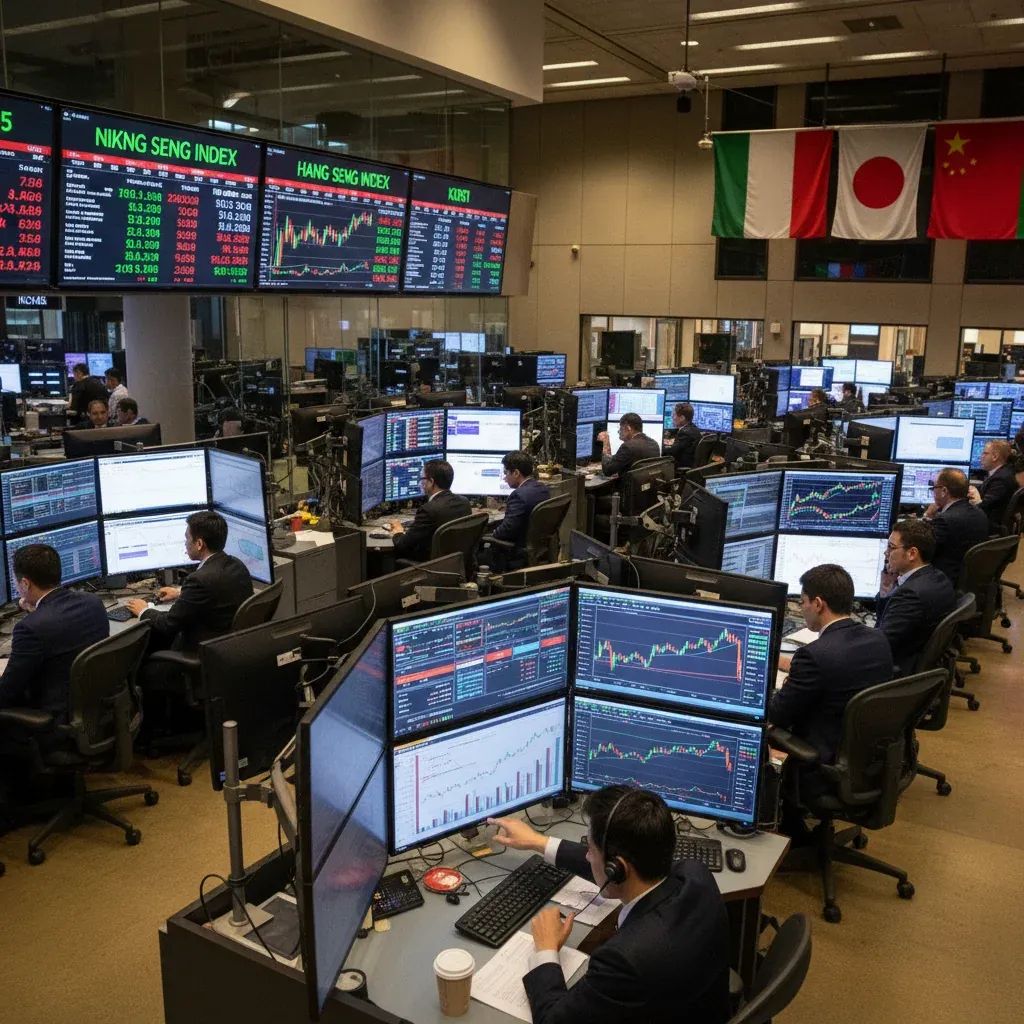
The Tokyo Stock Exchange's Nikkei 225 index opened down 0.29%, shedding 196 points to settle at 68,361. By mid-session, losses had deepened to 0.75% as risk appetite evaporated. The yen held relatively steady at 161.90 against the dollar and 184.60 versus the euro, suggesting currency traders are waiting for clearer signals before repositioning.
South Korea's KOSPI bore the brunt of Monday's panic, plunging 9% in what ranks as one of the steepest single-session declines this year. The Seoul bourse is particularly sensitive to energy price shocks given the country's heavy reliance on imported oil and gas for its export-driven manufacturing base.
Mainland China also felt the pain: the Shanghai Composite fell 1.67% while the Shenzhen Component dropped 1.99%. Only Hong Kong's Hang Seng managed to tread water, slipping a marginal 0.04% as investors in the special administrative region adopted a wait-and-see posture.
What This Means for Italian Residents
Italian investors holding equity positions—whether through direct stock ownership, mutual funds, or pension plans—should brace for portfolio markdowns when Milan's Borsa Italiana opens. Financial advisers recommend reviewing exposure to sectors most vulnerable to energy cost spikes, including airlines, logistics firms, and energy-intensive manufacturers.
On the consumer front, rising crude prices typically translate into higher pump prices at Italian forecourts within 2-3 weeks, as Italy's fuel distribution network adjusts retail gasoline and diesel rates in response to wholesale crude benchmarks. Drivers in major cities may see the first noticeable increases at the pump by late July if disruptions persist.
The broader macroeconomic picture is equally concerning. The European Central Bank had projected 2026 inflation at 3.0%, with core inflation (excluding food and energy) at 2.5%. A sustained oil price rally would likely force the ECB to revise those figures upward again, complicating the central bank's efforts to balance growth support against price stability. Historically, when energy costs spike, the ECB has been cautious about easing monetary policy, meaning Italian borrowers could face higher-for-longer interest rates on mortgages and business loans.
Government support mechanisms remain unclear at this stage, though past precedent suggests possible interventions could include temporary fuel tax adjustments or targeted support for energy-intensive industries if the crisis deepens.
Critical Week Ahead for Europe and US Markets
Global markets face a data-intensive week that will test investor nerves. The European Central Bank will be closely watched for any emergency guidance or contingency planning, particularly regarding inflation scenarios. For Italian residents and businesses, ECB monetary policy decisions carry direct implications for borrowing costs and economic growth.
In the United States, the Bureau of Labor Statistics releases the June CPI report, which economists expect to show headline inflation around 3.4% year-over-year. Core CPI is forecast at approximately 2.81%. However, ECB policy direction matters more immediately for Italian economic conditions.
Adding to the complexity, a clutch of major US banks report second-quarter earnings on the same day, though Italian financial stability depends more on the health of local lenders.
In Italy, the domestic banking sector begins its earnings season later in the month. UniCredit kicks off on July 23, followed by Intesa Sanpaolo on July 29 and Monte dei Paschi di Siena on August 7. Analysts will scrutinize loan quality, net interest margins, and management commentary on how energy cost pressures might affect business and consumer borrowers.
Energy Price Impact on Eurozone Growth
Energy price shocks directly affect Eurozone inflation and growth prospects. With crude already climbing and the Hormuz situation unresolved, the Italy economy—heavily dependent on imported energy—faces renewed headwinds just as summer tourism season hits its stride.
Manufacturing sentiment, which had shown tentative signs of stabilization earlier this year, risks another setback. Italian exporters in sectors such as machinery, textiles, and automotive components operate on thin margins; a sustained jump in energy input costs could squeeze profitability and force companies to pass costs downstream, further fueling consumer price pressures.
Investor Positioning and Safe Havens
Market participants are shifting toward defensive positioning. Bond markets are resuming their traditional role as portfolio stabilizers, with government debt from core Eurozone issuers seeing renewed demand. Gold—the classic crisis hedge—experienced initial weakness, possibly reflecting fears that persistent inflation will compel central banks to maintain restrictive monetary policies longer than previously anticipated.
Equity strategists recommend investors favor companies with strong balance sheets, limited energy exposure, and pricing power sufficient to pass through cost increases. Conversely, highly leveraged firms and those with significant operational exposure to volatile commodity prices face increased scrutiny.
Geopolitical Uncertainty Ahead
The current escalation calls into question the durability of the diplomatic progress achieved last month, when a temporary accord between Washington and Tehran had briefly eased tensions and sent oil prices tumbling. That brief calm fueled a sharp equity rally, but the latest developments demonstrate how quickly geopolitical stability can evaporate.
Analysts note that Iran views Hormuz disruption as a strategic lever—a demonstration of its ability to disrupt global commerce and thereby extract concessions. The United States, meanwhile, faces domestic pressure to respond firmly to any perceived threats.
For now, European markets remain hostage to events unfolding thousands of kilometers away in the Persian Gulf, with little clarity on whether diplomacy or further military escalation lies ahead. Italian residents and investors should monitor official ECB communications and government announcements for updated guidance on contingency measures.