
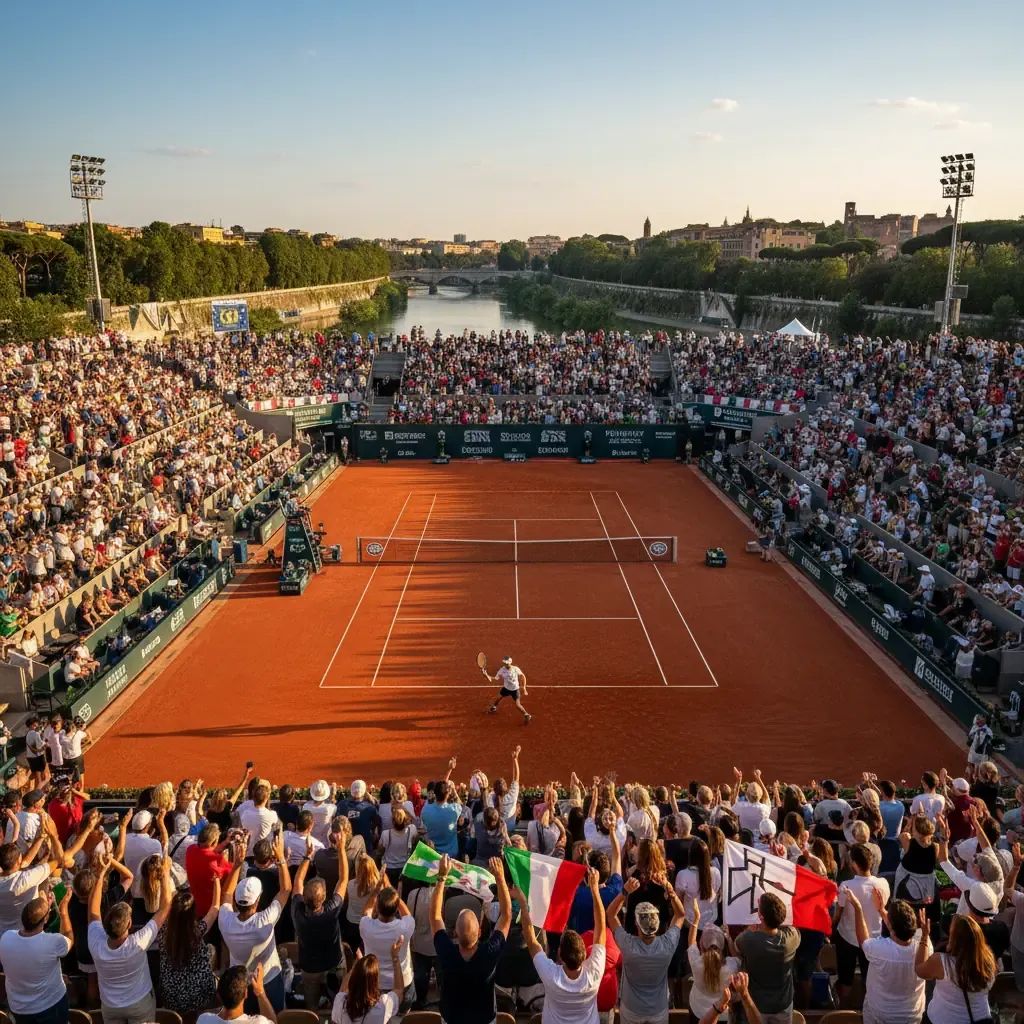
The Italian Tennis Federation and Sport e Salute, the state-owned sports infrastructure agency, have cleared the final regulatory hurdles for a €60M retractable roof over the Foro Italico's iconic Central Court, setting the stage for construction to begin in June 2026 and reach completion in late 2027, ahead of the 2028 edition of the Internazionali BNL d'Italia, the Rome Masters tournament that already draws nearly half a million spectators each May.
Why This Matters:
• Timeline locked: Construction starts mid-June 2026, pausing for the 2027 tournament, with completion targeted for late 2027 ahead of the 2028 season.
• Capacity boost: The venue will accommodate 12,400 climate-controlled seats for tennis, with configurations for over 13,000 for basketball or concerts, plus 2,000 sqm of panoramic terraces.
• Multisport ambitions: The new arena is designed to host up to 18 different sports and stage 150 event days annually, positioning Rome for year-round international competitions.
An 18-Month Sprint Against the Clock
Diego Nepi Molineris, chief executive of Sport e Salute, confirmed that site mobilization will follow the BNL Italy Major Premier Padel event in early June. Contractors will have approximately 18 months of active construction—interrupted only by the 2027 Internazionali—to install a 6,500 sqm fixed canopy and a 1,700 sqm sliding section, upgrade circulation with four panoramic lifts and four external staircases, and weave in 1,100 sqm of suspended promenades alongside 1,900 sqm of hospitality terraces.
That schedule mirrors the ambitious timelines seen at Wimbledon's Centre Court (2009 roof debut) and Roland Garros's Philippe Chatrier (mobile cover operational in 2020). Rome's project carries added complexity: the Foro Italico sits within a protected heritage zone, requiring coordination with the Ministry of Culture, Lazio Region, CONI, and Roma Capitale. Angelo Binaghi, president of the Federazione Italiana Tennis e Padel (FITP), credited the successful completion of this interagency coordination for finally unlocking a proposal debated since 2015.
Funding and the Broader Foro Italico Makeover
The retractable roof accounts for roughly €60M of a €160M master plan to overhaul the entire Foro Italico complex. The majority of financing flows from three primary sources: €80M from the Prime Minister's Mission Unit at Palazzo Chigi, €20M directly from Sport e Salute's balance sheet, and €20M channeled through the Ministry of Foreign Affairs via a dedicated instrument aimed at showcasing Italian engineering abroad.
Beyond the Central Court, the remaining funds will improve accessibility—new parking areas to ease match-day congestion—and retrofit secondary courts to meet international standards for disciplines ranging from fencing to rhythmic gymnastics. Sport e Salute also secured a concessionary extension until 2100, locking in long-term control and enabling private co-investment models for future phases.
What This Means for Residents and Visitors
For Romans, the covered arena translates to reliable, weather-proof entertainment within city limits—no more washed-out semifinal sessions or rescheduled concert nights. Tennis Federation officials estimate the upgrade will add roughly 2,000 premium seats per session, with Binaghi pointing to pent-up demand: corporate hospitality packages already sell out months in advance, and secondary-market ticket prices routinely double face value during marquee matches.
The venue's pivoting to a year-round operation also means jobs. Construction alone will employ several hundred specialized tradespeople, while the finished product is expected to generate permanent roles in event management, hospitality, and technical operations. Local business associations in the Flaminio district—home to the Foro Italico—anticipate spillover benefits: hotels, restaurants, and transport services stand to capture incremental spending from an estimated 50+ additional event days each year.
Risks: Tight Margins and the 2027 Interruption
Construction veterans caution that the 18-month active window, bisected by a mandatory halt for the 2027 tournament, leaves minimal slack. Weather-related delays during the winter of 2026–2027 could compress the post-tournament sprint in late 2027. Procurement, too, looms large: tenders are due between December 2025 and April 2026, and any legal challenges from losing bidders could push the ground-breaking ceremony into late summer, eroding the buffer.
European precedents offer both reassurance and warning. Wimbledon's Centre Court roof came in on schedule, but the No.1 Court canopy (2019) faced cost overruns tied to heritage-listing constraints—echoes of Rome's own regulatory environment. Conversely, rapid-deployment air-dome structures in Warsaw, Berlin, and Amstelveen have proven that modular coverage can be operational within weeks, though those projects lack the architectural ambition—and heritage sensitivities—of a permanent retractable steel-and-membrane system atop a 1930s monument.
Rome's Bid for "Fifth Slam" Status
Binaghi has been unequivocal: a covered Central Court is the non-negotiable prerequisite for elevating the Internazionali d'Italia to a prestige tier rivaling the four Grand Slams. Currently classified as an ATP Masters 1000 and WTA 1000 event, Rome trails Melbourne, Paris, London, and New York in prize money, broadcast reach, and scheduling clout. A climate-controlled venue that guarantees uninterrupted play—coupled with expanded seating and luxury boxes—arms the FITP with leverage in future negotiations with the ATP and WTA Tours over calendar slots and revenue splits.
The political symbolism is equally potent. Nepi Molineris framed the Foro Italico renewal as part of a national strategy to position Italy as a global sports capital, citing parallel efforts in Naples, where the America's Cup waterfront redevelopment in Bagnoli is slated to transform a long-derelict industrial site into a mixed-use precinct anchored by team bases for the sailing competition. That project, coordinated by the Italian Government with Campania Region and Comune di Napoli, aims for completion by late 2026, demonstrating the same cross-agency playbook that finally broke the Foro Italico logjam.
Technology and Sustainability Benchmarks
Nepi Molineris emphasized that the new Central Court must embody "future excellence at the technological level." Engineering specs include a climate-management system capable of maintaining 20–22°C during summer heatwaves, LED pitch lighting meeting broadcast standards for 4K HDR transmission, and acoustic baffles to preserve sound quality for concerts. The retractable section will deploy via electric motors in under ten minutes, critical for rapid response to sudden rain—a chronic headache that historically forced late-night finishes under the Roman stars.
Sustainability mandates, driven by EU cohesion-fund conditions attached to portions of the financing, require solar panels on ancillary buildings, rainwater-harvesting cisterns for irrigation, and recycled-aggregate concrete in non-structural elements. Sport e Salute has committed to LEED Gold or equivalent certification, a standard that will be audited before final disbursements are released.
Broader Implications for Italian Sport Infrastructure
The Foro Italico project exemplifies a broader shift: state-owned entities leveraging public-private partnerships and European recovery funds to modernize aging venues. Similar dynamics are unfolding at San Siro (proposed demolition and rebuild for Inter and Milan), the Stadio Olimpico (periodic upgrade studies), and regional facilities ahead of the 2026 Winter Olympics in Milan-Cortina.
For residents across Italy, the subtext is fiscal discipline. The €160M Foro Italico package avoids new taxation by tapping existing budget lines and recoverable loans, yet critics from municipal watchdog groups question whether Rome's creaking public-transport network—already strained by tourism—can absorb another 100,000+ annual visitors without commensurate investment in Metro C expansion or dedicated shuttle corridors.
Next Milestones
The immediate calendar is unforgiving:
• June 2026: Fencing goes up around the Central Court; preliminary demolition of upper-tier seating begins.
• May 2027: Construction pauses; the 2027 Internazionali proceeds on a partially enclosed site with temporary screens.
• June–December 2027: Final roof assembly, mechanical commissioning, interior fit-out.
• January 2028: Inaugural test events—likely a pre-season basketball exhibition or indoor volleyball match—stress-test climate and acoustics.
• May 2028: The Internazionali BNL d'Italia christens the completed venue under its new canopy, weather be damned.
Binaghi has promised that if the 2028 deadline slips, contingency clauses will activate temporary modular covers—a fallback that would preserve tournament continuity but sacrifice the prestige of a grand unveiling. With contractors due to be named within weeks and political capital heavily invested, all eyes now turn to the first pile driven into the Foro Italico's storied clay.


