
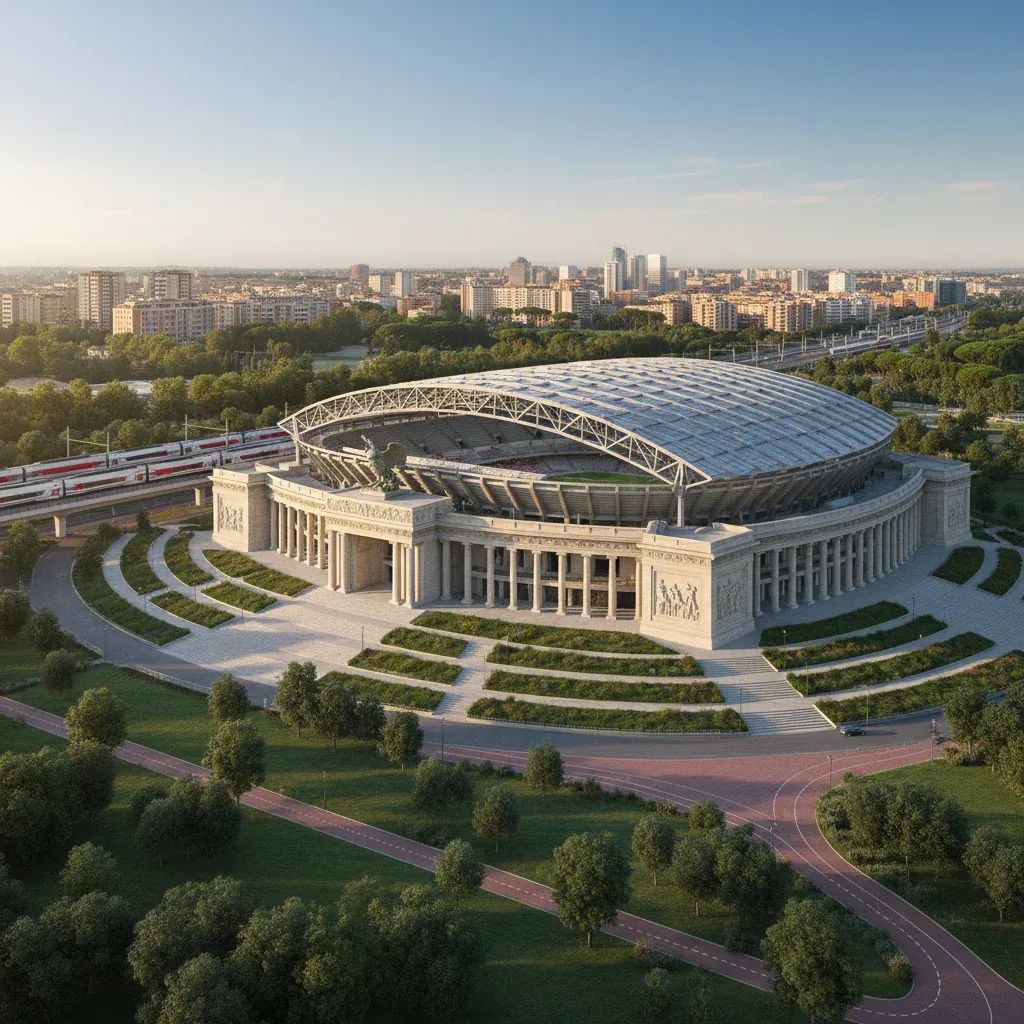
The Rome Capital Assembly is weeks away from a decisive vote on AS Roma's €1.05 billion stadium project in Pietralata, a move that could reshape the eastern edge of the capital and secure Italy's bid to host matches during the 2032 UEFA European Championship. The city's executive council approved the technical feasibility report on February 26, clearing the proposal for committee review before the full assembly weighs in between March 10 and 12.
Why This Matters:
• Timeline shift: First stone laid in 2027, opening now projected for 2031—missing Roma's centenary but aligning with Euro 2032 deadlines.
• Private funding: The entire €1.05B investment comes from AS Roma, with €696M earmarked for the stadium itself and the remainder for surrounding infrastructure.
• Legal battles ahead: Citizen committees have filed multiple appeals with the Regional Administrative Court (TAR Lazio) and Council of State, citing environmental violations and inadequate public consultation.
• Euro 2032 pressure: Italy must submit five stadium cities to UEFA by October 2026; Rome's inclusion hinges on this approval and subsequent regional authorization.
A 60,000-Seat Anchor for Pietralata
The Pietralata district, historically an underserved periphery northeast of central Rome, would receive a 60,605-capacity stadium featuring one of Europe's largest standing curves—a 23,000-seat south end designed to echo the Curva Sud's legendary atmosphere. Architectural renderings incorporate classical Roman motifs, with "Roma 1927" emblazoned on the southern facade and the club's wolf crest on the northern side.
Beyond matchdays, the 27-hectare site would function as a year-round urban hub. Plans include a 1,800 sqm fan store, a club museum, 30 retail units, and 21,000 sqm dedicated to hospitality and conference facilities. The project allocates 11.6 hectares to public green space across two parks, plus 3.5 hectares for pedestrian plazas and walkways. Mobility infrastructure includes 91,426 sqm of parking (2,606 car spaces, 5,712 motorcycle bays), plus interchange lots along Metro Line B and the FL2 regional rail line. A north-south cycle path would link the stadium to Tiburtina station via two pedestrian-cycle bridges, with berths for over 3,500 bicycles.
Rome Mayor Roberto Gualtieri framed the approval as a litmus test for the capital's ability to deliver major infrastructure. "This is not just a sports facility—it speaks to future, regeneration, and confidence in Rome's capacity to build quality projects while revitalizing an entire quadrant like Pietralata," he stated. Urban Planning Councillor Maurizio Veloccia echoed the optimism, calling it "a genuine new urban pole that will enrich the city."
Fierce Opposition and Environmental Flashpoints
A coalition of neighborhood committees and environmental associations disputes nearly every premise of the project. The "No Stadium Network" argues that the site harbors a protected 3.47-hectare urban forest, classified under regional and national law as a Laurus nobilis habitat covered by EU Directive 92/43/CEE. According to the activists, the wooded area supports significant biodiversity and preserves the character of the historic Roman Campagna landscape.
Rome Capital counters that the land is a "degraded environmental area" dominated by pioneer species and invasive vegetation of little ecological value, with national regulations permitting transformation provided adequate compensation is offered. The city's plan would create 6 hectares of new public greenery within the stadium park, ostensibly improving both quantity and quality over the status quo.
Archaeological findings have added fuel to the dispute. Pre-construction excavations unearthed remnants of a Roman villa and aqueduct cisterns, which committees claim render the site unsuitable for heavy construction and better suited to a public archaeological park. City officials note these features were already catalogued and can be integrated into the stadium's design—the cistern, for instance, is slated for incorporation into the structure itself.
Critics also highlight traffic congestion, insufficient parking, and incomplete transit interchanges on the FL2 line, warning that promised infrastructure will remain unfunded or delayed. They accuse the administration of offloading road-building costs onto public coffers while ceding prime urban land to a private entity. A petition demanding recognition of the area as a protected zone collected roughly 12,000 signatures, and legal challenges remain active despite setbacks at the Council of State.
The Euro 2032 Countdown
Italy's co-hosting agreement with Turkey for Euro 2032 requires each nation to nominate five stadiums from an initial roster. The Italian Football Federation (FIGC) whittled its candidate list from eleven cities to ten: Milan, Turin, Verona, Genoa, Bologna, Florence, Naples, Bari, Cagliari, and Rome. Salerno remains in contention pending modernization commitments, while Palermo dropped out of the final dossier.
UEFA's executive committee will announce the ten host cities in October 2026, applying strict criteria across four tiers of capacity: one venue must seat at least 60,000, one or two at 50,000, four at 40,000, and three at 30,000. Category 4 (formerly "Elite") accreditation mandates 105 m × 68 m pitch dimensions, 1,400-lux lighting for broadcast, a minimum 20 sqm referee changing room, and at least 150 VIP parking bays. Broader factors—mobility, security, accessibility, human-rights compliance, and long-term legacy—also weigh heavily.
Currently, only Turin's Allianz Stadium meets all UEFA specifications outright. Rome's Stadio Olimpico, which hosted Euro 2020 fixtures, will require upgrades; Milan's San Siro faces uncertainty around demolition-versus-renovation debates and potential replacement by separate club-owned arenas. In late February, a UEFA delegation led by Martin Kallen (CEO of UEFA Events SA) and Michele Uva (executive director for Euro 2032) visited Rome, Florence, and Cagliari to assess progress. The group toured the Olimpico with support from Sport e Salute, inspected Florence's Stadio Franchi, met Cagliari officials regarding the Gigi Riva stadium project, and reviewed AS Roma's Pietralata plans with club representatives. Follow-up site visits to Milan, Palermo, Salerno, and Genoa are scheduled for March.
FIGC President Gabriele Gravina acknowledged Italy's late start relative to other European nations on stadium infrastructure but expressed optimism. "The interest and investment that have followed the Euro assignment, together with collaboration from involved ministries and local authorities, give us hope. The FIGC deeply wants this championship to showcase Italy's best image to the world," he said. The federation's goal is to present executive-level, funded, and construction-ready projects by April 2027, leaving a narrow window to finalize designs, secure regional permits, and break ground in time for a 2031 opening.
What This Means for Residents
If you live in Pietralata or surrounding neighborhoods:
• Construction disruption: Expect site preparation and excavation activity from 2027 onward, with potential traffic detours and noise impacts through 2031.
• Green-space trade-off: Official plans promise 15+ hectares of new parks and pedestrian zones, but activists warn these gains may come at the cost of existing woodland habitat.
• Matchday congestion: A full-capacity event deposits 60,605 spectators into an area historically underserved by rapid transit; promised Metro B and FL2 interchange upgrades are essential to prevent gridlock.
• Economic spillover: Retail, hospitality, and conference facilities could generate employment and foot traffic year-round, though the extent depends on final lease agreements and operating hours.
For prospective investors and business owners:
• Commercial real estate: The surrounding Pietralata and Tiburtina zones may see upward pressure on property values once construction commences; however, legal uncertainty and the risk of project delays counsel caution.
• Hospitality sector: Hotels, restaurants, and event-services firms near Tiburtina station stand to benefit if the stadium delivers consistent non-matchday bookings.
For sports fans and tourists:
• 2032 showcase window: If approved and completed on schedule, Pietralata would host European Championship fixtures, burnishing Rome's profile alongside the refurbished Olimpico.
• Museum and fan experience: The integrated club museum and 1,800 sqm store aim to create a destination beyond the 90-minute match window, though opening hours and ticketing policies remain undefined.
Next Steps and Regulatory Hurdles
Following committee scrutiny in early March, the Rome Capital Assembly will hold a plenary session to confirm public interest. A green light triggers submission to the Lazio Region for a unified authorization procedure encompassing Environmental Impact Assessment (VIA) and a Conference of Services—a multi-agency forum that can add months or years to timelines. Archaeological clearance, hydrogeological permits under Royal Decree 3267/1923, and forestry consent from the regional authority must all align before excavation resumes.
Political dynamics also loom. Mayor Gualtieri's administration has staked considerable capital on demonstrating Rome's ability to deliver flagship infrastructure after decades of stalled projects. Opposition councillors and external committees view the stadium as a test case for transparency, environmental stewardship, and the balance between private investment and public benefit. Any slip in the March assembly vote—or subsequent regional bottlenecks—could jeopardize Italy's Euro 2032 roster and leave AS Roma playing at the aging Olimpico indefinitely.
Broader Context: Italian Football's Stadium Puzzle
Italy's broader struggle with stadium modernization underscores the Pietralata saga. Decades of shared municipal ownership, heritage constraints, and bureaucratic inertia have left most Serie A clubs playing in aging, municipally owned bowls. Turin's Juventus remains the lone club to have built and operated a purpose-designed, privately owned arena since 2011. Inter and AC Milan's on-again, off-again San Siro replacement plans, Bologna's Dall'Ara renovation, Cagliari's Gigi Riva project, and Florence's Franchi overhaul all hinge on intricate negotiations among clubs, city councils, heritage authorities, and regional governments.
The FIGC's Euro 2032 bid injects urgency—and UEFA's October 2026 deadline acts as an external forcing mechanism. Yet history suggests caution: Rome's previous stadium proposals at Tor di Valle collapsed under a tangle of corruption investigations, environmental objections, and financing gaps. Whether Pietralata breaks the pattern or repeats it will become clear over the next twelve months, as legal appeals wind through administrative courts and regional permits inch toward resolution.
Other Italian Football Notes
Elsewhere in Italian football, Inter Milan players Federico Dimarco and Nicolò Barella, alongside club president Giuseppe Marotta and legends Francesco Toldo and Giuseppe Bergomi, visited burn victims from the New Year's Eve Crans-Montana fire at Milan's Niguarda Hospital. The delegation met patients in the Major Burns Unit, delivering messages of support and thanking medical staff for their dedication.
In Turin, tensions at the struggling Torino FC boiled over when roughly 50 ultras confronted the squad—captained by Nikola Vlašić and Duván Zapata—in the Filadelfia training ground courtyard. The supporters, speaking in heated but peaceful tones under police supervision, demanded improved form to avoid a final-day relegation showdown against Juventus at the Stadio Olimpico Grande Torino. New coach Davide D'Aversa prepared his first training session ahead of a crucial fixture against Lazio.
Ahead of the eighth anniversary of Davide Astori's sudden death on March 4, 2018, Udinese, Fiorentina, Serie A, and the Astori Foundation launched a free cardiac-screening initiative tied to the March 2 match in Udine. Fans attending the game can scan QR codes on posters and big screens to register for complimentary check-ups provided by the Friuli Centrale University Health Authority. The campaign honors the former Fiorentina captain, who died of an undiagnosed heart condition, by promoting preventive cardiology across the football community.


