
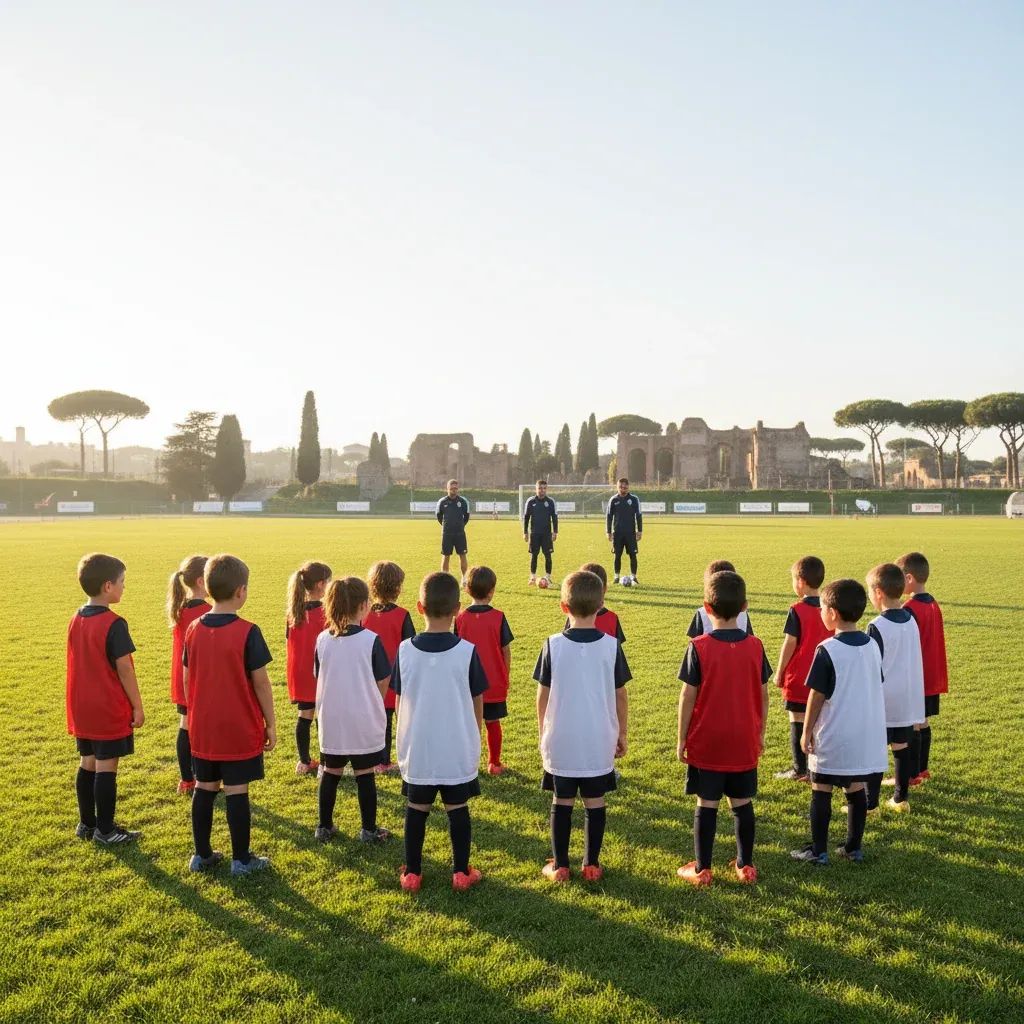
The Asd Vigor Mellis, a Rome-based amateur sports association, has opened its doors to a completely free football school for children aged 7 to 14 from families facing economic hardship or social challenges. With the backing of Rome's municipal government, the initiative targets a demographic systematically locked out of youth sports: minors from group homes, children with parents entangled in the legal system, and families unable to afford annual fees that in the capital routinely range from €300 to €1,200 per season—before equipment costs.
Why This Matters:
• Cost barrier removed: Traditional football academies in Rome charge an average of €600 to €800 annually, climbing to €1,250 for elite programs like AS Roma Scuola Calcio. Kit expenses add another €80 to €150.
• Targeted inclusion: The school specifically welcomes children from group homes, vulnerable family situations, and immigrant backgrounds—20 participants enrolled for the inaugural session.
• Coaching pedigree: Former Serie A players and national team staff, including Pietro Ghedin (ex-Italy assistant coach under Trapattoni), lead the training sessions.
A Former Lazio Player Tackles Social Exclusion
The project springs from the personal initiative of Renato Miele, a former Lazio midfielder who transitioned into sports law and now serves as honorary president of Asd Vigor Mellis. Miele, a practicing attorney with Italy's Supreme Court bar (Cassazionista), framed the school as a response to structural inequity. "We want to reach all those families who cannot afford to pay for a football school," he said. "We address children in group homes for social reasons, or those with parents who have problems with the law and who, being excluded from classic football schools with mandatory payment, cannot participate."
The language is blunt, but the operational model is specific: no registration fees, no tuition, no exclusions based on legal or financial status. The association operates under the patronage of Rome's Department of Social Policies and Health, positioning the program within the city's broader social welfare architecture rather than as a standalone charity initiative.
First-Cohort Demographics and Training Structure
The inaugural group consists of 20 children and adolescents, including participants from Ukraine, Ecuador, Peru, and Palestine, alongside Italian-born minors from disadvantaged households. Training sessions launched at the Campo Sportivo "V. Angelucci" in Rome, with a curriculum blending technical drills, physical assessments, and play-based learning.
Pietro Ghedin, who served as Miele's teammate at Lazio and later worked as assistant coach for Italy's national squad during Giovanni Trapattoni's tenure and for the Malta national team, serves as technical director. Ghedin emphasized continuity in his coaching philosophy: "I will train these children with the same enthusiasm with which I trained the Italian national football team."
Assisting Ghedin is a roster of coaches with Serie A pedigree: Bruno Giordano (Lazio, Italy national team), Odoacre Chierico (Juventus), Sergio Brio (Juventus, Italy national team), Giancarlo Oddi (Lazio), Nando Orsi (Lazio), Franco Cordova, Michele Sulfaro, and Stefano Mauri (Lazio). The concentration of recognizable names is deliberate—Miele has stated that if the pilot succeeds, the model could expand into a permanent free academy accessible to children unable to afford commercial alternatives.
What This Means for Families in Financial Distress
For households navigating Italy's high cost of youth sports, the Vigor Mellis model represents a potential blueprint. Standard football schools in Rome require upfront commitments of several hundred euros, a threshold that effectively excludes families with monthly income near or below the median. Oratory-based programs offer cheaper options—sometimes €200 per semester—but remain fee-based and often lack the training quality or continuity of club-affiliated academies.
Municipal and regional voucher schemes provide partial relief. Rome's city council has allocated funds for €500 vouchers for youth aged 5 to 16 from families with an ISEE (equivalent family income indicator) between €8,000 and €40,000. The Lazio Region runs a parallel program, capping eligibility at an ISEE of €50,000 and extending age range to 18. However, vouchers depend on annual budget allocations, application windows are short, and funding is distributed on a first-come basis until exhausted.
By contrast, the Vigor Mellis school eliminates the application process entirely. Families do not need to demonstrate ISEE thresholds, submit documentation, or compete for limited slots within a voucher lottery. The association directly enrolls children referred by social services, group homes, or families self-identifying as unable to pay.
Broader Landscape of Inclusive Sport Initiatives
Rome hosts several other organizations working at the intersection of football and social welfare, though most focus on disability integration or broader educational goals rather than economic access:
• Accademia Calcio Integrato (founded 2015) runs "Calcio Insieme" for children with intellectual disabilities at the Centro Sportivo Pio XI.
• Totti Soccer School launched "Diamo un calcio alla disabilità" for participants aged 5 to 38 with neurodevelopmental disorders.
• The Italian Football Federation's Youth and Scholastic Sector (FIGC) operates "ReTe! Refugee Teams" and "FFBC 2.0" to integrate migrant and refugee youth, though these programs typically still involve fees.
• Sport Senza Frontiere (SSF), a Rome-born nonprofit, embeds at-risk minors in partner sports clubs, covering costs and providing tutors, psychologists, and transportation.
None of these programs replicate Vigor Mellis's universal free-access model without application gatekeeping. SSF, the closest analogue, still requires referral coordination with schools or social services, and its capacity is limited by volunteer resources.
Scalability and Next Steps
Miele described the current program as an experiment with clear conditions for expansion. "If this experiment succeeds, we can think in the future about a true organization of a football school, but always available to those children who cannot afford to pay," he said. The conditional phrasing suggests the association is tracking specific metrics—likely enrollment retention, municipal funding continuity, and volunteer coach availability.
The program launched in early March 2025, positioning the pilot within the spring season and leaving several months to evaluate outcomes before the next academic year. Should the model prove sustainable, the association could seek additional municipal co-funding or partnerships with national programs such as "Sport di Tutti – Inclusione," which finances projects using sport as a tool for social recovery, or PNRR (National Recovery and Resilience Plan) allocations for sports infrastructure and social inclusion.
Families interested in the program or similar initiatives can contact Asd Vigor Mellis directly, monitor announcements from Rome's Department of Social Policies, or check annual voucher deadlines published by the Lazio Region and Rome's municipal sports office. The association has not yet published formal enrollment criteria beyond the target age range and economic or social vulnerability, suggesting intake may remain flexible and referral-based for the near term.
Replicability and Policy Implications
The Vigor Mellis experiment also poses questions for Italy's broader approach to youth sports equity. Unlike Northern European countries where municipal recreation budgets subsidize free or low-cost access to organized sports, Italy relies heavily on private sports associations (ASD/SSD), which operate on membership fees and parental contributions. Public funding exists—most notably through Sport e Salute S.p.A. (a government-owned company) and CONI (Italian National Olympic Committee)—but is typically channeled through competitive grant programs requiring formal project proposals, impact monitoring, and reporting cycles.
Vigor Mellis sidesteps this bureaucracy by leveraging volunteer labor from retired professional athletes and accepting municipal patronage without seeking direct operating subsidies. This lean structure reduces overhead but also limits scalability: the model depends on access to a network of high-profile coaches willing to donate time, a resource few neighborhood associations possess.
If the pilot demonstrates measurable outcomes—improved school attendance, social integration indicators, or reduced contact with juvenile justice systems—it could attract attention from foundations or become eligible for Erasmus+ Sport funding, which supports inclusion projects across the European Union. Several Italian banking foundations, including Fondazione Cassa di Risparmio di Lucca and Fondazione CR Firenze, have active grant cycles for youth sports inclusion, typically awarding between €50,000 and €500,000 to nonprofits with proven track records.
For now, the 20 children training at Campo Sportivo "V. Angelucci" represent a modest but concrete alternative to the pay-to-play model that dominates Italian youth football. Whether the initiative expands or remains a localized intervention will depend on sustained municipal support, the association's capacity to recruit and retain volunteer staff, and the willingness of families and social services to refer eligible children. The outcome will be closely watched by advocates for sports equity across Italy's other major cities, where similar barriers to youth participation persist.


