
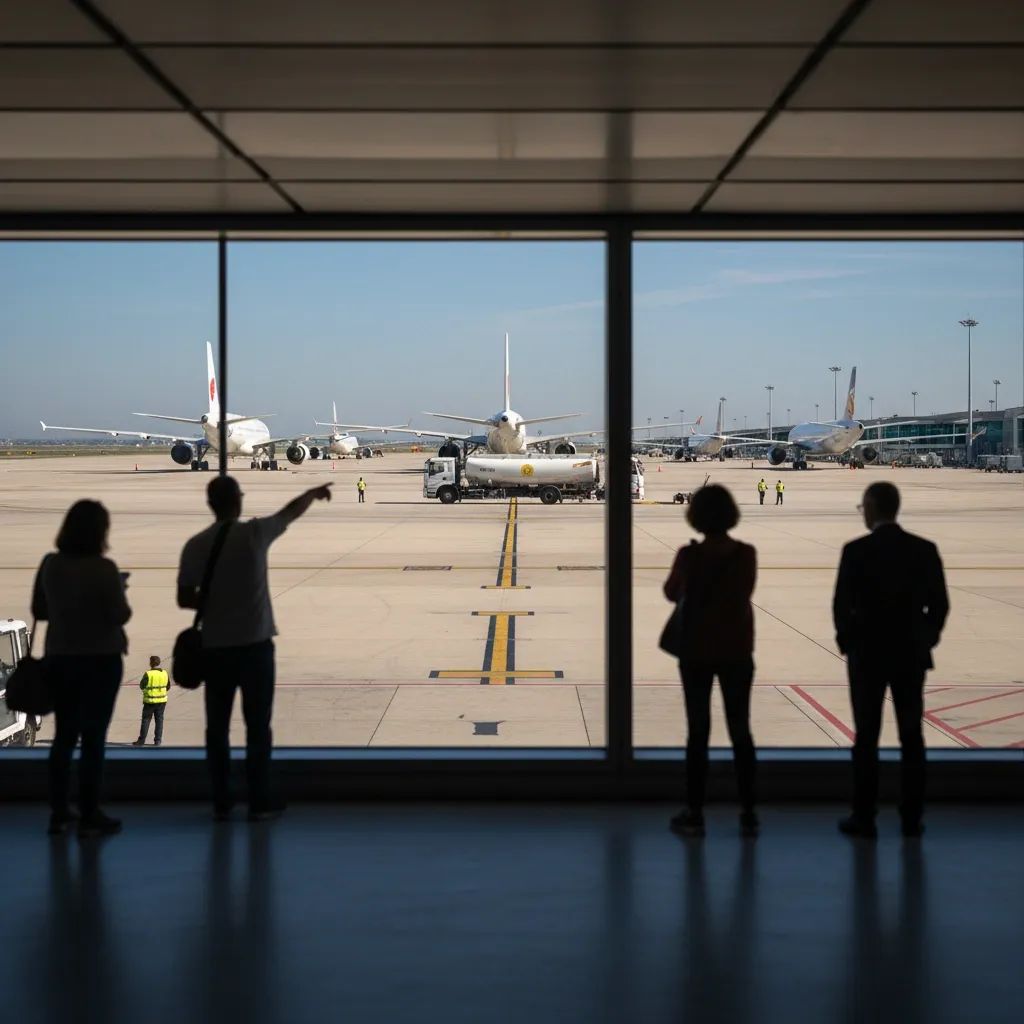
Italy's Rome airports are threatening to suspend biometric checks during the summer travel surge, as Europe's new Entry-Exit System (EES) buckles under the weight of peak tourist traffic. The warning from Aeroporti di Roma CEO Marco Troncone signals a growing rift between EU security objectives and the operational reality at border crossings across the continent.
Why This Matters
• Summer travelers through Fiumicino and Ciampino face potential wait times of up to 6 hours unless officials suspend fingerprint and facial scans.
• The EES system, mandatory since 10 April 2026 for all non-EU arrivals, has already triggered temporary suspensions in Greece, Portugal, and France.
• A pre-registration app exists to speed processing, but only Sweden and Portugal have activated it—Italy has not.
• Your passport stamp is gone forever: all entry/exit data now lives in a centralized EU database for 3 years.
The Breaking Point
Speaking to the Financial Times, Troncone described the current registration protocol as "incompatible with peak volumes" and stated bluntly that opening the relief valve—essentially bypassing the biometric requirement—is the only way to prevent a meltdown at Italy's busiest international gateways. Fiumicino and Ciampino together process millions of passengers during July and August, many arriving from non-EU markets like the United Kingdom, United States, and various Asian countries.
The Entry-Exit System replaces traditional passport stamps with digital records. Every non-EU citizen entering the Schengen Area for short stays (up to 90 days within 180 days) must register fingerprints and facial image at a self-service kiosk or staffed counter on their first crossing. That data remains valid for 3 years, theoretically allowing faster passage on subsequent trips—provided the technology cooperates.
Since full activation on 10 April 2026, however, the automated gates have proven unreliable. Passengers already enrolled frequently find themselves forced to repeat the entire procedure, compounding congestion. Industry body ACI Europe has documented processing delays of 70% or more at major hubs, with Frankfurt regularly recording queue times exceeding 220 minutes.
Rome's Infrastructure Reality
Aeroporti di Roma installed more than 200 self-service kiosks at Fiumicino in October 2025, along with units at Ciampino and the ports of Civitavecchia and Genoa. Yet hardware alone cannot resolve software glitches, system crashes, or the fundamental mismatch between a 70-second biometric scan and the volume of arriving travelers during a transatlantic morning wave.
Olivier Jankovec, director general of ACI Europe, put it simply: "The self-service stations need to work, and right now they don't." His organization has called for urgent fixes and greater deployment of border police to handle manual fallback when machines fail.
Greece, Portugal, and France Already Hit Pause
Italy is not alone. Greece announced in April that it would exempt British passport holders from EES registration during high season, citing the impossibility of maintaining schedules at island airports. Portugal informally relaxed enforcement at Lisbon Portela when queues spiraled out of control in May. On 23 May 2026, French border police at the Port of Dover temporarily stopped collecting biometric data altogether after hours-long backlogs stranded ferry passengers.
The EU Commission has built flexibility into the regulation, permitting member states to suspend biometric collection for up to 90 days post-launch, with a possible 60-day extension through September 2026. Several countries have invoked that clause, though Brussels insists the system itself is functioning as designed.
Brussels Fires Back
Commission officials counter that EES is "fully operational and working" and that bottlenecks stem from pre-existing shortfalls: inadequate staffing, outdated terminal layouts, and bunched flight schedules. A spokesperson emphasized that the regulation explicitly allows suspension "when exceptional circumstances result in excessive wait times."
The executive also points to more than 1,100 security threats flagged by the system since April—individuals on watchlists or with falsified documents—as proof of its value. "A 70-second check is worth it given the benefits," one EU official told reporters.
Yet the Commission acknowledges member states control implementation on the ground, including whether to activate the "Travel to Europe" pre-registration app developed by Frontex. The mobile application allows non-EU travelers to upload passport data, answer entry questions, and take a selfie up to 72 hours before departure. Fingerprints must still be collected in person, but the app shaves minutes off kiosk time.
Only Sweden and Portugal have enabled it. Italy has not, despite the Commission's recommendation. The lack of promotion and adoption has left most travelers unaware the tool exists.
What This Means for Residents
If you live in Italy and expect summer visitors from outside the EU, warn them to arrive at least 3 hours early for intra-European connections and 4 hours for intercontinental flights. The International Air Transport Association (IATA) forecasts wait times could hit 6 hours at the most congested airports in July and August, especially during morning arrival windows.
British tourists—Italy's largest non-EU visitor segment—are particularly affected. Post-Brexit, UK passport holders must register in EES like any other third-country national. If Rome follows through on suspension, it would ease pressure, but there is no guarantee other Schengen entry points will do the same.
For Italians traveling abroad and returning with non-EU family or friends, expect variability. Enforcement differs by country, by airport, and even by time of day. Terminals in Frankfurt, Paris CDG, Vienna, Brussels, Madrid, Barcelona, and Geneva have all logged significant disruptions.
The Blame Game
Airport operators insist kiosks malfunction too often and that biometric readers reject valid scans, forcing manual overrides. Border police unions argue they lack sufficient personnel to man both automated fallback lanes and traditional counters. Airlines note that bunched departures are driven by slot allocation—a regulatory function outside their control.
Meanwhile, the World Travel & Tourism Council (WTTC) warns that prolonged delays could cost Europe billions in lost tourism revenue and discourage millions of travelers from visiting altogether. The council has called for an urgent review of EES procedures before the damage becomes irreversible.
Looking Ahead
The dispute over resources and responsibility continues in Brussels, where member states, airport authorities, and carriers are locked in negotiation. The Commission projects that conditions will stabilize within 1 to 2 years as travelers complete initial registration and infrastructure matures, with modest improvement expected by September 2026.
In the meantime, a second layer of digital bureaucracy looms: the European Travel Information and Authorization System (ETIAS), scheduled for late 2026. ETIAS will require non-EU visitors to obtain advance electronic authorization—similar to the US ESTA—before boarding flights to Schengen countries. That system is distinct from EES but will add another pre-travel step.
For now, Italy's airports are hedging. If summer volumes overwhelm the biometric checkpoints, Troncone and his counterparts are prepared to pull the plug temporarily—a pragmatic acknowledgment that no security protocol survives contact with a July Saturday morning at Terminal 3.


