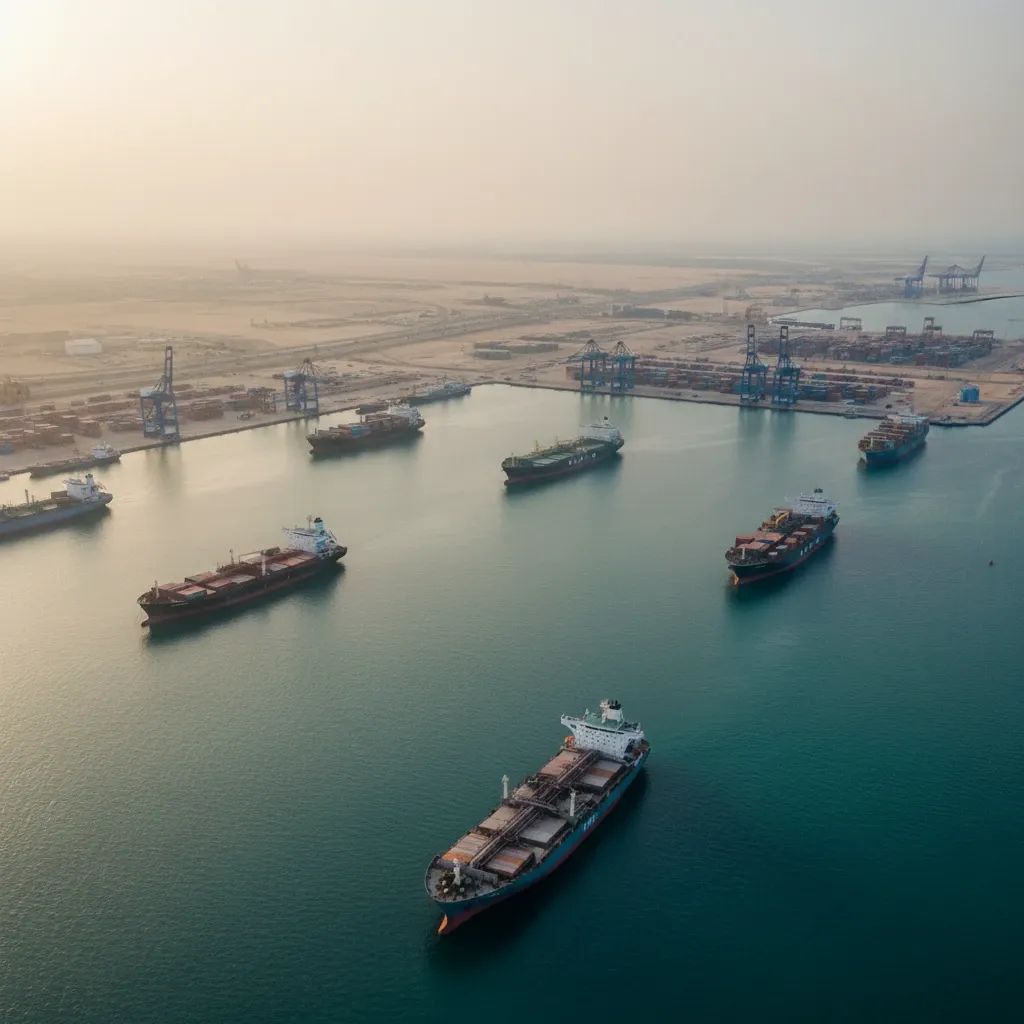
Iran has issued a directive to Yemen's Houthi rebels to prepare to close the Bab el-Mandeb Strait in the Red Sea if the United States launches strikes on Iranian energy infrastructure, according to Reuters, citing three sources briefed on the matter. The order, circulated within Tehran's senior leadership, represents a calculated escalation in a conflict that has already disrupted 25% of the world's seaborne oil and gas flows. If both the Strait of Hormuz and the Red Sea chokepoint close simultaneously, the global energy market faces a scenario not seen since the oil shocks of the 1970s.
Why This Matters
• Oil prices: Brent crude could spike to $100–$130 per barrel if both straits close, up from the current $85.
• Inflation risk: A 10% oil price increase typically raises European inflation by 0.2–0.3 percentage points.
• Shipping disruption: Rerouting via the Cape of Good Hope adds 10–14 days and over $1M in fuel costs per vessel.
• Strategic reserves deployed: The International Energy Agency has already released 400M barrels to offset Hormuz disruptions, but this buffer will run dry quickly under a dual blockade.
Houthis Standing By, Missiles Deployed
A source close to the Houthi movement confirmed to Reuters that the group has completed operational preparations. Missiles and drones are positioned near Bab el-Mandeb, across the Yemeni highlands overlooking Hodeidah, and along the Gulf of Aden. The rebels are awaiting a green light to commence attacks on merchant vessels. Critically, the decision to trigger the closure will rest with Iranian Revolutionary Guards Corps (IRGC) representatives already embedded in Yemen, not with Houthi commanders alone.
This arrangement underscores Tehran's direct operational control over Red Sea threats. The Houthis resumed strikes in late March 2026 following a brief ceasefire at the end of 2025, after the February 28 U.S.-Israel joint strikes on Iranian targets. Since then, they have targeted commercial shipping under a "total navigation ban" on vessels with alleged Israeli connections, framing the campaign as solidarity with Palestinians in Gaza.
What This Means for Energy and Trade
Italy and the wider European Union depend heavily on maritime routes through both the Suez Canal and Persian Gulf. Claudio Descalzi, chief executive of Italy-based energy giant Eni, told lawmakers in a hearing before the Chamber's Committee on Productive Activities that the current energy landscape is fundamentally altered. After the initial Iran agreement, oil prices briefly fell to $68 per barrel, then rebounded to $85 as tensions flared again. Since July 11, no vessels have transited the strait, he noted, marking a fresh blockade that "changes the order of things for Europe and the world."
Descalzi pointed out that the old supply configuration—anchored in Russia and the Middle East—has "completely eroded." Even if Gulf exports eventually resume, the perceived risk will be permanently higher, driving up insurance premiums, capital costs, and project financing rates for years. Italy itself maintains relatively strong gas storage at 71–72%, expected to reach 90% by January. For Italian households, these current storage levels provide approximately 3–4 months of buffer, but any prolonged disruption to Gulf supplies would require emergency measures, including rationing or premium-priced imports. Other European countries languish at 40–46%, raising the prospect of shortages if Russian pipeline flows halt completely in early 2027.
The Dual Chokepoint Scenario
The Strait of Hormuz handles roughly 20–25% of global seaborne oil and a similar share of liquefied natural gas (LNG). The Bab el-Mandeb Strait, linking the Red Sea to the Gulf of Aden, channels 12% of worldwide maritime trade, including 12% of oil shipments and 8% of LNG. Closing both simultaneously would sever approximately a quarter of the planet's oil and gas supply, forcing an unprecedented scramble for alternative routes and energy sources.
Container shipping has already rerouted around the Cape of Good Hope, adding 7–12 days to Asia-Europe voyages. The Shanghai Containerized Freight Index (SCFI) surged 177% between November 2023 and January 2024, with rates from Shanghai to Genoa jumping from $1,956 to $5,213 for a 40-foot container. Fuel costs for shipping firms have climbed 70% in some cases, and marine insurance premiums have spiked as underwriters classify the Red Sea as a high-risk theater.
Traffic through Bab el-Mandeb dropped over 40% compared to 2023 levels, and container volume via Suez collapsed by 90% at its nadir in 2024. Major carriers—Maersk, MSC, Hapag-Lloyd—continue to avoid the Red Sea entirely or transit only under heavy naval escort.
International Response: Naval Missions and Limited Diplomacy
The European Union's Operation Aspides, with Greece in a leading operational role and contributions from France, has intercepted Houthi missiles and drones targeting commercial vessels. The U.S. Navy has shot down hundreds of projectiles and conducted strikes on Houthi command centers, missile depots, and coastal surveillance infrastructure. Washington has also hit Iranian command posts, air-defense sites, and drone facilities in an effort to degrade Tehran's ability to threaten maritime traffic.
The United Nations Security Council extended reporting requirements on Houthi attacks through January 15, 2027, via Resolution 2826. The measure passed with 13 votes in favor and abstentions from China and Russia. Denmark and Greece urged the Houthis to de-escalate, emphasizing the stakes for global supply chains and freedom of navigation. Yet diplomatic outreach to Iran remains fragmented, and no breakthrough is in sight.
Economic Fallout: Stagflation Looms
Economists warn that a prolonged dual blockade could shave nearly 3 percentage points off global GDP, combining sluggish growth with surging inflation—classic stagflation. Energy-intensive industries—chemicals, plastics, fertilizers—face particularly sharp cost increases. Roughly 30% of nitrogen fertilizers once transited Hormuz, and disruption to that flow is already feeding into food price inflation.
For consumers across Europe, the ripple effects reach fuel pumps, grocery shelves, and electricity bills. The International Energy Agency's strategic reserves, totaling over 1.2 billion barrels in public stocks and 600 million in private holdings, offer a buffer but cannot sustain supply indefinitely. Alternative land routes and pipelines can replace less than one-eighth of the crude volumes at stake.
Asia, particularly China, is most exposed to Hormuz disruptions, importing 80–89% of Gulf energy exports via that route. Europe, however, faces the greatest combined vulnerability if both chokepoints close, especially as winter approaches and gas demand peaks.
Outlook: High Stakes, Few Off-Ramps
The standoff hinges on whether the United States proceeds with strikes on Iranian energy assets. President Donald Trump threatened such action earlier this week, though the precise timeline remains unclear. If Washington follows through, Tehran's contingency plan—mobilizing the Houthis to seal Bab el-Mandeb—will likely activate within hours.
Italy's energy sector, along with the rest of Europe, is bracing for volatility. Storage levels provide some cushion, but any extended interruption to Gulf supplies will force deeper recourse to North African gas, Norwegian exports, and U.S. LNG—all of which come at premium prices and face logistical constraints. The Italian government has not yet announced formal consumer protection measures or price caps, though energy officials continue coordinating contingency plans with the EU. Financial markets are already pricing in heightened risk, with equity indexes in the energy and transport sectors showing increased volatility.
The next few weeks will determine whether diplomacy can defuse the crisis or whether the world's two most critical oil arteries close in tandem, triggering an energy shock with consequences felt from Rome to Shanghai.