
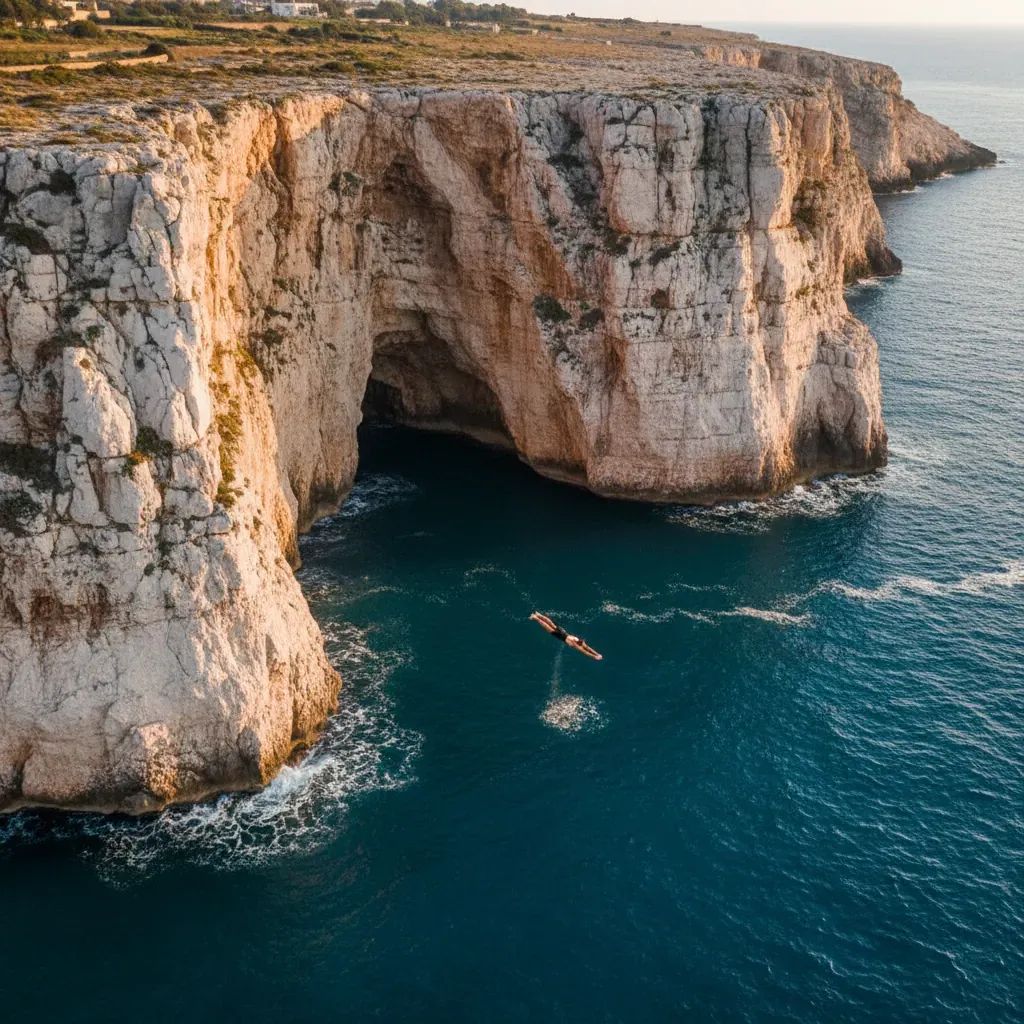
Europe's Cliff Diving Circuit Takes Shape With Italy as the Defining Venue
The Red Bull World Cliff Diving Series is now halfway through its 2026 calendar, and for residents across Italy, the trajectory is becoming clear: the Adriatic coast of Puglia will host the penultimate championship round in late September, a position that traditionally determines which athletes enter the season finale with realistic hopes of claiming the King Kahekili Trophy.
Key Takeaways
• Polignano a Mare hosts September 25–27, marking the 13th edition at this location and the second-to-last competitive stage of the season.
• Every point matters here. With three rounds complete, the men's standings show a 17-point gap between first and third place—close enough that a strong performance in Italy could reshape the title race entirely.
• Expect significant local disruption. The event draws over 20,000 spectators, filling the narrow streets of Polignano's historic center and overwhelming local accommodations.
• Direct economic benefit: €2M–€3M in tourism spending historically flows to the region during the event weekend.
The Road to Copenhagen: Setting the Stage
The 2026 season began with unconventional venues. After launching in Bali in late May—where divers launched from platforms suspended near jungle waterfalls—the series moved to St. Petersburg, Florida, marking the first North American stop for this European-dominated sport. That leg produced breakthrough moments: American Kaylea Arnett won her maiden World Series competition, halting Australian Rhiannan Iffland's seven-victory streak, while compatriot James Lichtenstein secured victory in front of a domestic American audience.
By late June, the circuit had shifted to Copenhagen's harbor, where the scale and urban complexity intensified. Against the backdrop of the Danish Opera House, the competition unfolded across the capital's working waterfront—boats, dockworkers, and tourists all contributing to the arena. This stop produced a moment of historical significance: Iffland matched the all-time career victory record of 47 wins, equaling the legendary Gary Hunt, a British pioneer who accumulated the same number of victories across 104 competitions. Iffland's achievement is weighted differently—she reached 47 wins in just 58 appearances, marking a win percentage that exceeds Hunt's legacy.
The Copenhagen women's final was determined by margins of less than six points. Simone Leathead of Canada pressed Iffland hard, finishing second with 356.05 points versus Iffland's 361.55. Leathead's consistency this season—she remains second overall with 37 points after three rounds—signals that the women's championship, historically dominated by Iffland's nine consecutive titles, is genuinely competitive for the first time in years.
On the men's side, Constantin Popovici of Romania seized his first victory of the season with 420.80 points, reclaiming the podium after earlier setbacks and claiming a venue where he had previously triumphed in 2022. Popovici's resurgence matters: Romanian divers now occupy two of the top three positions in the men's standings, suggesting emerging technical depth from Eastern Europe. The podium was decided only in the final round, with Britain's Aidan Heslop, the current series leader, attempting a high-difficulty dive to break free from Popovici's challenge. The strategy failed—Popovici executed with surgical control and left Copenhagen atop the men's leaderboard.
The Standings Reveal a Tightening Race
After three of six events, Rhiannan Iffland commands the women's standings with 57 points, nearly 1.5 times the total of second-place Simone Leathead (37 points). Yet this lead obscures the competitive reality: Molly Carlson and Lisa Faulkner are tied for third with 33 points each, only four points behind Leathead. If any of these challengers wins both Polignano and the season finale in Muscat, Oman, the calculations for a potential Iffland collapse become mathematically plausible.
The men's race is tighter still. Aidan Heslop leads with 52 points, a slim five-point margin above James Lichtenstein at 44. Constantin Popovici sits at 35 points—a 17-point deficit from Heslop but within striking distance given two rounds of competition remaining. This three-man contest has reshaped itself after Copenhagen; no clear favorite exists.
Mostar as Intermission: Testing Adaptability Before Polignano
Before the Italian leg arrives in September, athletes must navigate Mostar's Stari Most on July 31–August 1. The 16th-century Ottoman bridge, where divers launch from stone archways embedded in the structure itself, represents a stark environmental shift from Copenhagen's industrial harbor. Mostar demands a recalibration: the platform is physically integrated into heritage masonry, requiring precise foot placement and angle assessment that differs fundamentally from modern purpose-built platforms. For athletes, particularly those leading the standings, Mostar functions as a proving ground—a venue where tactical mistakes are magnified and where unconventional site conditions can shuffle the competitive hierarchy. This summer event will set the stage for Polignano's championship-deciding showdown.
Why Polignano a Mare Is Where Championships Are Shaped
Italy's Polignano represents the fifth stop of six, but it carries disproportionate weight. In a six-event calendar, the fifth round typically functions as a championship-deciding moment—early enough that the points earned remain significant, late enough that the final standings become visible. Athletes trailing by a few points must take calculated risks here; leaders cannot afford complacency.
The venue itself is singular. Unlike Copenhagen's urban harbor or Mostar's historical monument, Polignano integrates the competition directly into residential space. Athletes must pass through a private dwelling to access the launch platform, creating a surreal moment where world-class sport intersects with everyday life. Women launch from 21 meters above the Adriatic; men from 27 meters. The impact velocity for men approximates nine times the force of a standard 10-meter platform dive—a biomechanical reality that leaves no margin for imperfection.
The limestone geology of the site creates additional unpredictability. Water depth fluctuates with tidal conditions, requiring daily re-assessment of safety parameters. Wind behavior differs significantly from sea-level European venues; Puglia's southern exposure to Mediterranean thermal patterns generates gusts and shear that training sessions cannot fully replicate. Divers must execute a maximum of two full-height dives per day during training to manage cumulative impact stress.
The Economic and Cultural Significance for the Region
Polignano a Mare's participation in the World Series generates measurable economic activity. Tourism data from previous editions document €2M–€3M in direct spending—lodging, restaurant revenues, transport costs, and retail purchases concentrated into a single 48-hour period. Hotels in Polignano and nearby Monopoli book solid months ahead; rooms are virtually unavailable within 30 kilometers of the venue two weeks before the event.
For Italy-based residents planning to attend: Booking accommodations is essential by late July. If Polignano's limited availability proves restrictive, Bari—approximately 40 kilometers north—offers significantly more hotel capacity while remaining within reasonable driving distance. Alternatively, consider accommodations in Lecce (50 kilometers south), which serves as a secondary tourism hub for the Salento peninsula.
Regarding viewing access and logistics: The event offers free spectating from public vantage points including surrounding terraces, beaches, and designated balconies overlooking the dive site. However, optimal viewing requires arriving early; premium positions fill within hours of gates opening on competition days. Private ticketed viewing packages provide guaranteed seating; these sell through Red Bull's official channels and local tourism operators. Given that over 20,000 spectators concentrate into Polignano's narrow historic center, expect severe traffic congestion from midday onward. Travel to the area is advisable before 10:00 AM, or plan alternative routes through inland roads to avoid the coastal thoroughfare.
The global broadcast reach compounds the economic effect. Red Bull TV streams the competition to over 170 countries, positioning Polignano as an international symbol of Adriatic adventure tourism. Marketing analyses suggest the event generates brand value for the region equivalent to several million euros in paid advertising. For Italy's tourism authorities, the event functions as a platform: Polignano becomes synonymous with dramatic coastlines, accessibility, and spectacle.
Local infrastructure strains under the load. The narrow streets of Polignano's historic center become impassable during competition hours. Traffic control, waste management, and crowd barriers require municipal resources weeks in advance. For residents, the event creates both opportunity and disruption—hospitality workers experience their peak revenue weekend, while commuters and business owners face operational complications.
The Physical Reality of Urban Cliff Diving
What distinguishes urban venues from natural cliff sites is the additional variable layer. Every competition day begins with meticulous site inspection: water depth verification (minimum 4 meters required), scanning for submerged obstacles, assessing wind patterns created by building geometry, and calculating tidal shifts in harbor settings.
The psychological dimension intensifies as well. Cliff diving from natural formations involves distance and isolation; urban venues compress the experience. In Polignano, spectators line balconies meters away from launch points. Athletes see faces in the crowd, hear voices, and process the intimacy of a performance space. This proximity creates pressure that transcends physics—it becomes theater in the most literal sense.
Elite athletes recognize this dynamic. Top competitors like Iffland and Heslop structure their training to compartmentalize the dive into segments rather than complete rehearsals from full height. A single full-dive training session can require 24 hours of recovery due to impact stress. This constraint explains why you will never see a world champion execute unlimited practice rounds—the body simply cannot absorb the punishment beyond a narrow threshold.
The Final Countdown
With Polignano approaching in September, the championship framework is clear. Iffland's pursuit of a 10th consecutive title faces genuine resistance. The men's race remains a three-way contest with minimal separation. Mostar will shuffle the standings once more in late summer; Italy will crystallize them. By September 28, when the Polignano competition concludes, the narrative for the Muscat finale will be written.
For Italy-based enthusiasts, the event represents more than athletics. It is an opportunity to witness how precision, courage, and strategy unfold in real time on one of Europe's most visually dramatic coastlines. The Red Bull Cliff Diving Series has always been as much about location as performance—about transforming specific places into arenas where human physicality meets geography. Polignano a Mare, perched on its ancient Adriatic cliffs and suspended between history and velocity, remains the defining venue of that equation. In September, that stage awaits once more.


